 |
Dornier Do 11 / Do 13 / Do 231934 |  |
| BOMBER | Virtual Aircraft Museum / Germany / Dornier |
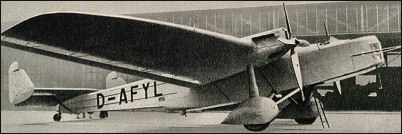 |
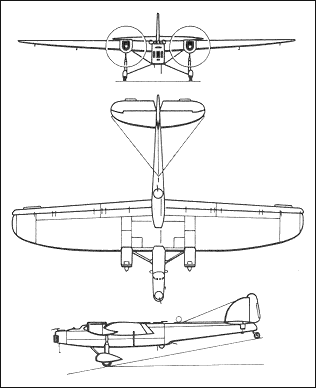
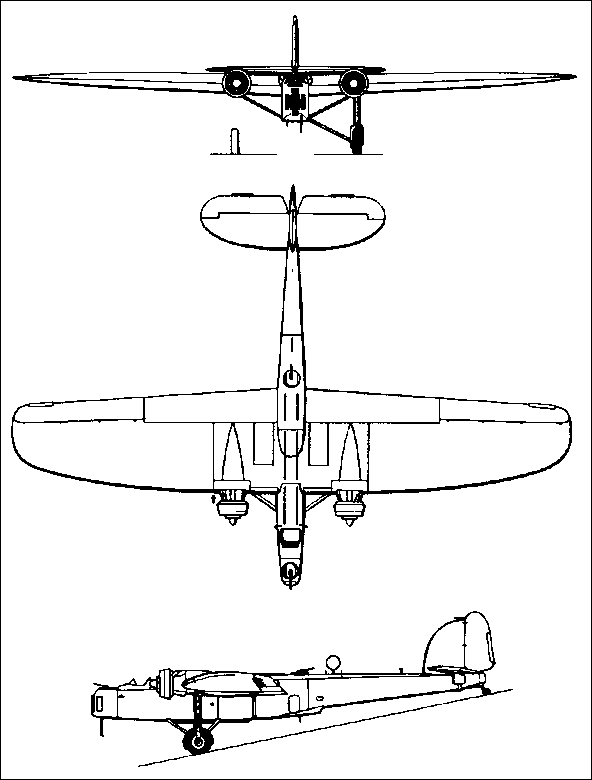
During the late 1920s the German Dornier Metallbauten set up a subsidiary at Altenrhein in Switzerland to build heavy aircraft expressly forbidden under the terms of the Versailles Treaty. The Do P had four engines, the Do Y three, and the Do F was a large twin. All were described as freighters, but their suitability as bombers was obvious. In late 1932 it was boldly decided to put the F into production at the German factory at Friedrichshafen, the designation being changed to Do 11. The Do 11 had a slim light-alloy fuselage, high-mounted metal wing with fabric covering carrying two 484.4kW Siemens Sh 22B engines (derived from the Bristol Jupiter), and a quaint retractable landing gear whose vertical main legs were laboriously cranked inwards along the inner wing until the large wheels lay flat inside the nacelles. There was obvious provision for a bomb bay and three gun positions. The first customer was the German State Railways which under the cover of a freight service actually enabled the embryo Luftwaffe to begin training future bomber crews. It had been planned to deliver 372 Do 11 in 1934 but delays, plus grossly unpleasant handling and structural qualities, led to the substitution first of the short-span Do 11D and then the Do 13 with 559kW BMW VI water-cooled engines and fixed (often spatted) landing gear. At least 77 Do 11D were delivered, some later being passed on to another clandestine air force, that of Bulgaria. The Do 13 was wholly unacceptable, but in September 1934 testing began of a completely redesigned machine called Do 13e with stronger airframe, Junkers double-wing flaps and ailerons and many other changes. To erase the reputation of its forbear this was redesignated Do 23 and in March 1935 production restarted of Do 23F bombers. No attempt was made to disguise the function of the bomber: the fuselage having a glazed nose for visual aiming of the 1,000kg bomb load housed in vertical cells in the fuselage, and nose, mid-upper and rear ventral positions each being provided with a 7.92mm MG 15 machine-gun. After building a small number the Dornier plant switched to the Do 23G with the BMW VIU engine cooled by ethylene-glycol. By late 1935 more than 200 had been delivered and these equipped the first five named Fliegergruppen - although about two-thirds of their strength comprised the distinctly preferable Ju 52/3m. Although it played a major part in the formation of the Luftwaffe and continued to the end of World War II to serve in training, trials and research roles, the Dornier Do 23 was not much better than its disappointing predecessors
|  COMPANY PROFILE | |||||||||||||||||||||||||||||||||||||||||||||||||||||||||||||
 The Peter
|


|
20
reply