|
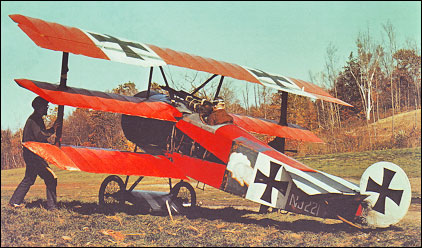
| Made famous as the red-painted mount of Baron Manfred von Richthofen and his Flying Circus at the time of his greatest success - and his death - the Fokker Dr.I (the 'Dr' denoting Dreidecker, or
triplane) was introduced into service in October 1917. Although the aircraft was extremely manoeuvrable, the Dr.I was already
outclassed by a new generation of fighter biplanes, and it was consequently never used in large numbers. Indeed, the fact that the
Dr.I achieved success in air combat was due more to the skill of the experienced pilots who flew it, rather than the design itself.
| ENGINE | 1 x 110hp Oberursel Ur11 9-cylinder rotary engine |
| WEIGHTS |
| Take-off weight | 586 kg | 1292 lb |
| DIMENSIONS |
| Wingspan | 7.19 m | 24 ft 7 in |
| Length | 5.77 m | 19 ft 11 in |
| Height | 2.95 m | 10 ft 8 in |
| PERFORMANCE |
| Max. speed | 185 km/h | 115 mph |
| Ceiling | 6100 m | 20000 ft |
| ARMAMENT | 2 x 7.92mm machine guns |
| Joe, e-mail, 10.12.2017 23:08 The top wing was more suseptable to failure no doubt because it was a full span wing and set at a slightly higher incidence angle than the other wings. I can't imagine that the four center supports would have been sufficient. (My source is having been an aircraft design and performance engineer for 30 years.) reply | | Robert, 06.02.2015 23:04 I have one, fly's great ! reply | | Mike Michigan, e-mail, 28.12.2012 22:15 The struts were necessary to control wing "flutter"...not sructural, per se, but needed. reply | | Jim Glover, e-mail, 23.03.2012 01:20 The Dr 1 was a pretty poor copy of the Sopwith tripe, the Fokker organisation didn't have an available engine big enough for a true copy, and they didn't want to build an airframe requiring that much manpower. The bird they did build was prone to fall apart due to bad glue joints on the winter wet western front. When Gonterman was killed by one falling apart in the air, they were withdrawn from service except for "specials" with the problems corrected handed to top pilots, Aces like Goering, Richthofen, Udet, all had their own Dr-1s to play with when their albatri were down for service. they kept them to the end. For them, the albatros was replaced with the D-7 when it became available. reply | |
| | Tricky Loopsy, 19.12.2011 18:54 Manfred Von Richthofen (Red Baron) rules, but...
...medals for kill 80 innocent peoples, is a face of f*cking child with wings and a machine gun!!!!! reply | | Rick, e-mail, 26.05.2010 06:42 200 years from now gentlemen, someone will be researching this aircraft and find this post on the archives of the "ancient" internet and wonder which of you is correct? sources men, sources, please. reply | | geoff, e-mail, 20.08.2008 17:29 The myth of the struts not being needed is just that. in testing Fokker found the upper wing prone to vibration (flutter). The struts were added to prevent this. At least two fatalities occured asa result of the upper wing breaking in flight, also the fabric on anumber of aircraft came adrift in flight. Fokker claimed this was the result of poor factory workmanship.In fact NACA investigations in the 1920's showed that most lift and stress on a triplane cellule was taken by the upper wing. An american (USA)replica aircraft has a tested stall speed of between 40-45mph, which would seem to be higher than the quoted 50km /h reply | | Dave Settle, e-mail, 06.10.2007 19:10 I am looking for blueprints for WW1 airfraft. Any information on how I may obtain any would be appreciated. Dave Settle reply | | Tim, e-mail, 08.08.2007 05:14 Lt.Werner Voss could INDUCE a flat spin in his Dr. I to drop him
below and behind a pursuing fighter, pull up, and shoot the underside out of the enemy's craft. It is estimated this little gem had a stall speed of 50kph> ! When initially shown to German High Command, it was criticized for a lack of outer wing struts. Anthony
Fokker, knowing that the aircraft did not need these struts, simply
installed a pair cosmetically. The High Command bought the ruse, and Fokker received the contract. reply |
|
Do you have any comments?
|
| 
COMPANY
PROFILE
All the World's Rotorcraft
|