|
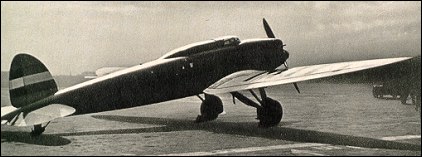
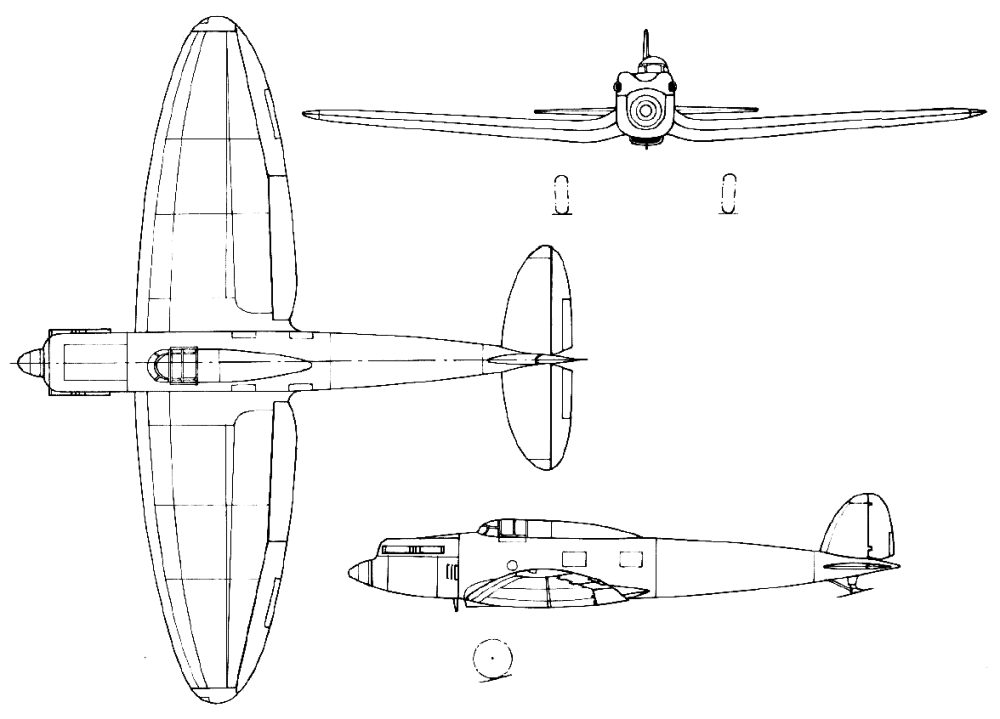
| The He 70 was produced as a commercial and military high-performance monoplane, powered by a 469.5kW or 559kW BMW VI engine. It first flew on 1 December 1932 as a commercial type, accommodating a pilot, navigator and four passengers (an additional folding seat for a passenger was provided behind the pilot). Aft of the passenger cabin was a baggage compartment. The low cantilever wings tapered in chord and thickness and were of spruce construction, planked with plywood. The fuselage was an oval duralumin monocoque, and the landing gear was retractable. Deutsche Luft-Hansa received 14 aircraft, although actual production of the passenger-carrying variants was 28.
Meanwhile the He 70's military potential had not gone unnoticed and, following the delivery to the Luftwaffe of a number of He 70D for communications duties, the He 70E and He 70F appeared as three-seat light-bombing and reconnaissance aircraft respectively. Only the F entered production, numbers serving with the Luftwaffe and going to the Condor Legion and the Nationalist forces in Spain during the Civil War. The production total of nearly 300 military He 70 included 18 He 170A exported to Hungary during 1937-38, each of these powered by a 678kW Gnome-Rhone 14K Mistral Major radial engine and armed with two 7.8mm Gebauer machine-guns for defence.
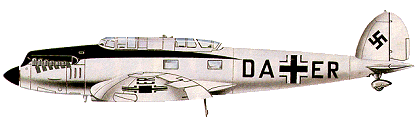
| MODEL | He-70D |
| CREW | 1-2 |
| PASSENGERS | 4-5 |
| ENGINE | 1 x BMW VI 7.3, 559kW |
| WEIGHTS |
| Take-off weight | 3640 kg | 8025 lb |
| Empty weight | 2530 kg | 5578 lb |
| DIMENSIONS |
| Wingspan | 14.80 m | 49 ft 7 in |
| Length | 11.70 m | 38 ft 5 in |
| Height | 3.25 m | 11 ft 8 in |
| Wing area | 36.51 m2 | 392.99 sq ft |
| PERFORMANCE |
| Max. speed | 360 km/h | 224 mph |
| Ceiling | 5485 m | 18000 ft |
| Range | 1250 km | 777 miles |
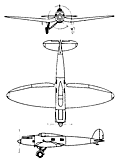 | A three-view drawing (1000 x 719) |
| BD, e-mail, 14.01.2017 03:13 The influence of the Henkel He70 wing on the Spitfire design is obvious. The primary advantage of elliptical wings are drag reduction at any angle of attack the wing is at relative to oncoming air. The great improvement of the Spitfire wing was designing a wing that used two different ellipses that keeps the center of lift of the wing section aligned with a single main spar. Since that is usually around the front third of the airfoil, you end up with a 1 /3 front ellipse and 2 /3 for the back half. reply | | CJD, e-mail, 05.10.2016 17:16 So many weird stories surround this aircraft. The famous claim that the Spifire wing design was based on the HE70. The Heinkel clearly has a pure elliptical wing, the Spitfies compound elliptical wing and monospar is nothing like It. Look at Ludwig Prandtl submission of his doctorial thesis to Leipzig University in 1918. Even that did not use 22xx NACA aerofoils and 3* washout.
Even more interesting are UK comments about the superb flush riveting "such that the wing appeared to be wooden" Great design for its day but nothing to do with Vickers type 300
Regards reply | | zhuma, 20.06.2011 14:29 when the accident investigators are the perpetrators of a conspiracy, No, I must be mistaken. They were all sweet guys. reply | | Pat, e-mail, 16.05.2011 23:07 My uncle brought home a desk model of this aircraft after WWII and gave it to me before he died. Thanks to your website I can now identify what model it is. The model is dated as 1939. That must the year the military version was in flight test. Photos of this model are available on request. reply |
|
| | teddy, e-mail, 03.04.2010 14:41 I have this model kit of "revell".This is the best aircraft i ever seen! reply | | leo rudnicki, e-mail, 09.04.2009 06:35 the wing was not tapered,it was elliptical and inspired maybe the Spitfire and definitely the Aichi D3A "Val" And in Nazi Germany, when a guy has enemies and a guy dies in an accident, and when the accident investigators are the perpetrators of a conspiracy, No, I must be mistaken. They were all sweet guys. reply | | Raymond G. Wiles, e-mail, 26.01.2008 05:43 Do you have any other aircrft aavailable reply | | Christopher Crossley, e-mail, 31.10.2007 15:09 On June 3, 1936, the then-chief of staff of the Luftwaffe, Lt. Gen. Walther Wever, who was bound for Berlin to attend the funeral of a World War I aviator, was killed along with his flight mechanic when taking off in an He 70 at Dresden. He had inadvertently forgotten to release the aileron locking controls after allegedly neglecting to conduct a ground check of the aircraft beforehand.
Source: Corum, James S. (1997) "The Luftwaffe: Creating the Operational Air War, 1918-1940", Lawrence (KS), University of Kansas Press, p.179. reply | | Bob, e-mail, 05.09.2007 00:19 An He70 was bought by Rolls Royce in 1936-37 to use as an engine testbed as several engineers could monitor the engine in flight reply |
|
Do you have any comments?
|
| 
COMPANY
PROFILE
All the World's Rotorcraft
|




Hello Pat,
Searching more info about the Heinkel He 70 aircraft, I came across your post about the desk model your uncle brought home after WWII.
I recently bought some Heinkel related stuff from the grandson of someone who used to work for Heinkel Flugzeugwerke during the 1930's and the war. Among the things that I bought, there is a desk model of a HE 70. It must be from the same period as your uncle's model. So my question to you is, if you could share some photos of the model that you have. And of course I will be more than happy to share some photos of the model that I bought.
Hoping to hear from you, kind regards,
Hugo van Rooij
reply