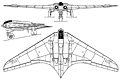
Horten Ho-IX / Gotha Go 229
1945
Back to the Virtual Aircraft Museum
  JET FIGHTERVirtual Aircraft Museum / Germany / Horten  

Horten Ho-IX / Gotha Go 229

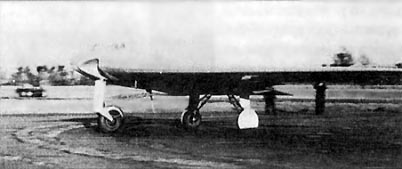
The Horton Ho IX twin-jet tailless fighter-bomber, of which two prototypes were flown before the end of the war, was of extremely advanced design, which benefited from considerable experience gained by the brothers Reimar and Walter Horten in the development of flying-wing aircraft, of which the majority were gliders. Designed by Sonderkommando 9, starting in 1942, the first prototype Ho IX VI was found to be unable to accommodate the two intended BMW 109-003-1 turbojets owing to an unforeseen increase in engine diameter, and it was therefore flown as a glider at Oranienburg during the summer of 1944. The redesigned Ho IX V2 was fitted with two Junkers 109-004B-1 turbojets and flown successfully at Oranienburg, demonstrating speeds of up to 960km/h before it was destroyed while making a single-engine landing. Such promise encouraged the RLM to instruct Gothaer Waggonfabrik to assume development of the design, and a third prototype, the Go 229 V3, was produced with 1000kg thrust Jumo 109- 004C turbojets, but was prevented from flying by the end of hostilities in May 1945. Work had also started on the two-seat Go 229 V4 and Go 229 V5 night-fighter prototypes, the Go 229 V6 armament test prototype, and the Go 229 V7 two-seat trainer, No progress had been made on 20 pre-production Go 229A-0 fighter-bombers, on order at the end of the war, that were intended to carry two 1000kg bombs and four 30mm MK 103 cannon.

Horten Ho-IX / Gotha Go 229


Specification 
 MODELHo-IX V2
 CREW1
 ENGINE2 x 2 x Jumo-004, 900kg
 WEIGHTS
    Take-off weight6900 kg15212 lb
    Empty weight4844 kg10679 lb
 DIMENSIONS
    Wingspan16.8 m55 ft 1 in
    Length7.2 m24 ft 7 in
    Height2.6 m9 ft 6 in
    Wing area52.8 m2568.33 sq ft
 PERFORMANCE
    Max. speed960 km/h597 mph

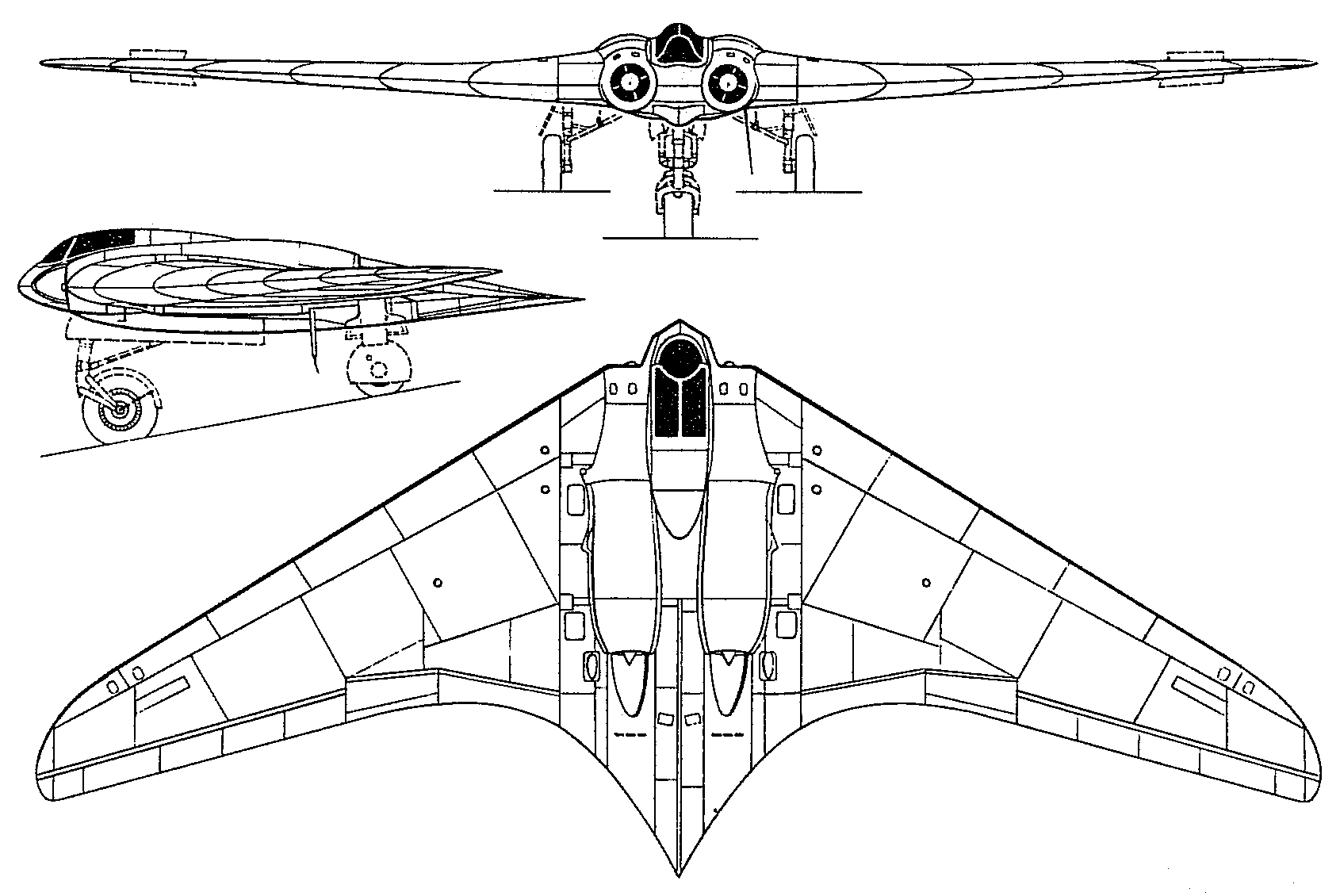
3-View 
Horten Ho-IX / Gotha Go 229A three-view drawing (1690 x 1130)

Comments 
brute4c, 16.02.2010

In looking at the history of the B2 and the preceding flying wings of Jack Northrop an the Horten brothers, it is clear that much more of the aerodynamic principles discovered by the Hortens were used than that of Mr. Northrop.
The width an basic idea of an all wing fits Jacks ideals but when on looks at the center section of Northrops wings from the 30-50's, none have the extended center section that the Hortens used in the HO IX and other designs of theirs.
The Horten brothers found increased directional stability and lift with what they called the "middle effect" caused by the drastic increase of the chord of the center section, instead of leaving it as a reverse V like their early designs and those of Northrops.
Remember, the original design of the B2 Spirit had a long single V extension to the rear of the cnter section that was later broken up into multiple facets for less overall length and added stealth. By doing so, the B2 actually improves the "middle effect" stability increase by spreading it along the wing span.
One year at the Oshkosh Air Show, I attended a forum where the chief designer and chief test pilot of the B2 program spoke. They took some questions at the end. Someone asked if they used the Northrop XB35/YB49 as a starting point and that was denied. I asked if they and the Horten info, that too was denied.

I find that hard to believe as they went far afield of "normal" and at great expense. If they did not use the existing knowledge, at least in learning about the subject, they arent as wise as one would think and certainly shortsighted in some regards.

The original design of the B2 SCREAMS Horten HO IX in large scale with modern electronics and flight controls.

michael, lollipupmd(@)msn.com, 31.12.2009

personaly, the horton HO 229 is my personal faverote WW2 German jet.

skullangel, 27.12.2009

If they built this aircraft in large numbers we'd all be speaking german.

James Wittewr, j.wittwer(@)att.net, 07.12.2009

Northrup Grunman recently built a full size model of the 229 and they found out that it was indeed a stealth fighter that would only have given the English military only about a 2:00 minute warning that the fighter was in the air and heading their way. If this fighter was mass produced during WWII it may have changed the outcome, especially if the Amerika Bomber was built.

Clifford, ckjunk1(@)gmail.com, 04.12.2009

Wow,

What a spectacular plane, although I suppose it had some flaws too. For example, apparently one prototype lost an engine causing a loss of control and crash. The DC-3 & various derivatives on the other hand, had a reputation to be able to fly & land quite well with a single engine.

Was it designed to be a stealth plane?

I suppose in an era when Gliders were being used for troop transports, stealth was an issue. Yet, perhaps we're reading too much into the much later striking resemblance to the B-2 Stealth Bomber. As mentioned, there were other "flying wing" planes at the time, and this bears less resemblance to the F-117 stealth fighter. Much of the design also indicates simple elegance, and low drag.

Wood?

It is cheap, durable, good strength to weight ratio. If the plane had been successful, they could have made millions of them.

This certainly wasn't the only wooden plane of the era. Look at the Spruce Goose, for example.

Perhaps there is more to that comparison. A small "rogue" designer/manufacturer. Untested, unique plane design. Aluminum in tight supply. Perhaps Hitler would only allow the Horton Brothers to use wood for the construction, or at least for the prototypes. Or... maybe the Hortons could
only afford to buy wood.

Of course Messerschmidt was allowed to build their planes with aluminum.

Anyway, I hope the original gets restored. Or even reassembled and displayed as-is if it is deemed that restoration would destroy or replace too much of the original plane. And, while it would be wonderful to see it fly, the engines probably wouldn't support a safe flight.

Then the question is... should it be returned to Germany? It is their plane
afterall.

Swedish ww2 geek., mr_undeground1(@)hotmail.com, 03.11.2009

If you find this cool you should see the "Amerika Bomber",cant find much information on the net, but the plane was a bigger version of the Gotha Go 229, with 6 jetengines. It was designed to drop a nuclear bomb on New york. Luckely enogh the allies stopped it.

paul scott, psmiddx(@)yahoo.com, 26.08.2009

The Germans or Nazis, whatever your outlook, produced another world-beating design, fortunately for us, it didn't like so many, really have time to get off the ground as it were. Truly outstanding and we can see where all the major proponents of 'flying wings', Germany the USA and De Havilland in the UK, produced '163 Comet' lookalikes, though with its jets this made the grade better. would be nice to have seen film of it flying, but the only real pics I've seen is where American scientists/engineers have it in a hangar. hopefully one day, someone will find 'lost film' of it.

Leo Rudnicki, leo_rudnicki(@)hotmail.com, 08.08.2009

Francis Bacon first espoused the "scientific method". Don't trust what you read. V stands for "versuchsmachine" (prototype) Versuchs noch mal. Me (or Bf)-109's were produced in variants A through K. And maybe the Ho-229 was more like the Avenger II. It never flew either. Enjoyed the read, Tom.

Tom Krapf, bigredk5blazer(@)aol.com, 08.08.2009

A Truly revolutionary aircraft about which there is a ton of incorrect information on the web.

The B2 has very little in common with the Ho 229. For one thing it is over three times larger. The B2 is more closely related to the Ho 18, which was a proposed all-wing bomber that was to carry Germany's atomic bomb to New York City. The Ho 18 was still in the design phase when the war ended. Nothing was ever built.

What truly delayed aircraft like this from entering mass production before the end of the war was jet engine technology. The Me 262 could adapt to constantly changing engine sizes because the engines hung under the wing in nacels. If engine specs changed they could just build different cowlings. The Ho 229 placed the engines inside the center section of the aircraft. If the specifications, particularly the diameter, changed the entire airframe had to be redesigned. The Ho 229 was designed with the use of two BMW 002 (also called the 3302) engines in mind, but BMW dropped this engine in favor of the 003. The Ho 229 V1 was converted to a glider because redesigning it for the 003 engines, which still weren't ready anyway, would have meant missing a deadline set by Goering for the first flight of the aircraft. The V1 flew well, albeit without power. The V2 was designed to house the 003, which changed twice during development and required redesigns to the airframe each time, and then still wasn't ready so a pair of Junkers Jumo 004B engines were used, requiring yet another redesign. The V3 was built with a pair of 004Bs from the onset, but the V3 was not complete at war's end. In fact former Horten workers were hired by U.S. General McDonald to complete the aircraft after the war was over so that it could be studied and flown. The flying never happened. It was given to the British initially, who wanted to replace the 004Bs with a pair of Rolls Royce Nenes, but determined that it would be too difficult and the results not worth the effort. The British returned the V3 to the US where it has languished ever since.

Never, ever, ever refer to this aircraft as a Go 229, or even worse a Gotha Go 229. This is totally incorrect and insults the true designers of the aircraft who were the ones who received the approval and funding of Goering to build the Ho 229. This confusion stems from the fact that Gothaer Wagonfabrik AG was tasked with building the aircraft as it entered series production. Essentially Gotha was building the aircraft under license, as the Horten brothers did not have the facilities to mass produce the aircraft; in point of fact both were active service Luftwaffe at the time, and for the duration of the war. The official designation handed down by the RLM is the Horten Ho 8-229. Ho designates the manufacturer, in this case Horten (Me for Messerschmitt, He for Heinkel, etc.). 8 designates a powered aircraft (gliders were designated 108). 229 is a series number assigned by the RLM, who gave various manufacturers a series of numbers to use for their models, which is why you will note that aircraft from the same manufacturer often have number designations that are close together, even if the aircraft differ greatly. The RLM would on occasion reassign numbers to other manufacturers if the original manufacturer wasn't using the number. The V and number after the aircraft states that it is experimental and the number of the prototype. V is for Versuch, which is German for experimental. Production aircraft would not have used the V designation; they would have used another letter as seen with the Me 109 which flew in A through G variants.

There is some great information available on this aircraft, but I caution anyone from trusting the info that is disseminated on the web. If you really want to be in the know read the books by David Myhra, who is probably the best living authority on the Ho 229 and the Horten brothers. He has written their biography "The Horten Brothers and Their All-Wing Aircraft" for which he interviewed both Walter and Reimar, as well as several other books on the Ho 229 specifically.

blofeld, mrjrsbd(@)yahoo.com, 03.08.2009

Spitzenklasse flugzeugmaschinenbau fur fliegen nach Russland.Auf Wiedersehen, ESB

Paco, metod_1981(@)yahoo.com, 13.07.2009

Very good aircraft

Dave, dvdauger(@)yahoo.com, 02.07.2009

we are indeed very lucky,this aircraft along with the 262 & 163 would have completely altered the outcome of the war, if they had gotten into any kind of production-But owing to Hitlers absolute stupidity - in all areas of the military - We have the present outcome.

Doug Beasley, energytool(@)sbcglobal.net, 30.06.2009

I like that wing aircraft. I think the Germans would of started making that aircraft later to start another war. I think i like to make a version of this aircraft. I think it would be neat to fly around the city or the country to get some TV airtime. It looks easy to build.

Jim Kleiner, skrewt666(@)yahoo.com, 30.06.2009

This aircraft was a Horten IX(9) or a H-229 v3, not a Go-229 (even if Goethaerfabrik were to build them). The Hortens developed the Nurflugel (all-wing) aircraft up from gliders starting in the early 1930's. They designed, tested and flew some 40 (or more) gliders and motorized airplanes with little support from any major manufacturers (or established aeronautical engineers). The Hortens were true aviation pioneers. Thank you both, Reimar and Walter.

Mike, mfvogle(@)netscape.net, 29.06.2009

Last night (6-29-09) The National Geographic Channel ran a program on the Horton 229/Ho IX. The aircraft was built from scratch (a full size reproduction) using original plans and tested against 1940's radar. A beautifull plane and a spectacular show! It waill air again on July 15. Check the link for more:
http://channel.nationalgeographic.com/episode/hitler-s-stealth-fighter-3942/Overview12#tab-Photos/14

Fred Wesselius, fredwess1949(@)yahoo.ca, 29.06.2009

Looks to me very similar to the Komet without the vertical stabilizer. The German engineers were extremely innovative. U.S. and U.S.S.R. later copied and took credit for many of their ideas.

murray, awinfieldmurray(@)gmail.com, 27.06.2009

if hitler could have massed produced the me-262, long enough to make the horton go-229 into a bomber , then what would ww2 could have been like ? stalin would have been driven out of moscow.... a possible stale mate with the west ?

Ron, sontio(@)tpg.com.au, 17.06.2009

Does anyone know where I may be able to get plans suitable for Radio Control Model build of the XII and Ho229
Any help appreciated

ringo, dringler(@)tampbay.rr.com, 17.05.2009

i have a modle of this plane and it is magnifisant

leo rudnicki, leo_rudnicki(@)hotmail.com, 09.04.2009

Nice comments, Jeff. Every aircraft builder based his designs on something before except two brothers from Ohio. The tried to copy lilienthal but found nis data flawed. And engineers and designers build aircraft. Demented,power-crazed murderers become nazis or stalin. Burgess- Dunne may have "invented" the flying wing when Jack and the Hortens were in diapers. And doesn't anyone care that this aircraft, suitably treated with RAM, ferrite paint, carbon laminate,conical jet intake spike and RAM baffles and a gold tinted canopy, could have been the first generation stealth airplane if only the myriad technological and metallurgical hurdles facing proper engine manufacture had been solved. I heard they did use carbon/sawdust in the skinning.

Jeff, conestogaman(@)yahoo.com, 06.04.2009

(Kong) Electric Flight International has some nice plans that are for the Ho IX and uses a pair od WeMoTec ducted fans with a 68.5" (1740mm) wingspan. The ribs are all built up, not sheet, so it can be safely enlarged. I got my plans from an Ebay supplier.

Jeff, conestogaman(@)yahoo.com, 06.04.2009

(BoydKid) The Northrop N9M and Horton Go 229 were designed separately at about the same time, without the knowledge of the other (AFAIK). The N9m first flew in 1941, 4 years before we aquired the Go 229 at the end of the war.

http://en.wikipedia.org/wiki/Northrop_N-9M

Jack Northrop had a national reputation for an interest in flying wings before the war (and before we recovered wing technology from Germany). He got permission to use the wing plans and materials for aircraft consideration.

The US Government nixxed any flying wing plans, not Northrop (Northrop wanted to continue, but lost Federal funding), on the grounds that there were other designs that were more acceptable platforms, better handling, cheaper, conventional, and/or easier to build.

(Castle22R) Hitler didn't Concieve this design, the Horton brothers did, and Goering gave the official authority to build it. Hitler had no part in it but to give his ok to Goering.

I hope the NASM does restore this plane and display it with their Me 262 in the same exhibition hall, perhaps with some Mustangs and P-38's and a N9M.

Kong, evorcu(@)gmail.com, 19.02.2009

Hi there,
Is there anywhere that I can find the original plans of Horten GO-229?
Best regards,
Kong

J P Brito, j.p.brito(@)oninet.pt, 15.01.2009

If you'll take the time to explore in detail another great website, www.luft46.com, you'll see how advanced the German aerospace investigation was by late wartime (also NASA took huge profits on this), fortunately that Hitler and the people sorrounding him were blind enough to save us from bigger troubles :-)

wayne holmes, 13.01.2009

Where is the Horten XVIII Amerika bomber ??

Boyd Kidd, Timespanr(@)Yahoo.com, 06.01.2009

You think that is Bad?
look at the stupidity demonstrated by the United States.
It first of all has all of this technology, with copies dropped into their hand at the Wars end.
What does it do with it? I locks it away for 50 - 60 - 70 Years until some dummy comes along and says what is this.
Then we take off running ninety on a thrity mph track telling the world about all of this new Technology! In a pigs eye new. The bottem line here is that that Russians understood what they got, looked at it immediately, put it into service or set it asside, developing their weapons from the AK through A Bomb based on German designs. While at the same time, we went back to sleep, hell the War was over!

fabio, 04.01.2009

A Wonderfull Flying Wing!!! Iam wanted Skins For This Beautifull Flying Wing !!!

bao, bao_b2_15(@)yahoo.com, 02.01.2009

Now there are only one survival go 229 protype there was good flying wing fighter

Valentin, 500sgm(@)mail.ru, 18.11.2008

Do you have the dawing of GO 229?
If who have sand my plise

Volker Steiger, 01.10.2008

You can fly this baby in IL2, a famous Flightsim for PC. They designed the model based on original plans.

Joshrv144, joshrv144(@)aim.com, 26.09.2008

Best fighter in the Luftwaffe at that time in my opinion. The Horten Ho 229 looks similar to the XB-35, YB-49 and the B-2

Engel, 24.08.2008

Wings are available !

B2 might have only looked like a copy would this aircraft already have been restored and on display.

L.Head, lou3702(@)yahoo.com, 28.07.2008

war ended and the advanced tech info goes to Jack Northrop..

Castle22r, castle(@)castlerockhobbies.com, 12.07.2008

Only a Nazi like Hitler could even deceive a plane like this.Of all my 7 years of studying ww2 I have never saw anything like this.

Harry peters, 14.05.2008

amazing

Harry peters, 14.05.2008

amazing

Aero-Fox, 27.03.2008

Apparently, the sample th U.S got ahold of is being restored at the Smithsonian Institution for the Air & Space museum...who knows, they may even get it into flyable condition...the center fuselage and engines are mostly intact, but new wings have to be built...

nitu andrei, andreinitu_98(@)yahoo.com, 10.03.2008

it whant to kill you,it look's like it came from hell(i'm from romania)

nitu andrei, andreinitu_98(@)yahoo.com, 10.03.2008

a nice aircraft

Massimo Battistin, battistin.massimo(@)tele2.it, 10.03.2008

I'm italian (forgive my naive english). I read on H. Nowarra's four volume essay about history of german aircraft technology that a sample of this revolutionary aircraft was brought in U.S.A., together with large amount of drawings and projects for the so called "wunderwaffen"(==wonderweapons).

Dr. Nikholas M. Stage--PHD., sarge_46077(@)yahoo.com, 10.11.2007

This is where the modern USAF B-2 "stealth-Spirit"
bomber got it's start with the Horten GO-229, more than
sixty years ago.

Nazi Germany was well ahead in military aircraft
technology, but Hitler failed to give his "go-ahead"
in deployment of these aircraft.
Ergo hoc; Germany lost World War Two.
ALSO:
Soviet leader Joseph Stalin was of the same
"mind-set" as Hitler, but he, Stalin, had geography,time,
and the vastness of the Soviet geo-political heartland
to "save his skin".

Do you have any comments about this aircraft ?

Name    E-mail


COMPANY
PROFILE


All the World's Rotorcraft


Virtual Aircraft Museum


All rhe World's Rotorcraft AVIATION TOP 100 - www.avitop.com Avitop.com