It would take rather more than a Solomon to judge which was the best of the fighter aircraft used by the combatant nations during World War II. But as it is virtually impossible to arrive at a fair basis of comparison - having regard to a number of variables - it is safe to say that the Bf 109 (designed by Willy Messerschmitt) was not only one of the great fighter aircraft of the war, but almost certainly the most famous of all German aircraft ever built. If numbers constructed was the criterion, it would have been in first or second place, for it has been estimated that about 35,000 were built, which is not far short of the total production figure estimated for Russia's Ilyushin IL-2 Shturmovik.
Design of the Bf 109 was initiated by Bayerische Flugzeugwerke in late 1933, following issue by the Reichsluftfahrtministerium (RLM) of a specification for a monoplane fighter to replace the Arado Ar 68 and Heinkel He 51 in Luftwaffe service. The need was not then urgent, but the RLM believed that by competitive evaluation and with reasonable time available for development, they would have a worthwhile fighter when the moment came for it to enter operational service. Submissions were made by Arado, Bayerische Flugzeugwerke, Focke-Wulf and Heinkel: those of the second and last companies were selected for construction and evaluation, with each initially to build ten examples. Heinkel's He 112 was the first to fly (in the summer of 1935) but it was the Bf 109 (first flown in mid-September 1935) that was to be built in very large numbers. Strangely both of these prototypes made their first flight under the power of a Rolls-Royce Kestrel in-line engine, as the Junkers Jumo 210 in-line engine - around which both had been designed- was not available in time.
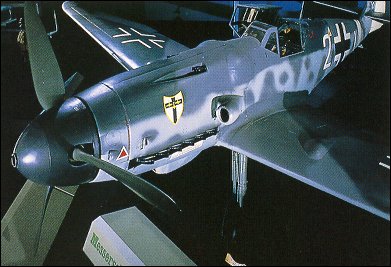
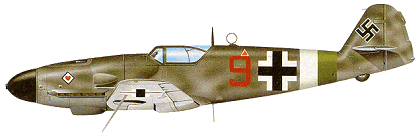
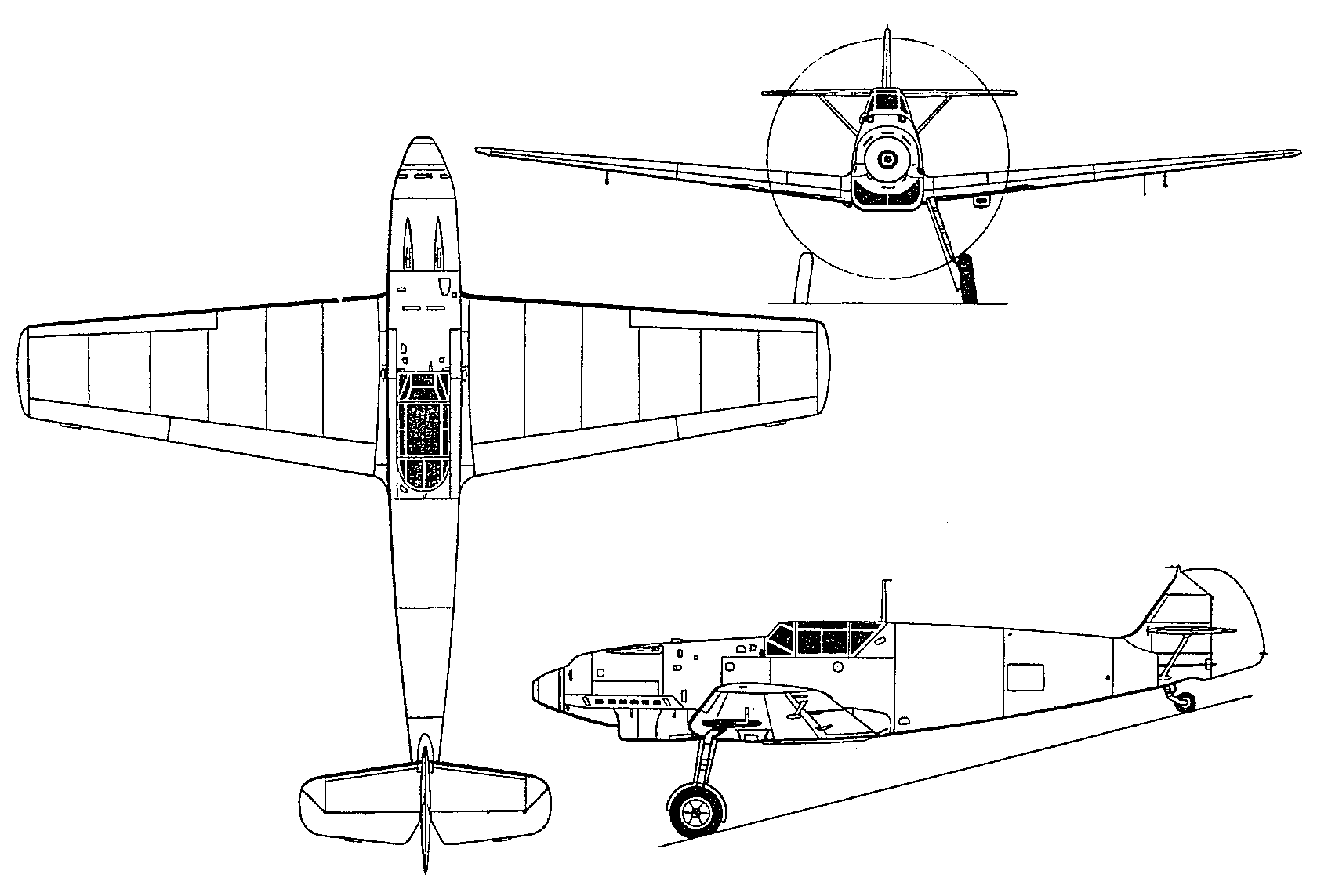
First production version to enter service with the Luftwaffe was the Bf 109B-1 powered by a 473.2kW Jumo 210D engine, followed by the 109B-2 with a 477kW Jumo 210E and later with a 499kW Jumo 210G. A single-seat fighter of all-metal construction, the Bf 109 was a cantilever low-wing monoplane, the wing having automatic leading-edge slots, large slotted trailing-edge flaps, and ailerons which drooped when the flaps were right down. The main landing-gear units were retractable but most versions had a non-retractable tailwheel. The tail unit was conventional, but the tailplane was braced by struts until a tailplane of cantilever structure was introduced with the Bf 109F.
Bf 109B-2 and variants of the Bf 109C were flown by the Condor Legion in the Spanish Civil War. The Daimler-Benz DB 600 engine was introduced in the Bf 109D version: more than 200 of these being in service with the Luftwaffe at the outbreak of war. It was followed into service by the Bf 109E with 820kW DB 601A engine. In addition to production for the Luftwaffe, some 300 examples of this type were exported. The Bf 109E was the principal version
used in the Battle of Britain and was followed by the Bf 109F with an 894.2kW DB 601N or 969kW DB 601E engine. Considered to represent the peak of development of this superb aeroplane, the Bf 109F had much cleaner aerodynamic lines, introducing the unbraced tailplane and retractable tailwheel.
Most extensively built version was the Bf 109G which was inferior in performance to the version which had preceded it, although introducing a more powerful Daimler-Benz engine. Despite the effects of strategic bombing by the Allies, Bf 109G were still being produced in very large numbers right up to the end of hostilities in Europe. Last versions to see limited use were the increased-span Bf 109H and a refined version of the Bf 109G, designated Bf 109K. Production of the Bf 109 continued in Czechoslovakia and Spain during early post-war years, and some Czech-built S-99 were used in a training role until 1957.
THIS IS BEST AIRCRAFT FROM WW2. ERIK HARTMAN 352 VITORY. ALL OF LUFTWAFEN PILOT HAVE OVER 100 VITORY OF THIS AIRCRAFT, WAW VERY HEVY OF VITORYS OF ONLY ONE AIRCRAFT NAME BF-109. GREATE OF GEATES OF ALL AIRCRAFT FROM WW2. NOT USA, RYSSA AND GRAT BRITANIA AIRCRAFT CAN NOT COMMING SO HI TO KILL THE ENEMY IN AIR. I LOVE BF-109. BEST KILLER IN HEVEN. AMEN...
The me 109 was the best fighter the germans had before the jet fighters arrived I had a terrible feeling the war went on because of this very duel between the me 109 and the spitfire to see whose technology was the best a very interesting time during the new technological and engineering age the spitfire was tweeked about a dozen times before the final mk 9 or 10 was able to compete with the me109 I believe but I think it was mass production of hurricanes that finally won us the battle of the skys over Briton not taking anything away from the pilots.
Beemer is right. Once in the air the ME 109 was a great plane. Takeoffs and landings...not so much. And it could not stay in the air very long. Poor range. The P-51D Mustang could fight in the air for 8 hrs. The ME 109, about 2 hrs. I sat in the cockpits of many WWII fighters. I'm 5'10", 180# and could barely fit in the pilot's seat of the ME 109. Very poor rear visibility. Accident prone. Not forgiving of pilot error. The ME 109 Report Card: an A for 2 hours in the air. D's or Fs for everything else.
THIS IS THE BEST WW2 AIRCRAFT. ERIK HARTMANN 352 victories. AND I have an aunt called Karl H WEBER WAS IL-2 KILLER 28 pieces of IL-2 of 136 wins and over 500 air missions. This is an JEWELLERY GOOD HUNTING PLANES believe me it's true.
As posted earlier, I've seen test dives up to 594 mph for the 109G; 609 mph for the 109F. The Bf 109F terminal dive was as high as 572 mph; redline 564 mph. True airspeed? Who knows? I believe the 466 mph true air speed redline is the safest bet since the stick was so heavy above 440 mph.
Ron speeds all equate to roughly the Same TAS of 450 kts. Iv not done the maths But its a fair guess. Also if you have read Anything about the Russian pilots it is the undeniable truth that they were As tough as old boots And that's an Unquantifiable factor
The Russian test of the G-4 model was not much different than those earlier versions since it still had the light cowl guns. Turn (360) sans wing-boots:
20.5 seconds left; 21 right.
Also, an English post on the same site has the dive limitation on the Gustav-2:
Of course I've seen higher dive speeds for Bf 109s but most fighters could go well past red-line if they had to. Also there is the matter of indicated vs true speed.
Those dive speeds are indicated (without instrument error taken into account). As you go higher in altitude the air gets thinner and actual air speed is greater than indicated. So the 357 mph speed quoted at 23,000 feet equates to 450+ mph actual air speed. Furthermore, the 466 mph limit is from sea level to 10,000 feet.
I agree that the F model of the 109 was the best handling version. The climb rate and level max speed was also a huge improvement over the E model. It initially was armed with a very high velocity 15-mm Mauser hub cannon and twin light MGs in the cowl. Thus it was on the light side in firepower. Then it up-gunned the cannon to 20-mm with the trade-off of average velocity. All of us on this site know these things, but how many know about the fly-off between the luftwaffe and Italy at Guidonia? The up-engined Gustav-4 version of the Bf-109 was considered average compared to the Re2005 and the Fiat G55 fielded by Italy. The purpose of this comparison was to standardize on the best Axis fighter for mass production in 1943! The Fw 190A-5 was on top except at high altitude where the Centaro and Sagittario were impressive. Plus they had equivalent firepower to the A-5. They could out-turn both Luftwaffe fighters. The 3rd place Italian fighter was the Macchi MC205 Veltro because of it's dangerous stall turn at high altitude (it could still out-turn the Spitfire however). It also had better roll-rate and firepower than the Bf 109G-4. Alas, nothing much resulted for Italy. But the Fiat was the winner and helped inspired Kurt Tank to produce the Ta 152. In the meantime the Bf 109 became one of the most mass produced WW2 fighters dare I say by default. Man-hours you know. The Bf 109K-4 version was a reasonably competent interceptor though, considering it's pushing it for a 1935-1945 design.
Oh yeah, not to mention the top aces in history flew it.
hate to disagree with Maverick's statement was a better plane than the Spitfire but Adolf Galland did tell Hermann Goering when asked what he,Galland, needed to beat the Brits, replied a "Squadron of Spitfires". Winky Brown considers the Spit the best fighter ever.
Hate to burst you bf109 lover's bubble but it wasn't that great an aircraft in the final analysis. The landing gear was too narrow which caused ground-looping. Fully half of all 109s were lost during takeoff or landing. Once in the air it was pretty good.
Messerschmitt Bf 109 Το Messerschmitt Bf 109 υπήρξε ένα Γερμανικό καταδιωκτικό αεροσκάφος του Β΄ Παγκοσμίου Πολέμου, που σχεδιάστηκε από τον Βίλλυ Μέσσερσμιτ (Willy Messerschmitt) στις αρχές της δεκαετίας του ’30. Ήταν ένα από τα πρώτα πραγματικά σύγχρονα αεροσκάφη της περιόδου εκείνης, περιλαμβάνοντας χαρακτηριστικά όπως ολομεταλλικό κέλυφος ατράκτου, κλειστό κουβούκλιο και ανασυρόμενους τροχούς προσγείωσης. Το Bf 109 παρήχθη σε μεγαλύτερους αριθμούς από οιοδήποτε άλλο καταδιωκτικό αεροσκάφος στην ιστορία, με 30.573 μονάδες κατασκευασμένες μόνο κατά την περίοδο 1939-1945. Η παραγωγή καταδιωκτικών αποτέλεσε το 47% της συνολικής Γερμανικής παραγωγής αεροσκαφών και το Bf 109 κάλυψε το 57% της παραγωγής καταδιωκτικών όλων των τύπων.
Το Bf 109 ήταν το βασικό καταδιωκτικό της Luftwaffe καθ’ όλη τη διάρκεια του Β΄ Π.Π., αν και από τα 1942 άρχισε να αντικαθίσταται εν μέρει από το Focke-Wulf Fw 190. Το Bf 109 σημείωσε περισσότερες καταρρίψεις από οποιοδήποτε άλλο αεροσκάφος στην ιστορία. Κατά περίσταση υπηρέτησε ως μαχητικό «αεροπορικής υπεροχής», μαχητικό συνοδείας, καταδιωκτικό, ελαφρό βομβαρδιστικό και αναγνωριστικό. Αν και είχε κάποιες αδυναμίες, όπως μικρή ακτίνα δράσης και, κυρίως, ένα στενό κι επικίνδυνο σύστημα τροχών προσγείωσης που ανασύρονταν προς τα έξω, ανταγωνίστηκε επάξια τους αντιπάλους του μέχρι το τέλος του πολέμου.
Το Bf 109 χρησιμοποιήθηκε από τους τρεις κορυφαίους άσσους του Β΄ Παγκοσμίου Πολέμου: τον Έριχ Χάρτμαν (Erich Hartmann), τον μεγαλύτερο άσσο όλων των εποχών με 352 νίκες, τον Γκέρχαρντ Μπάρκχορν (Gerhard Barkhorn), με 301 νίκες, και τον Γκίντερ Ραλ (Günther Rall) με 275 νίκες. Όλοι τους πέταξαν με την 52η πτέρυγα μάχης, κυρίως στο Ανατολικό μέτωπο, σε μια μονάδα που χρησιμοποιούσε αποκλειστικά τους διάφορους τύπους των Bf 109, σημειώνοντας συνολικά πάνω από 10.000 νίκες. Ο Χάρτμαν αρνήθηκε να πετάξει στη μάχη με άλλο αεροσκάφος, καθ’ όλη τη διάρκεια του πολέμου. Ο Χανς Γιόαχιμ Μαρσέιγ (Hans-Joachim Marseille), ο «αστέρας της Αφρικής», πετώντας επίσης με Bf 109, επέτυχε 158 νίκες, κυρίως ενάντια στους Δυτικούς συμμάχους στη Βόρειο Αφρική, συμπεριλαμβανομένων 17 καταρρίψεων που σημείωσε μέσα σε μια μόνο μέρα.
Το Bf 109 θα συγκρίνεται πάντα με τον κύριο αντίπαλό του, το Supermarine Spitfire. Τα δυο αεροσκάφη υπήρξαν ανάμεσα στα καλύτερα της εποχής τους.

 Darren


Those dive speeds are indicated (without instrument error taken into account). As you go higher in altitude the air gets thinner and actual air speed is greater than indicated. So the 357 mph speed quoted at 23,000 feet equates to 450+ mph actual air speed. Furthermore, the 466 mph limit is from sea level to 10,000 feet.
reply