|
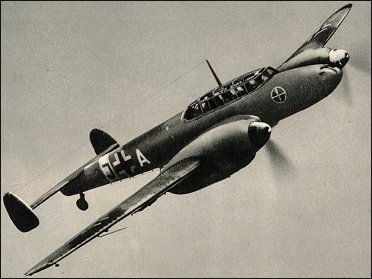
| Second of the important fighters designed by Willy Messerschmitt, the Bf 110 originated from a Reichsluftfahrtministerium requirement of 1934 for a long-range escort fighter or heavily armed Zerstorer (destroyer). Of cantilever low-wing monoplane configuration, this two-seat fighter had an oval-section fuselage, long glazed canopy, high-mounted tailplane with endplate fins and rudders, retractable landing gear, and power plant comprising two Daimler-Benz DB 600 in-line engines. When the prototype flew for the first time on 12 May 1936, it was able to demonstrate a most satisfactory turn of speed. However further testing showed that the Bf 110 might face problems in combat, for despite its high speed, its manoeuvrability left much to be desired.
Pre-production Bf 110A-0 were powered by two 454.5kW Junkers Jumo 210B engines, bringing a deterioration in performance. Early production Bf 110B had similar engines of increased power. Only a small number of this version were built before 820kW DB 601A engines became available and these powered a much-improved Bf 110C. Unfortunately for the Luftwaffe, it had not been possible to evaluate the Bf 110 in the Spanish Civil War, with the result that when Bf 110C escorted the bomber units that devastated Poland at the beginning of World War II, it was believed that they had acquired a valuable new weapon. Perhaps this belief was strengthened when, just before Christmas 1939, Bf 109 and 110 destroyed 12 of a force of 22 Wellingtons which were making a reconnaissance of Heligoland Bight.
Bf 110C and longer-range Bf 110D were, therefore, launched confidently against Britain in the summer of 1940. But even before the Battle of Britain had reached a peak, it was clear that the Bf 110 was no match for the RAF's highly manoeuvrable single-seat fighters. Indeed it was so vulnerable that this 'escort' fighter was unable to operate in British airspace by daylight unless it was itself escorted.
Despite its failure in this role, the Bf 110 was to prove a most valuable and successful night fighter until more advanced aircraft entered the scene in the latter stages of the war. Bf 110E with DB 601N engines and Bf 110F with DB 601E engines formed the nucleus of such operations. Considerable success was gained by these aircraft in conjunction with Wiirzburg radar, the pilots being directed by ground controllers into an interception position.
The three-seat night-fighter Bf 110F was followed into production by a series of Bf 110G with DB 605B engines, the early versions serving as fighter bombers. However the four-seat Bf 110G-4a, -4b, -4c, and -4d variants were provided with differing airborne radar installations for operation as night fighters. Final production version was the Bf 110H, generally similar to the Bf 110G but equipped with heavier armament. It is worth recording a significant factor in favour of the Bf 110, so often dismissed as a complete failure. During early 1944 almost 60% of the entire German night-fighter force was composed of variants of the Bf 110. A total of about 6,000 of these aircraft was built before production ended.
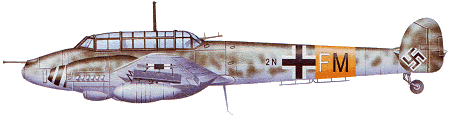
| MODEL | Bf 110G-2 |
| CREW | 2 |
| ENGINE | 2 x DB-605, 1065kW |
| WEIGHTS |
| Take-off weight | 7100 kg | 15653 lb |
| Empty weight | 5600 kg | 12346 lb |
| DIMENSIONS |
| Wingspan | 16.2 m | 53 ft 2 in |
| Length | 12.3 m | 40 ft 4 in |
| Height | 4.1 m | 13 ft 5 in |
| Wing area | 38.5 m2 | 414.41 sq ft |
| PERFORMANCE |
| Max. speed | 595 km/h | 370 mph |
| Cruise speed | 450 km/h | 280 mph |
| Ceiling | 10000 m | 32800 ft |
| Range | 1200 km | 746 miles |
| ARMAMENT | 4 machine-guns, 5 cannons |
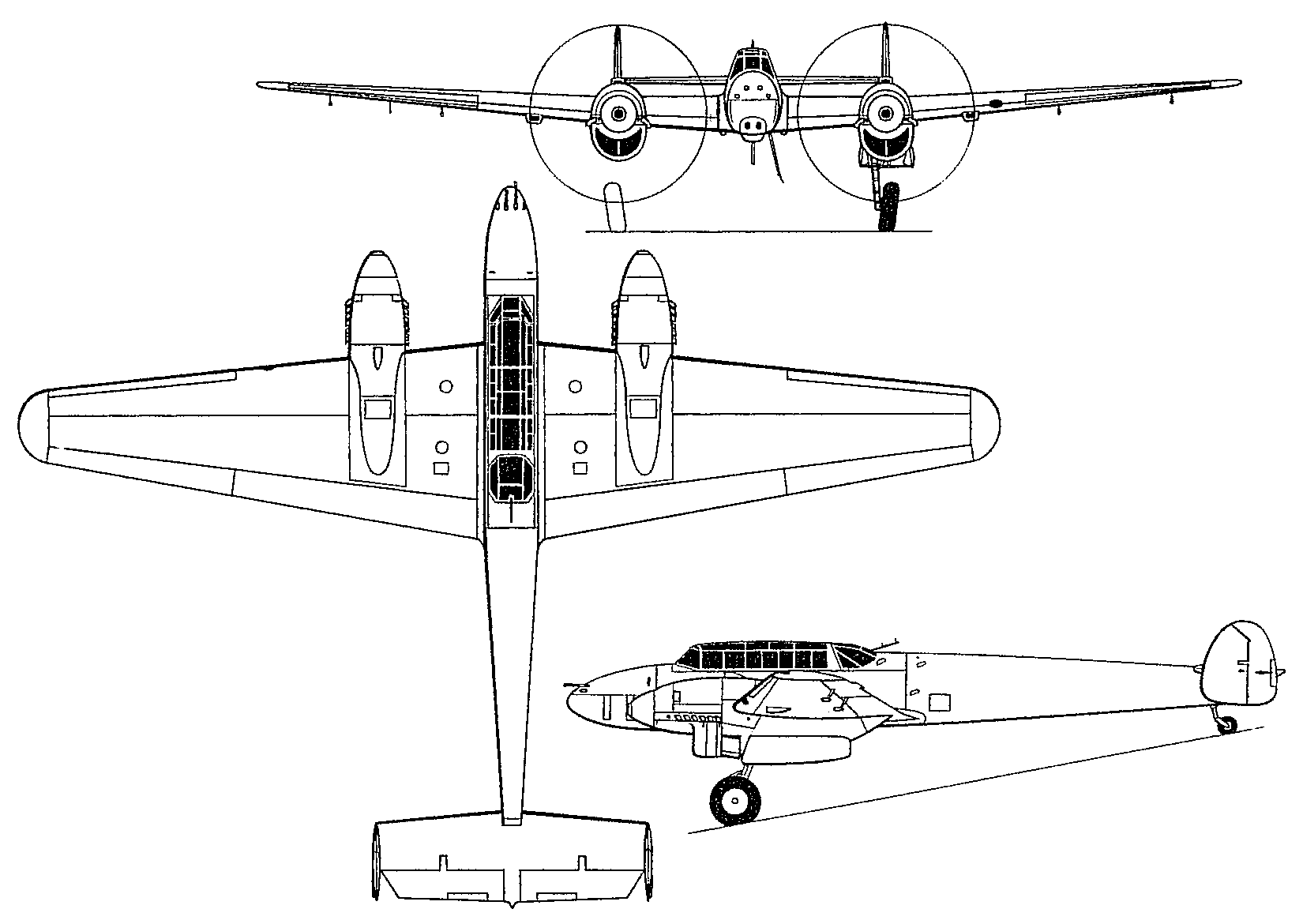
 | A three-view drawing (1650 x 1170) |
| Klaatu83, e-mail, 24.02.2015 01:48 A lot of nations believed that this 2 or 3 seat, multi-role, twin-engine fighter formula was a good idea during the late 1930s. The French tried it with the Potez 63 series. The U.S. tried it with the Bell FM-1 "Airacuda". The Soviets tried it with the Yak-4. Japan tried it with the Kawasaki Ki-45 ("Nick"). None of those proved very effective in the daylight long-range escort fighter role, for which most of them were originally intended. The Me-110 did prove successful, but mainly as a night-fighter. The Beaufighter and Mosquito, which came a little later, also proved successful in the light-bombing and maritime strike roles. The Lockheed P-38, which was a single-seater, differed in that it was designed strictly as a day fighter, not as a multi-role aircraft, although it was later successfully modified for the photo-reconnaissance role. reply | | Mark, e-mail, 20.09.2012 17:17 Messerschmitt Bf 110
Το Messerschmitt Bf 110 ήταν ένα δικινητήριο βαρύ μαχητικό («Zerstörer» : «Καταστροφέας»), που υπηρέτησε στη Γερμανική Πολεμική Αεροπορία (Luftwaffe) κατά τη διάρκεια του Β΄ Π.Π.. Στην πορεία, ο ρόλος του άλλαξε σε μαχητικό–βομβαρδιστικό («JagdBomber» ή «Jabo») και νυκτερινό μαχητικό, εξελίχθηκε δε στον βασικό τύπο νυκτερινού μαχητικού της Luftwaffe.
Επιχειρησιακή χρήση
Ένα σύνολο επτά διαφορετικών τροποποιήσεων του Bf 110C εμφανίστηκαν. Ο τύπος αυτός ήταν ο πρώτος που είχε ευρεία πολεμική χρήση και γνώρισε αρκετή επιτυχία στις εκστρατείες της Πολωνίας και της Γαλλίας.
Το Bf 110 «Zerstörerwaffe» (καταστροφικό όπλο) είδε άφθονη δράση κατά την εισβολή στη Δανία και τη Νορβηγία. Δύο «Zerstörergeschwader» (Μοίρες Καταστροφέων), η 1η και η 76η, συμμετείχαν με 64 αεροσκάφη. Στις 9 Απριλίου, στη Δανία, κατέστρεψαν 25 στρατιωτικά αεροσκάφη επί του εδάφους. Ένα Δανικό Fokker D.XXI κατάφερε να απογειωθεί, αλλά αμέσως καταρρίφθηκε κι αυτό.
Στη Νορβηγία, τα Bf 110 συνέβαλαν στην κατάληψη του αεροδρομίου του Όσλο, συνοδεύοντας μεταγωγικά Junkers Ju 52 στα οποία επέβαιναν αλεξιπτωτιστές. Οι Γερμανοί δέχτηκαν επίθεση από πολλά Gloster Gladiators και στη μάχη που ακολούθησε έπεσαν δύο αεροσκάφη από κάθε πλευρά.
Οι πιλότοι των Messerchmitt δεν γνώριζαν πως τα προηγούμενα κύματα μεταγωγικών είχαν υποχωρήσει και πως το αεροδρόμιο δεν είχε ακόμη τεθεί υπό Γερμανικό έλεγχο. Προσπαθώντας να προσγειωθούν, πολλά μεταγωγικά καταστράφηκαν. Τα εναπομείναντα Bf 110 βομβάρδισαν το αεροδρόμιο και βοήθησαν τα επίγεια τμήματα να το καταλάβουν. Η αεροπορική υποστήριξη που προσέφεραν οι Καταστροφείς ήταν αποφασιστικής σημασίας και στις επερχόμενες εκστρατείες επρόκειτο να φανούν πολύ χρήσιμα στο ρόλο του μαχητικού-βομβαρδιστικού. Κατά τη διάρκεια αυτών των αερομαχιών ένας μελλοντικός άσσος της Luftwaffe, ο Helmut Lent, σημείωσε την 5η και 6η νίκη του με Bf 110 ενάντια στους Νορβηγούς.
Η εμπειρία από τη Νορβηγική εκστρατεία έδειξε πως θα έπρεπε να αυξηθεί η ακτίνα δράσης του αεροσκάφους κι έτσι δημιουργήθηκε το Bf 110D «Langstrecken Zerstörer» (καταστροφέας μεγάλης εμβέλειας). Μια ποικιλία εξωτερικών δεξαμενών καυσίμου των 1.050 lit, που εγκαθίσταντο κάτω από την κοιλιά της ατράκτου οδήγησε σε τέσσερις διαφορετικές πειραματικές εκδόσεις του Bf 110D. Ο τύπος δεξαμενής Dackelbauch, λόγω του ψυχρού κλίματος και της περιορισμένης γνώσης σχετικά με την εξάτμιση του καυσίμου, κάποιες φορές εκρήγνυτο, προκαλώντας ανεξήγητες απώλειες κατά τις περιπολίες στη Βόρειο Θάλασσα. Ως αποτέλεσμα, πληρώματα αντιπάθησαν αυτό τον τύπο. Οι δεξαμενές επηρέασαν και το χειρισμό του αεροσκάφους. Το Bf 110 δεν ήταν πλέον τόσο ευέλικτο όσο πριν και το επιπρόσθετο βάρος μείωσε σημαντικά τις πολεμικές του αρετές.
Ευτυχώς για το Zerstörerwaffe, οι αντίπαλοί του στη Νορβηγία ήταν κυρίως βομβαρδιστικά και έτσι άφησε καλές εντυπώσεις. Στις 13 Ιουνίου 1940, οκτώ Βρετανικά βομβαρδιστικά καθέτου εφορμήσεως Skua καταρρίφθηκαν σε οκτώ λεπτά. Οι συνολικές απώλειες στην εκστρατεία αυτή ήταν μόλις 20 αεροσκάφη.
Η εκστρατεία που ακολούθησε στη Δύση το 1940 απέδειξε πως το Bf 110 ήταν ευάλωτο σε εχθρικούς ουρανούς. Απέδωσε καλά ενάντια στις αεροπορίες του Βελγίου, της Ολλανδίας και της Γαλλίας, με σχετικά ελαφρές απώλειες, αλλά όταν βρέθηκε αντιμέτωπο με ικανούς αριθμούς από Hurricanes και Spitfires αποδείχθηκε ξεπερασμένο. Το Zerstörerwaffe έχασε 60 αεροσκάφη στη Δυτική Εκστρατεία.
Η Μάχη της Αγγλίας
Η Μάχη της Αγγλίας αποκάλυψε τις θανάσιμες αδυναμίες του Bf 110 σαν ημερήσιο μαχητικό ενάντια σε μονοκινητήρια αεροσκάφη. Ακόμη και με τον οπίσθιο πολυβολητή δεν μπορούσε να τα ανταγωνιστεί. Το μέγεθος και το βάρος του σήμαιναν αυξημένο φορτίο πτέρυγας, κάτι που περιόριζε δραματικά την ευελιξία του. Ακόμα, αν και διέθετε μέγιστη ταχύτητα κατά πολύ ανώτερη από τα σύγχρονά του Hurricanes της Βρετανικής RAF, δεν τη συνδύαζε με αξιόλογη επιτάχυνση, γεγονός που του αφαιρούσε το πλεονέκτημα. Ωστόσο, την περίοδο εκείνη ήταν μοναδικό στο ρόλο του μαχητικού συνοδείας μεγάλων αποστάσεων, καθώς δεν υπέφερε από την περιορισμένη ακτίνα δράσης του Bf 109E. Αν και ξεπερασμένο, εξακολουθούσε να είναι τρομερό σα συνοδευτικό βομβαρδιστικών, εφαρμόζοντας την τακτική της εφόδου από ψηλά εναντίον των αντιπάλων και βάλλοντας από μακριά μια μεγάλη ριπή με τον πανίσχυρο εμπρόσθιο οπλισμό του, για να απομακρυνθεί κατόπιν ολοταχώς από τα πιο ευέλικτα καταδιωκτικά του εχθρού.
Σε ένα παράξενο επεισόδιο στο τέλος της Μάχης της Αγγλίας, στις 10 Μαΐου 1941, ο Rudolf Hess, το δεξί χέρι του Hitler και ανώτατο μέλος του Ναζιστικού κόμματος, πετώντας από τη Γερμανία με ένα Bf 110, προσγειώθηκε στη Σκωτία, σε μια προσπάθεια να κλείσει συνθήκη ειρήνης μεταξύ Γερμανίας και Μεγάλης Βρετανίας. reply | | joe, e-mail, 01.12.2011 03:25 Hey: That guy who keep saying The ME 110 has too many engines should look The lighting P-38. Then take a wire brush to get the egg off his face. The lufwaffa said the same dumb kaff clap trap back in 1939 about the P-38. reply | | joe, e-mail, 01.12.2011 03:24 Hey: That guy who keep saying The ME 110 has too many engines should look The lighting P-38. Then take a wire brush to get the egg off his face. The lufwaffa said the same dumb kaff clap trap back in 1939 about the P-38. reply | |
| | joe, e-mail, 01.12.2011 03:23 Hey: That guy who keep saying The ME 110 has too many engines should look The lighting P-38. Then take a wire brush to get the egg off his face. The lufwaffa said the same dumb kaff clap trap back in 1939 about the P-38. reply | | good, 20.06.2011 13:15 It is bizzare how this plane is a fighter, yet it has more than one engine, which is a common characteristic on bombers. Just saying. reply | | MAVERICK, e-mail, 27.01.2011 05:34 BF-110 KICKS ASS! reply | | wlkriessmann, e-mail, 24.09.2010 00:57 I had quite a few turns with different Me 110`s at the airfield in Hildesheim. May & June 1944. Hard on the dtick like most MEE`s , not much of a glide angle and poor maneuverability but a very succcessful nightfighter wlk reply | | carl wollaston, e-mail, 17.06.2010 14:51 It is bizzare how this plane is a fighter, yet it has more than one engine, which is a common characteristic on bombers. Just saying. reply | | Gaute, e-mail, 25.04.2010 19:13 what was the color on the pilot dress reply | | Les Wilson, e-mail, 14.04.2010 03:36 Be nice if they got the the armament right reply |
|
Do you have any comments?
|
| 
COMPANY
PROFILE
All the World's Rotorcraft
|