Before going to war in 1939 Germany had explored and developed the use of parachute and airborne troops, thus ensuring that man-made barricades (such as the Maginot Line or Albert Canal) or natural barriers (such as the Kithirai Channel) would provide no hindrance to gaining a strong foothold in desirable territory. Early deployment of airborne forces had shown the need for gliders of greater capability than, for example, the DFS 230 used to capture the Belgian fort of Eben-Emael. There were many advantages in using gliders as opposed to free fall paratroops: the unit was not dispersed and troops did not need often precious moments to disentangle themselves from shroud lines or a billowing parachute.
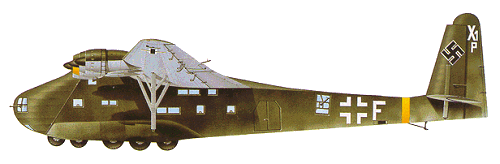
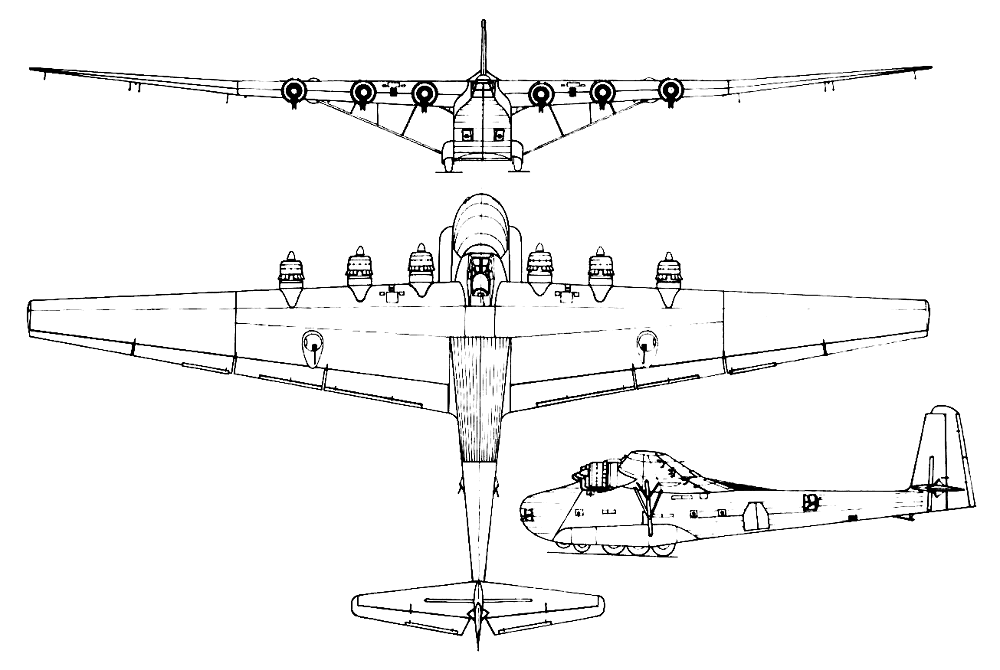
Consequently Junkers and Messerschmitt competed in 1940 to design and develop a very large transport glider suitable for the delivery of men or materials. Junkers' Ju 322 Mammut (Mammoth) spanned 62.0m and would have accommodated more than 100 fully equipped troops, but when tested proved to be unstable and was cancelled by the Reichsluftfahrtministeriurn. On the other hand Messerschmitt's Me 321 was a most successful design of braced high-wing configuration and with construction of welded steel tube, wood and fabric. The pilot was perched high on the fuselage in a single-seat cockpit, adjacent to the wing's leading edge. Access to the main cabin was via large clamshell doors in the nose or by doors on each side of the rear fuselage. A payload of 22,000kg could be carried.
The Me 321 VI prototype flew first in March 1941 and Me 321A-1 production aircraft entered service in May of that year. The later Me 321B-1 had a crew of three and defensive armament of four 7.9mm MG 15 machine-guns. Me 321 (some 200 built) were towed usually by a trio of Bf 110C or by the unusual five-engined Heinkel He 111Z. Rocket units could be used to assist take-off from rough fields.
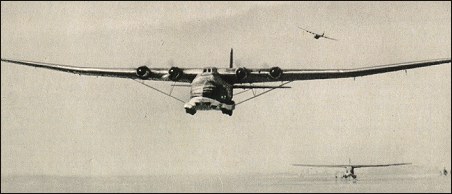
The Me 323 was, in effect, a powered version of the Me 321, basically similar except for strengthening and the installation of engines in nacelles of the same type as those designed for the Bloch 175: four in the original prototype and six in subsequent prototype and production aircraft (about 200 built). Versions included the Me 323D, E and F (plus variants), with a variety of engines, defensive armament and fuel capacity. They were no easy machines to fly, often needing rocket or towing assistance to get them airborne. Slow and vulnerable - despite heavy defensive armament - they suffered severe losses when ferrying supplies to the Afrika Korps in the closing stages of the North African campaign.
Hi, Where can I buy one of those 1 /32 scale me-232? I went to Trumpeter website and I did see it? Can someone help me find a website where I can buy a me-232 and ju-52 in 1 /32 scale? Thanks
The Me323 owing to it's lack of manouverability proved very susceptible to fighter attack. One flight of 16 aircraft flying across the Mediterranean lost 14 of thir number due to an Allied fighter attack. Shortly afterwards they were withdrawn from the North African theatre and redeployed on the Eastern front where the Germans enjoyed some degree of air superiority. However, in April 1944 after 198 had been built the production line was closed and shortly afterwards all Me323's were withdrawn from use.
I love the cover art to the 1 /32 ME-323 GIGANT kit. It shows Anna Kreisling, The White Wolf of the Luftwaffe standing in front of this massive six engined aircraft. Her gorgeous breasts are straining against her black leather flying jacket!! WOW, FANTASTIC COVER ART!!!
wE IN THE IRANIAN AIR FORCE LIKE BIG AIRPLANES LIKE THIS ME-323 GIGANT. WE KNOW IT WAS FLOWN INTO STALINGRAD BY HOT HOT BLONDE BOMBSHELL, ANNA KREISLING, THE HOT HOT GORGEOUS GIRL WITH THE 38D BEAUTIFUL BREASTS!! BETTER THAN ANY PAIR IN PLAYBOY MAGAZINE. HEY ANNA, PLEASE COME TO IRAN AND GIVE US FLYING LESSONS, WE LOVE YOU!!
Wow, TRUMPETER IN CHINA has just released a 1 /32 kit of the ME-323 GIGANT!! On the cover art they show it flying into STALINGRAD flown by ANNA KREISLING, THE WHITE WOLF OF THE LUFTWAFFE!!! SS Sniper Peter Schubert said that Anna flew into Stalingrad in a JUNKERS JU-52 so badly shot up, that it was abandoned after they unloaded the supplies. A ME-323 GIGANT had landed with both the pilot and Co-Pilot very badly wounded. She quickly helped in the repairs and had over 125 wounded soldiers and nurses were loaded into the ME-323 GIGANT. Anna found the biggest German soldier she could find to help her on the controls and she wasted no time on takeoff! Enemy fire killed eight of our wounded soldiers, but Anna flew the ME-323 to safety!! It took me 3 days to build and paint this model, and it is huge!! It's hanging from my ceiling with my 1 /32 Revell Junkers JU-88!!
Yah, by quiet a bit. I did not know that. Thanks for bringing it up; but maybe next time you can check to see if it is in the museum and compare specs. Thanx!
You will find alot of good info and pics on this and other German aircraft at this site: www.warbirdsresourcegroup.org /LRG /me323.html
I told that .org sites are more reliable sources of information than .com sites...in any case, feel free to copy and paste that site in your address bar if the link doesnt work.
In south-east of Poland, in small village <> N = 50°25'33,1'' = 50,42586° = 293125 m (1992) E = 23°17'44,1'' = 23,29558° = 804979 m (1992) ater WW2 - villagers had used part of wing me 323 as an small brigde over the creak. Look at the picture by "wylye" link to polish explorer site www.odkrywca-online.pl /pokaz_watek.php?id=418120#446930
This "bridge" existing to this moment still, its not used just for a few years !