|
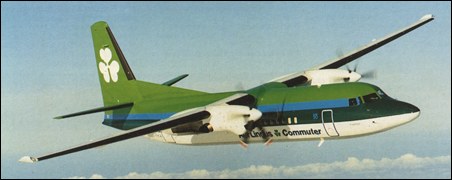
| During celebrations held in November 1983 to mark the 25th anniversary of the F27 entering airline service, Fokker announced the launch of a 50-seat follow-on to be known as the Fokker 50. Based on the proven F27 airframe, but fitted with more fuel-efficient engines, six-bladed 'quiet' propellers, improved aerodynamics, a redesigned cockpit incorporating digital avionics and a new cabin interior, the external differences include extra windows, twin-nosewheel landing gear and upturned wingtips. Much use is made of lighter composite materials, and F50 commonality with the F27 is only 20%. Production is shared with Dassault, Fuji Heavy Industries, Deutsche Airbus, SABCA, Dowty
Rotol and Pratt & Whitney Canada with final assembly, systems integration and flight test carried out by Fokker at Schiphol. The first two prototypes were conversions of F27 airframes, with the first (PH-OSO), flying on 28 December 1985 followed by (PH-OSI) on 30 April 1986. The first production aircraft (PH-DMO) flew on 13 February 1987 and first delivery made (to DLT), on 7 August 1987. By mid-1991 Fokker held firm orders from 18 customers for 132 Fokker 50s, and had delivered 116. The standard production variant is the 46/50-seat Fokker 50-100 and the current build rate is 30 aircraft per year.
| PASSENGERS | 46-58 |
| ENGINE | 2 x Pratt & Whitney Canada PW125B turboprops, 1864kW |
| WEIGHTS |
| Take-off weight | 18990 kg | 41866 lb |
| Empty weight | 12570 kg | 27712 lb |
| DIMENSIONS |
| Wingspan | 29.0 m | 95 ft 2 in |
| Length | 25.2 m | 83 ft 8 in |
| Height | 8.3 m | 27 ft 3 in |
| Wing area | 70.0 m2 | 753.47 sq ft |
| PERFORMANCE |
| Cruise speed | 522 km/h | 324 mph |
| Ceiling | 7620 m | 25000 ft |
| Range | 2630 km | 1634 miles |
| ubaTaeCJ, e-mail, 21.02.2025 15:02 20 reply | | John Kelly, e-mail, 05.04.2024 05:36 Fokker 50 available for sale or long-term lease. Email me. reply | | Aymansidig@hotmail.com, 03.08.2023 11:14 Hi
Does anyone have F50 /27 for sale ?
Please reply with your offer
Thank you reply |
| joe, e-mail, 09.07.2013 00:39 Have Fokker50 available ACMi Sudan
$2,800.oo per block hour , minimum 60hrs reply | |
| | Frank, e-mail, 26.02.2011 12:52 Worked at Fokker from 1986 to 1996.
F-50 was an upgraded F-27. Very robust airplane with a long live span over more than 35 years. In 1986 it was equiped with the most high tech avionics available, to high tech for airliners in Africa and Far east for changing from F27 to F50. Made it also an expensive airplane , more expensive to maintain and not easy to sell.
The simple avionics of the F-27 was missed by pilots.
Flown with a F-50 in Iceland from a small bay. Short take off performance was great. There were also militairy versions, marine and a stretched version F-60 (4 planes)for the Royal Dutch Airforce. Stretched version to transport a F-16 engine troops, and had defense weapons reply |
| Darryl Johnston, e-mail, 09.04.2010 12:43 Flew in these in Bolivia. Nice plane but uncomfortable seats in the transport /paratroop versions (local?). I remember my first thought landing on a rough jungle strip was concern about the strength of the (in my mind) long landing gear from the engine nacelles! reply | | jaranjil, e-mail, 26.11.2009 11:36 hi.my name is jaranjil I'm stydy reply | | nick, e-mail, 11.11.2007 08:07 this is not the real plane reply |
|
Do you have any comments?
|
| 
COMPANY
PROFILE
All the World's Rotorcraft
|


 Frank
Frank

20
reply