|
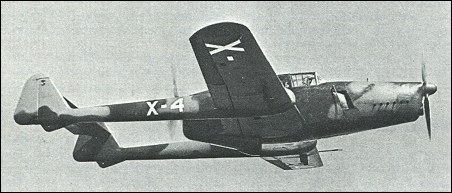
| The D XXIII single-seat fighter was unusual in employing
a fore-and-aft tandem engine arrangement, the prototype
being powered by two 528hp Walter Sagitta
I-SR engines and flying for the first time on 30 May 1939.
Versions of the D XXIII were also proposed with Hispano-
Suiza 12Xcrs, Junkers Jumo 210G and Rolls-Royce
Kestrel XV engines, and although all-metal construction
was intended, the prototype was fitted with a
wooden wing of greater thickness/chord ratio in order
to expedite the test programme. Owing to various problems,
including rear engine cooling, only four hours of
flight testing had been completed when the invasion of
the Netherlands brought the D XXIII development programme to a halt. The proposed armament comprised
two 7.9mm and two 13.2mm FN-Browning machine
guns.
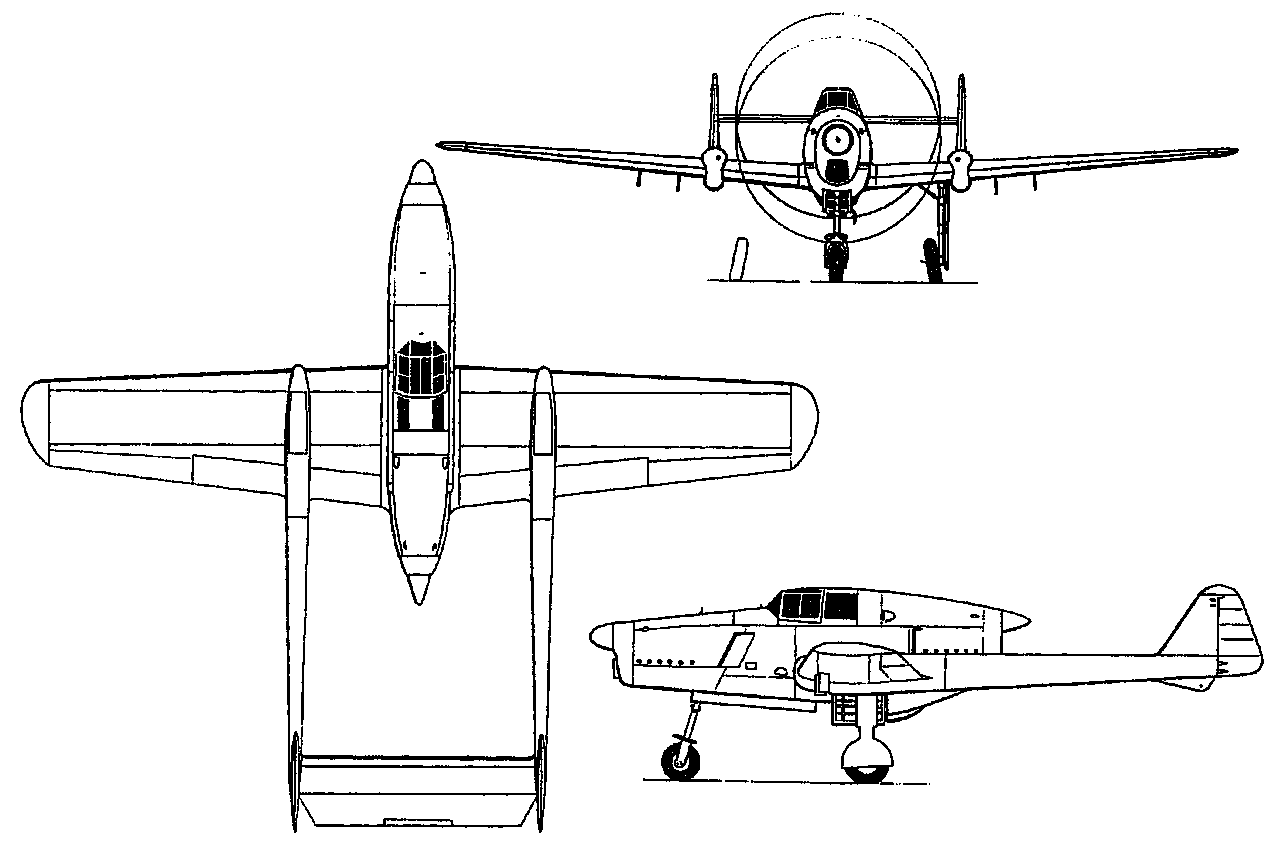
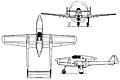 | A three-view drawing (1280 x 850) |
| WEIGHTS |
| Take-off weight | 2950 kg | 6504 lb |
| Empty weight | 2180 kg | 4806 lb |
| DIMENSIONS |
| Wingspan | 11.50 m | 38 ft 9 in |
| Length | 10.20 m | 33 ft 6 in |
| Height | 3.80 m | 12 ft 6 in |
| Wing area | 18.50 m2 | 199.13 sq ft |
| PERFORMANCE |
| Max. speed | 525 km/h | 326 mph |
| Cruise speed | 390 km/h | 242 mph |
| lxbfYeaa, e-mail, 14.03.2024 05:27 20 reply | | Thomas, e-mail, 15.10.2014 22:06 I reckon Steve might have had the right answer. The Rhone 1000hp radial was so ubiquitous that the Luftwaffe used it in large numbers. Now, perhaps a small airframe change to duct air to an air-cooled engine and you might have 2000hp on tap!
OK, the radial is not aerodynamic; but, with that kind of power on tap. it could easily carry a few 23mm Madsens and a brace of 13mm mg.
But someone did raise the problem of 'bail-out'. Yes, a serious problem with a propeller behind you... reply | | Nella, e-mail, 03.01.2013 18:37 Fokker měl fakt super letadla 1* reply | | Ian, e-mail, 04.05.2012 14:22 Agreed, fokker did & still does produce some first rate aircraft designs. Perhaps I should have been more specific. I was referring to his appraisal of the DXXI, G1 & DXXIII as being the most effective aircraft of their time up to the advent of widespread jet propulsion in combat aircraft. reply | |
| | Scott Boyd, e-mail, 06.04.2012 04:26 Fokker built a number of fine aircraft well into the current century.
Stellar might be a little over stated. reply | | Ian, e-mail, 05.04.2012 15:55 I think Jarno is a Fokker fundamentalist. It seems to him /her that everything they built was stellar! reply | | Jarno, e-mail, 13.07.2011 16:35 @Jos: er waren er maar 2 die daadwerkelijk vlogen, maar alleen in tests. Tijdens de infasie zijn deze toestellen niet van de grond geweest maar vernietigt zodat de Duitsers ze niet konden gebruiken. Totaal zijn er maar 2 vlieg klaar geweest, 2 die bijna klaar waren en 3 waren nog maar half klaar.
@NV Smith: The armament was weak due to it being in test phase only, same counts for it's weapons. But overall if it was already in service at the time, it would have been more then a match against the German aircraft at the time. Better yet, it pretty much would have dominated.
@Tom Kerr: Look at the Fokker G.1, that is over powering the P38 and even pre-dates it. The G.1 was already in service as well and was called a 'flying devil' by the German pilots since it was far superior to their own aircraft. reply | | Martijn, e-mail, 30.01.2011 17:44 Jos: Geen, het gaat hier om 'n vliegtuig in prototype (test) fase. De Duitsers vielen aan voordat het model strijdklaar was. reply | | gene, e-mail, 14.02.2010 00:07 The Me109E had two rifle caliber Mg's and two low powereed cannon. Later 109's had only 3 weapons two mg's and a cannon that's all they could carry without serious performance penalties. Marseilles blew P-40's and Hurricanes out of the sky in ME109F with 1 20mm cannon 2 light mg's. The 13.2mm Browning would be about equivalent to US .50 MG with added benefit of explosive shells. Two 7.92mm Mg and two 13.2mm with explosive shells would have been more than adequate at any time in WWII and was quite powerful for 1939- as good as or better than Me109E with two 7.92mg and two low velocity 20mm MGFF cannon. reply | | Stewart, e-mail, 12.02.2010 00:50 This seems like a failure of the thought proccesses. If you were going to arm it with pop-guns, why not build a mini-plane like the Cauldron racers conversions or P-77? But at this puppies size, it will loose all of the advantages that acrew to the mini-plane. reply | | paul scott, e-mail, 16.09.2009 20:57 Nice aircraft from The Netherlands - I agree, very namby-pamby armament - I mean, pea-shooters (Which were reserved for British bombers!). reply | | Marcel, e-mail, 30.07.2009 17:51 As WW2 was coming near, getting engines was quite difficult as most countries kept them for themselves. The Walter Sagitta-engines were not intended, but they were available and this speeded up flight-testing. As for armament the productionversion of this type surely would have hadmore /heavier guns then in this prototype. reply | | Steve, e-mail, 17.07.2009 19:16 Note that the D.XXIII is not the usual twin-engined fighter. It is little larger than a Hurricane and represents an alterative to the usual single-engined fighter - getting high power by two small engines instead of one large one. (Think MiG-19) I would have used the Gnome-Rhone 14M radial with FW190-style fan cooling, and with 100-octane fuel, these interesting little engines might have been good for nearly 1000 HP each. And I agree that the tail booms cried out for heavier armament, which for me would mean two Oerlikon 20mm FFS (the aircraft version of the familiar AA gun). But bailout...??? reply |
| jos, e-mail, 27.05.2009 16:39 hoeveel waren er in de tweede wereldoorlog in dienst? reply | |
| | leo rudnicki, e-mail, 14.04.2009 20:23 Another "various problem" was rear propellor vibraton, a BIG problem common t many pushers. The Do-335 and Cessna 337 didn't change the world. Had they continued development underground, D.XXIII would have rolled out of the cave just in time for the VE Day parade but missed the fly-past. reply | | NV Smith, e-mail, 01.01.2009 01:24 -Well, the armament is a little weak. How about two 13mm Brownings and a brace of Madsen 23mm in the wings?
-As for power, the Bristol Taurus was available.
-Even so, given a first flight in May of 1939 it would have been too little, too late.
-Imagine a couple of squadrons of these in Finland. Uncle Joe would not have been happy at all... reply |
| coamh, e-mail, 02.12.2008 06:39 would this have stood up to the me-109 in 1940, if things had worked out differant? reply | | Tom Kerr, e-mail, 31.10.2008 18:28 Imagine this with the hispano engine of 890HP + replace the rifle calibre mg with 13mm,
This might be possible without rebuilding the airframe. Now we have a real contender - a P38 in 1940! reply |
|
Do you have any comments?
|
| 
COMPANY
PROFILE
All the World's Rotorcraft
|


 NV Smith

20
reply