|
| Fokker had produced some excellent airliners during the 'between wars' years, and with the end of World War II lost little time in formulating the design of a new medium-range aircraft in this category. The company's design study of 1950 was for a 32-seat transport to be powered by two Rolls-Royce Dart turboprop engines. Known as the P.275 project, it was enlarged slightly and modified to incorporate a circular-section pressurised fuselage by 1952, when Dutch government backing was sought for its construction and development.
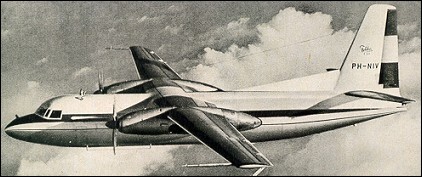
The type was then designated Fokker F27, and the first of two prototypes made its maiden flight on 24 November 1955, powered by two Dart 507 turboprops. Of high-wing monoplane configuration, the F27 has a pressurised fuselage, retractable tricycle landing gear and accommodation for 28 passengers. The second prototype, with Dart Mk 511 engines and its fuselage lengthened by 0.91m to seat 32 passengers, was flown on 31 January 1957. Between the initial flights of these two prototypes, Fokker concluded an agreement with the Fairchild Engine and Airplane Corporation for the latter to manufacture and market the F27 in North America, where it was known as the Fairchild F-27.
Fokker's first F27 Friendship entered service with Aer Lingus in December 1958, but Fairchild had been a little quicker off the mark, its F-27 entering service with West Coast Airlines three months earlier. The American company had modified the interior layout to seat 40, increased the fuel capacity and made provision for weather
radar in a lengthened nose; Fokker adopted similar improvements at a later date. The initial Dutch production version was designated F27 Mk 100 (Fairchild F-27), and was powered by two 1279kW Rolls-Royce Dart RDa.6 Mk 514-7 turboprops. It was followed by the similar F27 Mk 200 (Fairchild F-27A) with 1529kW Dart RDa.7 Mk 532-7 engines. Both airliners had standard accommodation for 40 passengers, but a high-density arrangement made it possible to seat 52. An executive version of the Mk 200 was available with the interior design to customer requirements. Subsequent versions include the F27 Mk 300 Combiplane (Fairchild F-27B), a passenger/cargo aircraft with Mk 100 powerplant, a reinforced cabin floor, cargo tie-down rings and a large cargo door forward of the wing on the port side. A similar Combiplane version of the Mk 200 had the designation F27 Mk 400, but no equivalent version was produced by Fairchild in America. Fokker next developed a lengthened fuselage (by 1.50m) variant of the Mk 200. Designated F27 Mk 500, this failed to appeal initially to airline operators, but 15 were acquired by the French government for service with the nation's Postale de Nuit. Friendship Mk 500s now in service with airlines have standard accommodation for 52 passengers, with high-density seating for 60. Fairchild in America produced its own stretched variant, the FH-227.
The last production version was the F27 Mk 600, combining the Mk 200 fuselage without the reinforced cabin floor but with the cargo door of the Mk 300/400 Combiplanes. The F27 Mk 600 introduced an optional roller-track quick-change interior so that the type could be used for passenger/cargo services. Other versions included the F27 Mk 400M and F27 Mk 500M military aircraft, an F27 Mk 400M aerial-survey version and an F27 Maritime suitable for coastal patrol, fishery protection, and search and rescue. Late production aircraft had an updated flight deck and cabin interior. Manufacture was shared by Dassault-Breguet (France), MBB (Germany) and SABCA (Belgium). When production was terminated in 1986 in favour of the Fokker 50, the company had sold 581 F27s alongside 205 Fairchild-built F-27/FH-227 variants. In mid-1991 Fokker stated that around 450 F27s were still in service and that the highest-time aircraft had made some 80,000 flights.
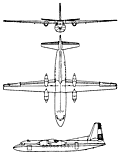 | A three-view drawing (752 x 964) |
| MODEL | Fokker F27 Mk 200 |
| ENGINE | 2 x Rolls-Royce Dart Mk 536-7R turboprops, 1730kW |
| WEIGHTS |
| Take-off weight | 20410 kg | 44997 lb |
| Loaded weight | 12148 kg | 26782 lb |
| DIMENSIONS |
| Wingspan | 29.0 m | 95 ft 2 in |
| Length | 23.56 m | 77 ft 4 in |
| Height | 8.5 m | 28 ft 11 in |
| Wing area | 70.0 m2 | 753.47 sq ft |
| PERFORMANCE |
| Cruise speed | 480 km/h | 298 mph |
| Ceiling | 8990 m | 29500 ft |
| Range | 1926 km | 1197 miles |
| ard, e-mail, 30.08.2024 05:24 Hi , I see some people enthousiast for the Fokker F27. I am looking for an answer on the type of autopilot in the F27. I think it is not the Sperry autopilot, but think it is a different one (at least in flight sim it looks different with different fucntions and buttons) . Could it be a Smiths SEP 1 or SEP 2 autopilot.
please let me know if you know hte type of autopilot in the F27-mark200.
I just learned that the F27-Mark 500 in use with the French had a Tapir autopilot, very interesting one.
thanks ard reply | | Ayman, 13.07.2024 20:27 I do have some F-27 parts for sale
Contact for details please .
Aymansiddig@hotmail.com reply |
| Ayman, 13.07.2024 20:27 I do have some F-27 parts for sale
Contact for details please .
Aymansiddig@hotmail.com reply | | John Kelly, e-mail, 05.04.2024 05:14 I have a Fokker 27 available for sale or for lease, send me an email. reply |
|
| | Aymansidig@hotmail.com, 03.08.2023 11:12 Does anyone have F27 /50 ( SERVICEABLE ) for sale ?
Kindly advise your availabilities and price reply | | Tom Gauthier, e-mail, 12.12.2017 20:06 Remember introduction of the new F-27 at Santa Barbara Airport in 1958. My father was Chief of Police and part of a VIP group for the inaugural flight around SB County. Beautiful then and now. I'm now a private pilot and veteran USAF aircrew. Much appreciative of outstanding design. reply |
| Robert Lindberg, e-mail, 12.09.2014 14:14 I flew the aircraft in many years from 1993 until 2003. First in Air Nordic Sweden, Newair Billund Denmark, Channel Express UK and Ureka in Italy. We operaded the acft in pax aswell asin cargo version in various conditions from North Scandinavia and Russia down to Guinnea Eqvatorial in Africa. I got more than 4000 hours on the type and was really good in handflying at that time. Robert reply | | Pieter F. van der Wedden, e-mail, 28.05.2014 03:32 I was working in the trade school when the first was built.. reply | | massamba mbengue, e-mail, 25.12.2012 14:38 a good plane.i work on this plane many years .maybe 25.but i say it is a good plane. a safety and long life plane. now i am retired from senegal air force but the fokker are fliying since 1976.thank you .fokker good job in africa. fokker is the plane of africa. i love fokker .if you need my help on fokker 27 contact me please.thanks.i went to italia for a d check of F.27. IT WAS WONDERFUL. reply | | scottb60, e-mail, 10.03.2012 06:49 I remember going from Chicago to Peoria Illinois a number of times in the F-27 as a kid, the big windows were great but most of the time I flew it was after dark.
Later I parked aircraft on a number of ramps and the Dart has probably left me with permanent damage after the G-1's. reply | | Wayne Brown, e-mail, 09.03.2012 17:04 The F 27 was the work horse of Wein Air Lines in Alaska in the 1960's and 1970's. Early model even had gun racks for flights to the bush, where passingers could put their firearms, in the gun racks as they borded the plane for the bush. Security wasn't necessay in those great days of flying, you just made sure your firearms were unloaded.
Also you were glad to have a Wein pilot at the controls as they were the best in the business. It is a shame with what we have to endure today to take a plane trip. reply | | Peter Kok, e-mail, 18.10.2011 04:17 My uncle Reul Hennick was one of the designers of this aircraft as well as the subsequent modifications. He worked for Fokker till he retired. He passed away a couple of years ago. He taught me how to play chess when I was a wee lad. When I got older I became a CH-47 Mechanic. I wish I could have talked with him more about his experiences. I do recall he was always proud of his work. reply | | S.Bhandari, e-mail, 19.08.2011 08:32 Can you confirm Fokker plane in 1967 did not have aircondion in cabin while it is stationery at airport for boarding.
Regards reply |
| Antal, 06.02.2011 07:37 I was working on this aircraft as a ground /flight engineer betveen 2007-2010. It is a great old Lady, with many small problems. The main systems are working with pressurized air and during the winter time the air was leaking from everywhere....
I was 22yrs old, in 2007 and the aircraft were 50yrs old!
.... nice memories!!! reply | |
| | Frank Stookey, e-mail, 13.01.2011 01:32 I had the good fortune to fly the F-27 for Horizon Air, with a home base of Portland, Oregon (USA) in 1987. Although the technology was quite dated by then, the aircraft was a delight to fly. Our route structure covered an extensive portion of the Pacific Northwest. It was a very stable instrument platform, and responsive. On hot days, with high density altitudes and near-max gross weight, the introduction of water injection was necessary to get it into the air. One of our check airmen like to refer to the F-27 as "works good - lasts a long time." In those days we did not have operating autopilots, so everything was hand-flying. Our F-27s were the combo model with the forward section for cargo, and seating in the rear for 39 pax plus the flight attendant. Due to the fact we were hand-flying the machine, we could feel the trim changing in cruise flight as the flight attendant came forward to bring our meals and /or coffee. We could time her arrival at the cockpit door by the degree of control pressure required to keep a level altitude. I have very fond memories of those days with Horizon Air plowing the skys in the Friendship. reply |
| Steve, e-mail, 12.06.2010 18:21 I was a child in the 1960s while my dad was working for Airwest and later Hughes Airwest in Stockton, CA. I have fond memories of the aircraft and loved the flights we would take. The high wing design allowed for excellent viewing of the ground and I especially loved to sit under the wing and watch the hydraulics fight to overcome air resistance when the flight crew lowered the gear. It was a well designed aircraft. reply | | Peter Walter, e-mail, 23.01.2010 14:17 I have worked in aviation for nearly 50 years. One of my early jobs was with Schreiner Airways at the old Schiphil Airpor - now called Schiphil East. I have fond memories of our F27 fleet. I would love to see some pictures of Schreiner aircraft from those days. 1963-1967 reply | | Wouter Hobe, e-mail, 25.09.2009 03:20 I was working at Schiphol Airport in Amsterdam and I believe it was 1957, a airline congress was held at the airport. For the first time a Tupolev arrived from Moscow and for the first time a Caravelle. The F27 was rolled out of the hangar and the test pilot Flinterman took off, immediately into the air, circled the airport, wings vertical, on its axis and landed at he beginning of the runway to a full stop. Then he raced over to the hanger and stopped the airplane with its nose against the hanger door to a thunderous applause. reply |
| A. Michael, 31.05.2008 17:15 My friends dad has not so fond memories of this plane. he was performing maintenance on the airlerons or tail and some idiot in the cockpit played with the controls, lost all of his fingers and some of his right hand! reply |
|
Do you have any comments?
|
| 
COMPANY
PROFILE
All the World's Rotorcraft
|


 John Kelly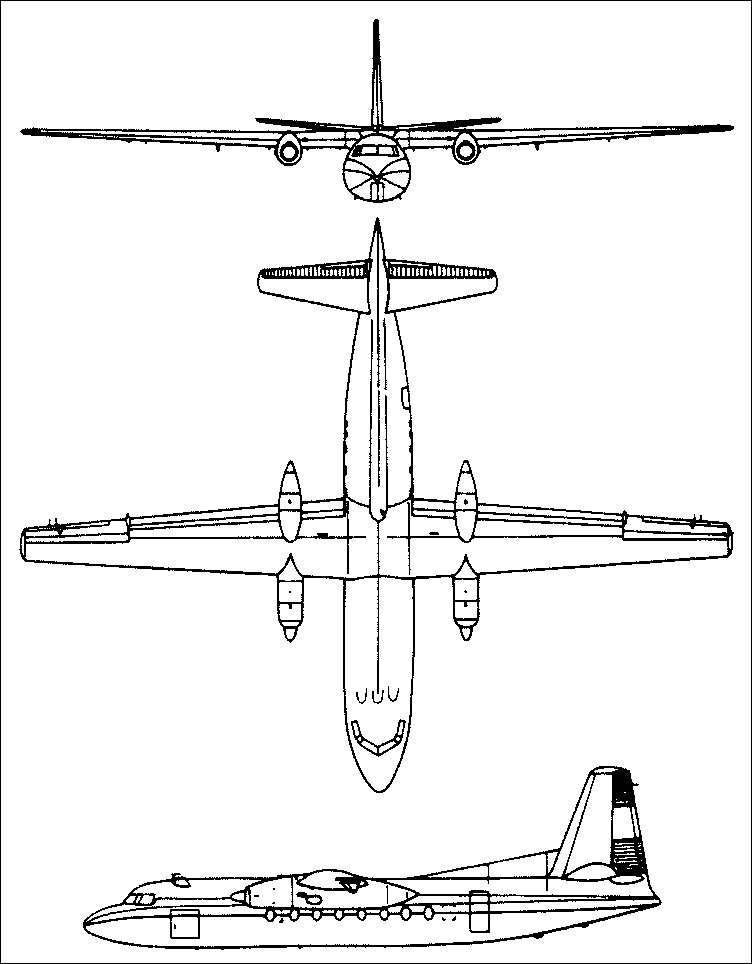


20
reply