|
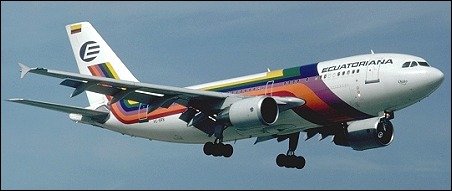
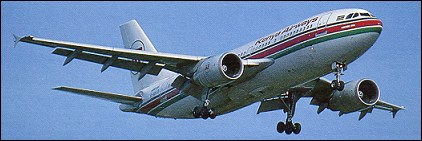
| One of the difficulties faced in the early days of the European Airbus development was the lack of clear guidance by airlines as to their exact capacity requirements, and at various stages up to 11 variants were proposed of differing lengths to suit the customers. While the A300 was under development, Airbus looked at a smaller capacity variant which was in much demand by many carriers. Thus was born the A310.
The fuselage was essentially the same as that of the A300, except it was considerably shorter. Much commonality allowed the development and manufacturing costs to be kept down considerably. The wing and horizontal tail surfaces were new, including a high technology wing from BAe of much reduced area and span. From the outset the cockpit was a forward-facing two-man area, with advanced digital avionics.
The A3T0 was officially launched in July 1978, offering a capacity between 210 to 250 passengers in mixed-class layouts. The prototype first flew on 3 April 1982 and on 11 March the following year received French and West German certification. In April the launch customers Lufthansa and Swissair began services. Since then sales have been healthy, including a major order from US carrier Pan Am.
The basic production version is designated the A310-200, and since May 1986 these have been delivered with drag-reducing wingtip fences. The A310-200C and A310-200F are convertible and all-cargo versions respectively. The first major variant was the A310-300 with extended range. First flying on 8 July 1985, this variant has wingtip fences as standard, additional fuel in the tailplane and an optional central tank fitted in part of the cargo hold. Swissair was again the first customer, and in the hands of carriers such as Wardair these regularly make transatlantic crossings.
| MODEL | Airbus A310 |
| CREW | 2 |
| PASSENGERS | 210-250 |
| ENGINE | 2 x Pratt & Whitney PW4152 turbofans, 220kN |
| WEIGHTS |
| Take-off weight | 157000 kg | 346128 lb |
| Empty weight | 70275 kg | 154931 lb |
| DIMENSIONS |
| Wingspan | 43.89 m | 144 ft 0 in |
| Length | 46.66 m | 153 ft 1 in |
| Wing area | 219 m2 | 2357.29 sq ft |
| PERFORMANCE |
| Max. speed | 1038 km/h | 645 mph |
| Cruise speed | 850 km/h | 528 mph |
| Range | 9175 km | 5701 miles |
| lxbfYeaa, e-mail, 15.11.2025 12:38 20 reply | | lxbfYeaa, e-mail, 07.11.2025 00:40 20 reply | | ubaTaeCJ, e-mail, 21.02.2025 19:15 20 reply | | ubaTaeCJ, e-mail, 21.02.2025 18:56 20 reply | |
| | ubaTaeCJ, e-mail, 21.02.2025 18:56 20 reply | | lxbfYeaa, e-mail, 14.03.2024 03:21 20 reply | | lxbfYeaa, e-mail, 14.03.2024 03:21 20 reply | | Israr Wasim, e-mail, 15.06.2015 18:06 Dear MR Kiril. good day sir, the sale A310-300 What is YOM ? if- after 1995+ please send detail & price also.
Best Regard
Wasim reply | | sami, e-mail, 29.12.2012 11:44 we are interested in air bus and beoing...
all more than 15 yrs old will be bought only for afghanstan, syria and north africa ..due to regulations in many countries and we don't want to mess with the law..
pls help these poor countries and don't find another opportunity to take advantage of the poor and depressed... reply | | Kiril, e-mail, 19.11.2010 15:53 2x A310 available for sale.
Contact me for more information.
E-mail: chochkov@aero-x.eu reply | | Rade, e-mail, 10.05.2010 13:01 Airbus 310-222 for sale. No timewasters please. reply | | samson, e-mail, 26.04.2010 13:07 thanks once again,pls we want to know whether if your company can sell this airbuse plane,as soon as possible to us, please this is the models types) Air A310 / 300, moten J.A )
A300 / 600,moten J.A, 95-97 boeing,320 / 200 V 2500.
thanks once again please treat this as urgent,so that we can get reasonable information to give to our colligues that need this plane.
so send all every details concerning this airbuse plane to us,both the prices, and are waiting to hear from you soon.
and also how to deliver it to us,and the payment system?,and the time to delivering to to us.
thanks,regards.
samson.
pls call me with this businessno ok, mobile(+229-96687349 ) so we can talk more better for this . reply | | samson, e-mail, 25.04.2010 23:56 thanks once again,pls we want to know whether if your company can sell this airbuse plane,as soon as possible to us, please this is the models types) Air A310 / 300, moten J.A )
A300 / 600,moten J.A, 95-97 boeing,320 / 200 V 2500.
thanks once again please treat this as urgent,so that we can get reasonable information to give to our colligues that need this plane.
so send all every details concerning this airbuse plane to us,both the prices, and are waiting to hear from you soon.
and also how to deliver it to us,and the payment system?,and the time to delivering to to us.
thanks,regards.
samson.
pls call me with this no ok, mobile(+229-96687349 ) so we can talk more better for this business,and pls we need any of those airbus plane. reply | | Kiril, e-mail, 04.04.2010 23:55 I am able to offer Airbus A310 for sale. Contact me for more information.
E-mail: chochkov@aero-x.eu reply | |
| | Zil Ruhain Jaigirdar, e-mail, 26.11.2007 16:45 Does the owner wants to sale this aircraft ? If yes then contact me urgently. reply |
|
Do you have any comments?
|
| 
COMPANY
PROFILE
All the World's Rotorcraft
|