|
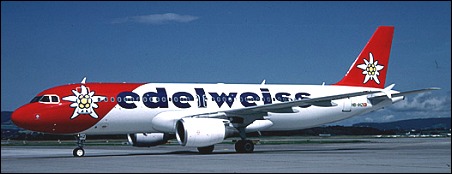
| Early Airbus proposals for a family of airliners centred around twin-aisle and single-aisle designs, and while the first two aircraft featured twin-aisles, the third member of the family introduced the single-aisle. Although it shared some aerodynamic similarities with its two larger cousins, the A320 is essentially an all-new design, incorporating state-of-the-art airliner engineering features. Among the technological, firsts are a full fly-by-wire control system with sidestick controllers, gust alleviation function for a smoother ride and greater fatigue life and a centralised fault display and warning system. Intended for the 737/MD-80 market, the A320 has seating for 150 to 179 passengers, these accommodated in a wider cabin than most single-aisle aircraft, allowing for far greater comfort and the ability to take standard baggage containers.
Go-ahead for the programme was announced on 2 March 1984, and on 22 February 1987 the first aircraft took to the air from Toulouse with CFM56 engines. The first 21 aircraft were the basic A320-100 version, but these have since been superseded by the definitive A320-200, this featuring an extra fuel tank and wingtip fences. Versions under consideration are a convertible passenger/freight model and an all-cargo freighter. In 1989 Airbus announced a stretched version, the A321 with.a 44.51m long fuselage. With 186 passengers in a two-class layout, this will fill the capacity gap between the A320 and A310.
In service the A320 has proved extremely reliable and economical. These factors, together with the advanced technology, have made it the best-seller yet for the Airbus family. Air France took the first delivery on 28 March 1988, and the type was certificated in 1989 for operations with the IAE V2500 high technology engine. The type has achieved major sales in the United States with Northwest and Braniff.
| MODEL | Airbus A320 |
| CREW | 2 |
| PASSENGERS | 150-180 |
| ENGINE | 2 x CFM56-5-A1 turbofans, 111.2kN |
| WEIGHTS |
| Take-off weight | 73500-77000 kg | 162041 - 169757 lb |
| Empty weight | 41900 kg | 92374 lb |
| Payload | 19100kg | 42109 lb |
| DIMENSIONS |
| Wingspan | 34.1 m | 112 ft 11 in |
| Length | 37.6 m | 123 ft 4 in |
| Wing area | 122 m2 | 1313.20 sq ft |
| PERFORMANCE |
| Cruise speed | 850 km/h | 528 mph |
| Range | 4800-5500 km | 2983 - 3418 miles |
| Aleksandr Sanosyan, e-mail, 06.10.2016 22:47 Good day,
I'm looking for one Airbus A320 aircraft , DOM 1993-1998, 180 PAX configuration.
If you have available aircrafts please provide specifications and prices.
Thank you in advance for Your kind cooperation. reply |
| Bert Berendsen from Banking an, e-mail, 13.01.2015 13:16 We have available 4 x A320-232, YOM 2 x1997 & 2 x 1998 in Dry Lease, and 2 x A320-232 YOM 2003 for Sale.
When you are interested, contact us by email at bert@bankingandengineering.eu reply | | Kae, e-mail, 21.06.2012 16:37 Looking for A320s the years of 93-96 to purchase...anyone have any quotes they can send me? reply |
| Anthony Meyers, e-mail, 16.05.2012 21:55 We are looking for A320 to purchase imm. Please send your offers to : contact@atlantic-aerospace.co.uk reply | |
| | Kiril, e-mail, 01.09.2011 12:06 We have 10 x A320s available for immediate sale. Price: between 46-48M USD each. Contact us for more information.
E-mail: chochkov@aero-x.eu reply |
| Bill Roll, e-mail, 22.02.2011 07:39 I flew Captain on the A320 for my last 4 years with Northwest Airlines. I liked the airplane but didn't feel it was "built tough" like the DC-9. I had a couple strange things happen that I still don't have the answers for but it worked as advertised. I wanted to fly it because I flew captain on the DC-3 and wanted to say I flew the technology of both era's in the first 100 years of aviation. Those were the "good ole days," never to be seen again. reply | | Flyhi, e-mail, 28.07.2010 13:29 We have A320-200 For lease on ACMI wet lease only , contact me if interested.
Flyhi1@hotmail.com reply | | Kiril, e-mail, 04.04.2010 23:57 I am able to offer Airbus A320 for sale. Contact me for more information.
E-mail: chochkov@aero-x.eu reply | | Kiril, e-mail, 04.10.2009 15:41 I have Airbus A320 for sale. Contact me for more information. reply | | SERGIO, e-mail, 18.07.2007 07:06 ESTE ES EL MISMO AVION DONDE EN SAO PAULO SE ESTRELLO EN UN EDIFICIO Y EXPLOTO MURIERON 200 SE CREE QUE AHI 5 PERSONAS VIVAS Y ESTO FUE OY. reply | | iskandar, e-mail, 02.03.2007 16:17 I'm UTM skudai student which major in aeronautical engineering..can i have some information on technical servis data for my research.Howto increase range for this a /c without decreasing pasengger number? reply |
|
Do you have any comments?
|
| 
COMPANY
PROFILE
All the World's Rotorcraft
|



 Kae
Kae

20
reply