|
| The French-built prototype Concorde 001 flew on March 2, 1969 and the British-made Concorde 002 flew on April 9, 1969.
Both prototypes entered service in 1971. Commercial service began in 1976 but only 9 aircraft were ordered.
| CREW | 3-4 |
| PASSENGERS | 144 |
| ENGINE | 4 x Rolls-Royce/SNECMA Olympus 593 Mk 610, 169.1kN |
| WEIGHTS |
| Take-off weight | 185066 kg | 408003 lb |
| Empty weight | 78698 kg | 173500 lb |
| DIMENSIONS |
| Wingspan | 25.55 m | 84 ft 10 in |
| Length | 62.10 m | 204 ft 9 in |
| Height | 11.40 m | 37 ft 5 in |
| Wing area | 358.22 m2 | 3855.84 sq ft |
| PERFORMANCE |
| Cruise speed | 2179 km/h | 1354 mph |
| Ceiling | 18290 m | 60000 ft |
| Range | 6582 km | 4090 miles |
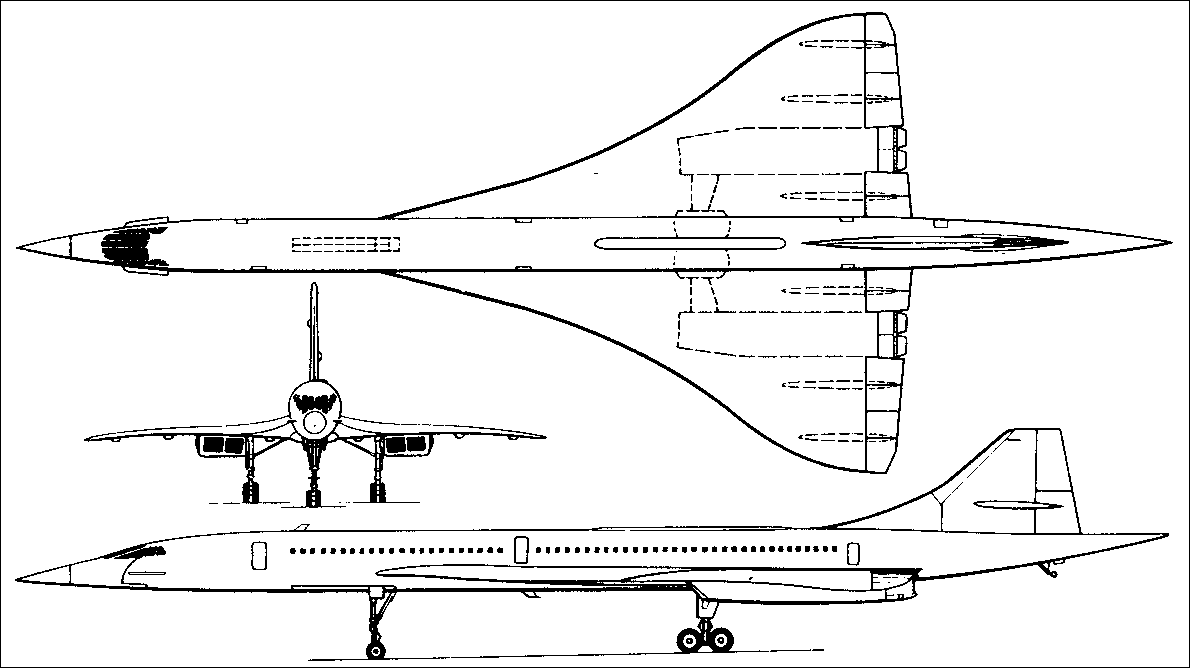
 | A three-view drawing (1190 x 668) |
| lxbfYeaa, e-mail, 15.11.2025 14:57 20 reply | | ubaTaeCJ, e-mail, 21.02.2025 19:20 20 reply |
| BHH, 31.07.2023 05:47 "Only 9 aircraft were produced" says the description.
Umm... excuse me but WHAT?? reply | | I Want You...mmmm...., e-mail, 12.11.2014 11:24 ^
Can I have you in my bed, I like bad movies....mmmmm...... reply | |
| | Air France, e-mail, 17.02.2014 04:06 I bet that the Tu-144 could beat the crap out of the Concorde. I mean, the Tu-144 is about one tenth faster than the Concorde so you see what I mean? reply |
| Scottb60, e-mail, 22.06.2012 21:13 The Concorde averaged 15.8 pm /g fuel consumption compared to the 707 at 33.3pm /g, the 747 46.4pm /g and the DC10 53.6pm /g.
With 3 times the consumption the economics are not in it's favor. reply |
| Barry, 22.06.2012 17:52 See how far we have come. No one has been to the moon in over 30 years and here we are in the 21st century unable to cross the Atlantic in anything capable of exceeding Mach 1. That's progress for you. reply | | Scott Boyd, e-mail, 28.09.2011 07:02 While having a stellar career the Concorde simply became too expensive to operate. While support issues may have played a part economic reality, fuel cost especially, and suitable destination pairs made the difference.
Concorde could easily have been kept in operation for charter operations, even though operating expenses would be high a premium would have been acceptable for those who would use it.
Parts can still be found or can be replicated for DC-3's and parting out one or two of the four would have keep 1 or two running.
They all flew to their last destinations. reply |
| Mick Skinner, e-mail, 27.09.2011 20:41 At the time of the only CONCORDE crash I had retired from BA but had been an engineering manager (licensed on Concorde )in the Concorde hangar for 6 years up to 1968. This aircraft was second to none in terms of performance and charisma. To put it in perspective for a few hundred pounds your granny in her sunday best could be drinking champagne and eating a steak dinner at Mach 2 when a jet jockey who is in a pressure suit and not even a drink of water in a fast jet would not be able to catch it as he would run out of fuel before getting near. There is still a lot of conjecture about the Air France Paris crash but the reason Concorde is no longer flying is only because the manufacturers stopped supporting it and without spares it was no longer a viable option. reply |
| Colin Cox, e-mail, 24.09.2011 13:25 More needs writing up on this iconic aircraft. 'Gooda' copies and pastes the post by 'Ian' but there was only 1 Concorde crash, not "crashes", as mentioned.
Air France flight AF4590 crashed into the Parisian suburb of Gonesse on
July 25th, 2000 as a direct result of encountering debris on the runway
during it's take-off roll from RW26R at CDG. Other contributory factors were involved, as is usually the case with aircraft accidents. A very good account of the event can be read in Concorde Captain John Hutchinson's book, 'The Wind Beneath My Wings'. ISBN: 978-0-9562176-2-2 reply | | gooda, 20.06.2011 05:59 Excellent achievement but not financially viable for larger scale use. The crashes sealed its fate. reply |
| Neville Junior, e-mail, 23.05.2011 13:16 i guess the other commercial aircrafts were jealous of the concorde because of its performance.too bad i did not get to see it. reply |
| Mick Skinner, e-mail, 18.02.2011 13:36 Many good comments but not all acurate.As an engineer with CAA Airframe & Engine approval on the A /C I was a hangar mgr looking after Concorde Maintenance for 6 years. It is a wonderfull A /C despite being a pig to work on, all my staff loved it and it made BA a good operating surplus doing sheduled and charter trips. Many were ordered by Airlines in the 60's but the orders were cancelled due to the fuel crisis causing a massive increase in operating costs and subsequent operating resrictions on supersonic flight over land not to mention the USA resistance on operations to America over noise levels. I have flown this wonderfull bird many times and when you consider your granny could fly at Mach 2 eating steak and champagne at 60000 ft when a fighter pilot in a supersonic fighter is in a pressure suit and not even a drink of water it puts it into persrective. reply |
| Uyraell., e-mail, 16.01.2011 04:07 The only reason Concorde came into existence at all was to make use of the bristol Olympus engines, which had originally been developed for the TSR2 aircraft.
Cancellation of the TSR2 created the opportunity to recoup the development costs of the Olympus family of engines.
Not that bay any means deride or belittle Concorde: the aircraft was an engineering triumph, unlikely to be repeated. It was elegant, efficient, and an example of technology at its' best.
The crash as a result of FOD was statistically an ever-present likelihood, and thus to employ the crash as justification for ending the career of Concorde was spurious at best. reply |
|
| | mike, e-mail, 08.11.2010 17:40 a fantastic aircraft.its a shame it wont fly no more.and, you will always have critics, but sipping champagne while breaking the sound barrier,yeah buddy sounds good to me reply | | Chris, e-mail, 16.09.2010 04:23 Another great idea way ahead of its time... reply | | rj, e-mail, 15.09.2010 22:14 Another total waste of taxpayers money, just like all government backed projects. Check the history of British built Dirigibles as a prime example. The private built job was great and the government built job was a disaster, fortunately killing one of those responsible for it's construction. Should happen more often. reply | | Brian, 20.05.2010 07:12 I remember seeing Concord overhead in 1987 in Maryland. Too bad it's not still around. BTW great site! reply |
| Barry, 24.08.2009 15:52 It was a very bad movie.It also featured a scene where the pilot (played by George Kennedy)dived the Concord towards the sea pulling up at the last moment to make a missile crash into the sea. This was truly a great aeroplane, but even it had it's limitations. reply | | d.jay, 13.07.2009 22:17 "Airport 80 the concorde" the co pilot opens a side window in the cockpit while the concorde is in a roll and fires a flare pistol out of it and deflects a missle from the F4. reply |
|
Do you have any comments?
|
| 
All the World's Rotorcraft |


 Air France


20
reply