|
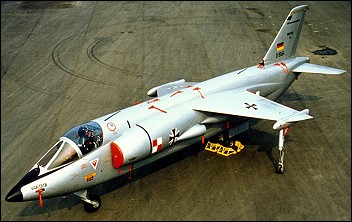
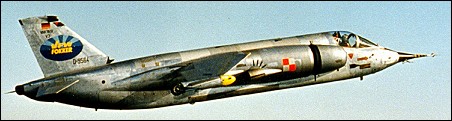
| The VAK concept of NATO and the German Armed Forces required an aircraft that was able to take off from unprepared airfields without runways. Its mission was close air support. In addition it had to be able to fly long distances in extreme-low-altitude in order to prevent attacks of antiaircraft weapons and radar detection. Because of this the VAK was designed with short wings and a minor extension so it would provide its pilots a tolerable flight and bear aerodynamically difficult extreme-low-altitude-flights. The equipment was stored in a weapon bay.
The first prototype flew on September 10, 1971, the first transition - the transfer of vertical flight in horizontal and vice versa as well as turning off and on the lift-engines - was achieved on October 26, 1972 in Manching, Bavaria, at a speed of 400 km/h.
All three VAK 191B experimental aircraft completed a total of 91 flights that lasted all together 12 hours.
| MODEL | VAK 191B |
| CREW | 1 |
| ENGINE | 1 x Rolls-Royce/MTU RB 193-12, 45.2kN + 2 x Rolls-Royce RB 162-81 F 08, 26.5kN |
| WEIGHTS |
| Take-off weight | 8507 kg | 18755 lb |
| Empty weight | 5562 kg | 12262 lb |
| DIMENSIONS |
| Wingspan | 6.16 m | 20 ft 3 in |
| Length | 14.72 m | 48 ft 4 in |
| Height | 4.30 m | 14 ft 1 in |
| Wing area | 12.5 m2 | 134.55 sq ft |
| PERFORMANCE |
| Max. speed | 1100 km/h | 684 mph |
| Cruise speed | 740 km/h | 460 mph |
| Range | 400 km | 249 miles |
| ARMAMENT | 2945kg of weapons |
| Bill Krouwel, e-mail, 09.11.2016 21:20 The aircraft also shows the inferiority of the Rolls-Royce two-engine system of V /SOL as compared to the Bristol-Siddely vectored - thrust (from ONE engine) approach - which was, of course, the only V /STOL system to be combat-proven... reply | | paul smith, e-mail, 05.11.2010 17:09 By brother Tom Smith was the USAF test pilot on this beautiful aircraft.Just how inteligent were people back then?WOW reply |
| Tom, 23.03.2010 19:24 David,remember that 400 Km /h = 240 MPH so it could have made the transition to lift motor at that speed, and used the lift engine as a type of dynamic brake(in other words the plane coasted until it came to 0 ft per second) reply |
| Adam R, e-mail, 05.09.2010 17:02 This aircraft is outside the EADS HQ area at Bremen Airport, Germany. One of a kind indeed! reply | |
| | Giuseppe Cirio, e-mail, 05.09.2009 20:25 La foto di questo bellissimo aereo mi porta indietro negli anni del mio lavoro come collaudatore parte elettrica dei velivoli presso l'Aeritalia di Torino,allora partecipai alla parte italiana del progetto, mi mandarono a Brema per le rifiniture e mi innamorai di quella bella città; fu un peccato che quel progetto finì solo con i prototipi, penso che fosse un validissimo velivolo, conservo ancora l'accendino che la VFW ci regalò per quella trasferta, ora ho 81 anni e vivo di ricordi come questo e spesso mi commuovo come adesso. Cordiali saluti reply | | David Williams, e-mail, 01.04.2008 09:08 Was the first transition really performed at a speed of 400 km /h? That seems highly unlikely to me. reply |
|
Do you have any comments?
|
| 
All the World's Rotorcraft |


 Tom
Tom

20
reply