|
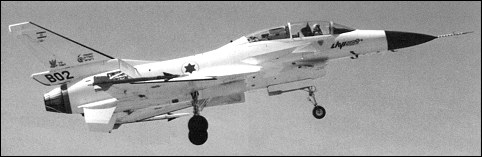
| The Lavi (Young Lion) was conceived as a multi-role
fighter with close air support and interdiction as
primary missions and air defence as a secondary mission.
Full-scale development began in October 1982,
the Lavi featuring close-coupled delta main wings
(with 54° of sweepback on the leading edges) and
canard surfaces. Approximately 22% of the
structure (by weight) was built of composite materials and power was provided by a Pratt & Whitney PW1120
turbojet with an afterburning thrust of 9353kg. Armament included an internally-mounted
30mm cannon, and up to 7257kg of external
stores could be distributed between seven
underfuselage and four underwing stations. Both
single-seat and fully combat-capable two-seat versions
were developed in parallel and five prototypes were
planned, the first and second of these being two-seaters
and the remaining three being single-seaters. The
Israeli requirement was for 300 aircraft. The first prototype
flew on 31 December 1986, being followed by the
second on 30 March 1987, but the Lavi programme was
terminated on 30 August 1987 as a result of severe budgetary
constraints. Although the first two aircraft were
then scrapped, the third prototype was completed as a
two-seat technology demonstrator, flying on 25 September
1989.
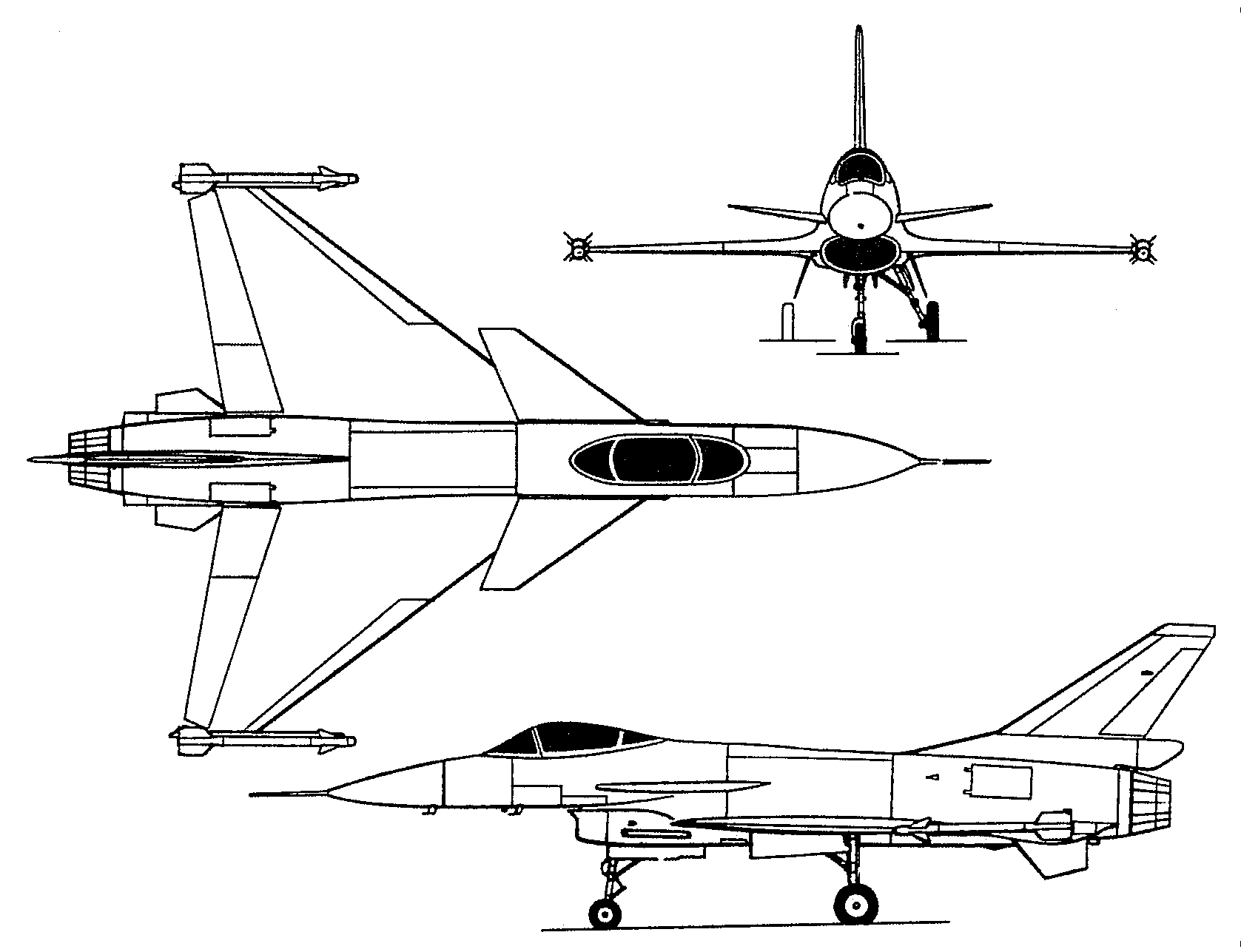
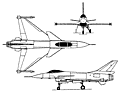 | A three-view drawing (1677 x 1287) |
| WEIGHTS |
| Take-off weight | 19278 kg | 42501 lb |
| Empty weight | 6942 kg | 15305 lb |
| DIMENSIONS |
| Wingspan | 8.78 m | 29 ft 10 in |
| Length | 14.57 m | 48 ft 10 in |
| Height | 4.78 m | 16 ft 8 in |
| Wing area | 33.05 m2 | 355.75 sq ft |
| PERFORMANCE |
| Max. speed | 1912 km/h | 1188 mph |
| Ariel Eskenazi, e-mail, 08.11.2012 12:34 it was a "tilor made aircraft" for our airforce and the americans gave us a grate deal on american aircraft - just to "help" our gov to stop the development.
it also caused them to deliver some contracts so lots of the electronics on america aircrafts today are made here . reply |
| Barry, 06.02.2012 18:39 Well "The Aviator Dude" you may be right about negotiating with the Palestinians but with neighbours like Israel has , especially those half witted Iranians, I would take every bit of hard ware I could get my hands on. Whilst the Lavi was still born, what the IDAF have done with their F16's exceeds anything that even the Americans have done so far. It would be a very brave or incredibly stupid Arab that went for a show down with the Israel. reply | | TheAviatorDude, e-mail, 29.08.2011 00:55 Why does the IAF need more aircraft? With this chaos, the local Arab Militaries don't have the capability to challenge Israel.
What would they use a Gen 4.5 fighter for, bombing Palestinian militants? They just need an effective negotiation policy, not 60-year-old aggression. reply | | Steven, 14.07.2011 09:04 China? the J-10 looks very similar reply |
|
| | Steven, 14.07.2011 09:04 China? the J-10 looks very similar reply | | paidui, 18.06.2011 10:58 You bid DUMMIES,can't you tell that it may be assembled in Israel and manufactured somewhere else?!Guess where?! reply | | Mike Miller, e-mail, 01.10.2010 03:13 Too bad there is no mention of the excellent engine supplied by P&W to power the Lavi. The PW1120 did and excellent job. I know. I was there as the P&W Engine Manager. Excellent close support aircraft. reply | | Jim, 15.09.2010 18:25 An example can be seen at the IAF Air Museum. reply | | Joe Moer, e-mail, 22.08.2010 21:57 America squashed this one to prevent competition to the F16A-B
Better payload- and range.
I guess the F16Is have the range to take out the Iranian Reactors- Watch your local media for details reply | | Leo Rudnicki, e-mail, 06.08.2009 06:32 DEFA 552 (Improved) gas operated. They had a licence to produce it and modifications, of course. reply | | Raider, 05.08.2009 22:04 Does anyone know which 30mm gun was intended to be used? French GIAT or DEFA? reply | | Cody302, 24.05.2009 01:48 Oh yea, and the F-16XL. reply | | Cody302, 24.05.2009 00:08 Sorry Roscoe, No Typhoon here.........just F-16. Also check out the X-31 project on thrust vectoring and laminar flow properties of various wing shapes and porosities reply | | rosco, e-mail, 28.01.2009 13:07 This plane was the base for the J-10 in production in china (Israel supplied plan and aided in technology upgrade). Part of the airframe technology (airintake and wing)of the EAP /typhoon was traded to augment performance en aerodynamics late 80's begin 90's when the relation with china smoothed. Supposedly also aid to electronics and glass cockpit was supplied. reply | |
| | Mohamad Rais, e-mail, 24.12.2008 17:30 You bid DUMMIES,can't you tell that it may be assembled in Israel and manufactured somewhere else?!Guess where?! reply |
|
Do you have any comments?
|
| 
All the World's Rotorcraft |


 Steven

20
reply