|
| It is perhaps surprising at first sight
that, having been the second nation to
fly an air-breathing jet-propelled aeroplane,
Italy did not feature among the
leading nations in this field of technology.
But in truth the Caproni-Campini
N.1 was no more than an ingenious
freak which employed a conventional
piston engine to drive a variable-pitch
ducted-fan compressor with
rudimentary afterburning. As such it
did nothing to further gas turbine research,
and was to all intents and purposes
a technical dead-end. The engineer
Secondo Campini had created
a company in 1931 to pursue research
into reaction propulsion and in 1939
persuaded Caproni to build an aircraft
to accommodate the fruits of this work,
namely the adaptation of an Isotta-
Fraschini radial engine driving a
ducted-fan compressor; the compressed
air was exhausted through a
variable-area nozzle in the aircraft's
extreme tail, and additional fuel could
be ignited in the tailpipe to increase
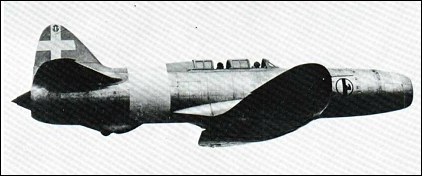
thrust. The two-seat low-wing N.1
(sometimes referred to as the CC.2)
was first flown at Taliedo on 28 August
1940 by Mario de Bernadi. A number of
set-piece demonstration flights was
undertaken, including one of 270km from Taliedo to Gindoma at
an average speed of 209km/h, but it was clear from the
outset that use of a three-stage fan compressor
driven by a piston engine
would limit further development, and
the experiment was abandoned early
in 1942 when Italy was faced with sterner
priorities. The N.1 survives today in
the Museo della Scienza Technica at
Milan as a monument to ingenuity if not
sophisticated technology. FACTS AND FIGURES © The low power of the N.1's piston
engine kept it below 4000m,
where the ducted fan arrangement
would have been effective. © The N.1 's power system had no
hot compressor section. The cold
compressed air was ducted and
mixed with jet fuel and ignited,
giving extra thrust. © The wing was mounted as low as
possible and the cockpit as high as
possible to give the most straight
airflow to the deeply buried engine. © Use of the afterburner massively
increased the fuel flow, but only
added an extra 40km/h to the top speed.
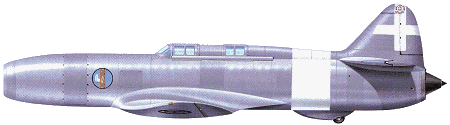
| CREW | 2 |
| WEIGHTS |
| Take-off weight | 4195 kg | 9248 lb |
| Empty weight | 3640 kg | 8025 lb |
| DIMENSIONS |
| Wingspan | 15.85 m | 52 ft 0 in |
| Length | 13.1 m | 43 ft 0 in |
| Wing area | 36 m2 | 387.50 sq ft |
| PERFORMANCE |
| Max. speed | 375 km/h | 233 mph |
| lxbfYeaa, e-mail, 07.11.2025 03:52 20 reply | | e, e-mail, 21.02.2025 12:24 e reply |
| lulu, 23.02.2017 22:03 cool plane reply | | Mauro, e-mail, 25.04.2016 18:35 Monument to ingenuity? No, a monument to the epic history of aeronautics, when the humans are attempting to flight more speedly, much highly, having more power. The air compressing mode and the afterburner feature are all previewed in this fantastic plane, concepts that will be realized 5 years later. reply | |
| | George Steed, e-mail, 20.03.2012 07:55 There's a copy of this aircraft hanging in the Italian Air Force Museum on Lago di Bracciano about 40 km northwest of Rome. If you're in Italy it is worth the trip. Hard to find but worth it. reply | | Trevor Webb, e-mail, 19.11.2011 14:30 The CC1 according to an old copy of Flypast magazine was a static test fuselage with a fixed tail and stub wings for ground testing the engine.It had as single cockpit unlikethe CC2, for an engineer only. reply | | Brummpa, e-mail, 01.10.2011 13:20 Did you forget the CC-1? As I recall it had a prop to take-off which was then jettisoned once it was airborne. The follow-on CC-2 no longer required a prop. reply | | Joseph Angelillo, e-mail, 02.01.2011 17:56 If you can get a copy of Air Progress Magazine 1942 October you will find a complete story and interal drawingf of this aircraft. It flew the mail with two operators. Funny how history depends many times on the bias of the writer. This airecraft was the first to fly without an external prop.
I have a copy of the October 1942 "AIR PROGREES MAGAZINE" WITH DETAILS. reply | | vimy, e-mail, 09.04.2010 00:28 flying boat
try wiki
en.wikipedia.org /wiki /Caproni_Ca.60 reply | | bill, e-mail, 18.03.2009 15:45 does anyone know how i can see a photo of Caproni's Transaereo flying boat ( it had nine wings ) 1921 reply |
| Sgt.KAR98, 03.08.2008 06:18 Should have been used as a fighter reply | | Aero-Fox, 11.04.2008 06:25 Zane, just so you know, the Re.2007 design was proven to be a hoax perpetrated by the president of Reggiane to generate publicity.
Anyway, I find this a fascinating machine...even if it was powered by an impractical engine design, it still represents a milestone in jet technology as the second air-breahing reaction-powered aircraft ever to fly and also the first jet to fly a respectable distance under its own power. reply | | Zane, e-mail, 22.03.2008 06:16 This was a more advanced version of Secondo Campini's technology path. With the help of Count Caproni, in 1932 he flew his own Stipa-Caproni which was basically a winged tube with a DeHavilland Gypsy III in the middle, dubbed a "motor jet" as it created an airflow within the tube or "ducted fan." Campini also funded Henri Coanda's Rumanian Coanda 1910 at Taliedo, Italy utilizing a Clerget four-cylinder inline engine to power the Coanda Air Reactive Engine. This was all prior to the air show in France, which had absolutely nothing to do with the Conada 1910 other than Coanda attending the international air show to demonstrate his creation. The Caproni Campini N.1 (CC.2) was the natural next step in development. It is also rumored (I don't know how true) that Caproni also influenced the Reggiane Re-2007 for a post-war Italian fighter. He emigrated to the USA in 1948. reply | | Frank Dowse, e-mail, 06.11.2007 13:01 This aircraft may not have been a technical marvel but our own Bell XP59 jet was not either. I find them admirable steps in jet evolution.
Very good site! Thanks. reply | |
| | Stephen Spears, e-mail, 18.02.2007 19:05 Could you produce a 3-line drawing of this aircraft? It would be most appreciated. Thank you. This is otherwise a very informative website. Thank you again. reply |
|
Do you have any comments?
|
| 
COMPANY
PROFILE
All the World's Rotorcraft
|


 bill
bill

20
reply