|
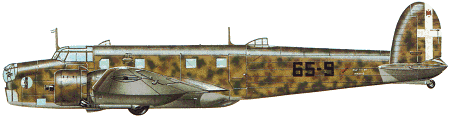
| A well designed and sturdy medium
bomber, the Fiat B.R.20 Cicogna
(stork) series fell nevertheless into that
category which was nearmg obsolescence
by the outbreak of World War II.
Designed by Ingeniere Celestino
Rosatelli, and owing much of its parentage
to the sleek Fiat APR.2 commercial
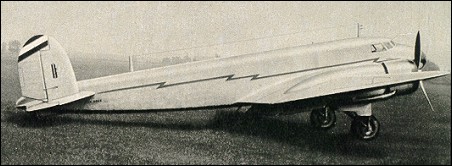
transport, the Fiat B.R.20 prototype
flew first on 10 February 1936. The first
unit of the Regia Aeronautica to receive
B.R.20s was the 13° Stormo BT
stationed at Lonate Pozzolo: the 7° Stormo
BT, also at Lonate, received Fiat
B.R.20s in February 1937. Powered by
two 745kW Fiat A.80 RC.41
radial engines, the B.R.20 possessed a
maximum speed of 430km/h at 4000m, and
was armed with two 7.7mm and one 12.7mm machine-guns.
Elements of the 7° and 13° Stormi
BT were despatched to Spain in May
1937 for combat experience, while
other B.R.20s were exported to Japan,
and saw service with indifferent results
in China and Manchuria as the
JAAF's Army Type 1 Model 100 Heavy
bomber. Modified nose contours, increased
armour protection and revised
armament featured in the
B.R.20M, of which 264 were ultimately
produced. When Italy declared war
on 10 June 1940 the Regia Aeronautica
had 162 Fiat B.R.20s and B.R.20Ms in
commission with the 7°, 13°, 18° and 43°
Stormi BT. The first bombing mission
was made on 13 June when 19
B.R.20Ms of the 13° Stormo BT attacked
installations at Hyeres and Fayence in
southern France. A detachment of 80
B.R.20MS of the 13° and 43° Stormi BT
were sent to the Belgian airfields of
Chieveres and Melsbroeck in late
September 1940 to assist the Luftwaffe
in its bombing campaign against England. As part of the Corpo Aereo Italiano
the B.R.20Ms suffered losses as a
result of crew failings and fighter
attacks. The campaign in Greece saw
the 116° Gruppo (37° Stormo) in action
from bases in Albania, followed by action
over Crete, and on a day and night
attacks against Malta. In the USSR
B.R.20MS of the 38a and 116a Squadriglie
operated from August 1942 in the
southern sector.
Fifteen of the improved B.R.20bis
model were produced. These were
powered by two 932kW Fiat A.82 RC.42S engines, had additional
7.7mm machine-guns
and a power-operated dorsal turret.
Early in 1943 the B.R.20M bomber had
been withdrawn from active service
with the Regia Aeronautica, units
being re-equipped either with CANT
Z.1007s or with Savoia-Marchetti
S.M.79S/ Production totalled 602 of all
marks.
| CREW | 4-5 |
| ENGINE | 2 x FIAT A.80 R.C.41, 735kW |
| WEIGHTS |
| Take-off weight | 10100 kg | 22267 lb |
| Empty weight | 6400 kg | 14110 lb |
| DIMENSIONS |
| Wingspan | 21.6 m | 71 ft 10 in |
| Length | 16.2 m | 53 ft 2 in |
| Height | 4.8 m | 16 ft 9 in |
| Wing area | 74.0 m2 | 796.53 sq ft |
| PERFORMANCE |
| Max. speed | 430 km/h | 267 mph |
| Cruise speed | 340 km/h | 211 mph |
| Ceiling | 7200 m | 23600 ft |
| Range w/max.fuel | 3000 km | 1864 miles |
| ARMAMENT | 2 x 12.7mm machine-guns, 2 x 7.7mm machine-guns, 1600kg of bombs |
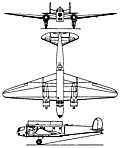 | A three-view drawing (692 x 852) |
| Anonymous, 12.03.2023 20:36 There seems to be some weir-do out there who's inventing German female pilots and planting them all over the internet.
IMO 'Anna Kreisling' is totally fictional. No mention of her in Zegenhagen's 2007 Ph.D. thesis on German aviatrices and Zegenhagen always appeared extremely well-informed on aviation personalities to me. That's particularly surprising because Kreisling (allegedly) was a Flugkapitän, i.e. high-profile professional aviator. Requirements for Flugkapitän were hard to meet for men, almost impossible for women of the time. You had to be older than 30 years with at least 8 years in aviation and 5 years in air transportation plus a completed 500.000 flight kilometers as a pilot. Even Hanna Reitsch and Countess von Stauffenberg received the title only ad honorem, not for fullfilling the requirements.
What is more, the family name 'Kreisling' doesn't exist in Germany or Austria at all :lol:
h99p: / /www.verwandt .de /karten /absolut /kreisling .html
Both search engines check the national phonebooks so have an extremely good coverage of family names.
No entries for 'Kreisling' at h99p: / /www.volksbund .de (German War Graves Commission) as well.
I have the odd feeling there may be a connection to the mysterious female fighter ace 'Grunter von Haart' who allegedly downed 168 allied planes in Italy. reply | | Barry, 31.05.2016 15:51 E.Wagamon hear hear - unfortunately the world is full of nutters! reply |
| Dr. Jacob Steinbrunner USC, 12.08.2014 09:44 On the History Channel last night they showed how Anna Kreisling flew a Fiat BR-20 Bomber into North Africa and was shot down by British P-40's. Her mission was to rescue Rommell and bring him to Berlin. She survived being shot down and convinced Rommel to dress up as a British Doctor and she as a British Nurse. The History Channel showed how with just a jeep they drove through the British lines and drove into Tobruk. There she stole an American DC-3 and flew Rommel to Italy! 24 hours later Rommel was in Berlin giving his report to Hitler! In 1944 Anna Kreisling pleaded with Hitler to spare the life of Rommel but he refused. This was when she was ordered to Japan to assist the Japanese in their Atomic Bomb Project. The History Channel also showed how she saved the life of the Emperor of Japan. That only her sword stood between the Emperor and two highly trained killers. In one of the most famous sword fights in history she killed both of these Communist Murderers before they could kill the Emperor! The History Department here at USC has pictures of the Japanese version of the Junkers JU-390 at a base in the Kuril Islands! reply |
| Scott Allen Clark, e-mail, 02.04.2014 06:15 Whats with all the retarded anna kriesling comments reply | |
| | Dr. Pepper Gomez UCLA, 02.10.2012 07:13 I teach Plasma Physics and World History here at UCLA. UCLA is world famous for its California hot babes and our Tecquilla chugging contests. Yesterday I was in Bakersfield and I saw a FIAT BR-20 Bomber come into land. It was tan and green and in the World War II ITALIAN markings. A gorgeous Blonde pilot emerged and as I talked with her I found out that it is a new Warbird that is part of her collection of airplanes. She was very kind and let me sit in the cockpit and this Italian airplane is really fascinating. Did you know that in 1936 it was rated as one of the best bombers in the world! reply | | Dr. Irene Gonzales, 11.10.2010 08:50 I wish to thank Senator Barbara Boxer and President Bill Clinton for arranging the visit to Roosevelt High School of Luftwaffe Pilot Anna Kreisling, THE WHITE WOLF OF THE LUFTWAFFE! She was an inspiration to all the students both the boys and girls! Her story of overcoming obstacles and male sexism was exciting, she is a great roll model for all women. She also talked to the boys and men that they should always respect women and honor them. She showed slides of all the aircraft she has flown. What really impressed the gang members was her demonstration of Martial Arts. She showed that dance and ballet combined with a Samurai Sword could be deadly! Many students had tears in their eyes when she showed them pictures of Japanese families she had met in Hiroshima in 1945, when she returned to Germany she was soon captured by the greatest guys in the world, the American U.S. ARMY! While pouring coffee, she heard of Hiroshima being hit by the Atomic Bomb, and the loss of life. She said that this is why we must live in Peace because death hangs over all of us, we must stop this madness of war! reply | | Lord Godfrey Winston, 04.10.2010 05:47 Yes these chaps in the P-40's lied about this dogfight when they got back to their base! They reported that they had been jumped by 18 ME-109's! However ground observers reported one Italian twin engined bomber being rolled and turning violently and having many P-40's to blast away at! Finally it was shot out of the air and crash landed near the Afrika Korp lines. If it was flown by Anna Kreisling it would explain how Rommel was later able to slip through British lines and escape back to Germany!
In 1944 we know of her flying a DC-3 and picking up a German spy 50 miles north of London! reply | | Sir Gavin Lyall R.A.F., 14.09.2010 08:24 In 1943 Rommell and the German Afrika Korp were surrounded by British and American troops. Hitler was very concerned that he was going to lose his best General, so he ordered Heinrich Himmler to rescue Rommell. Himmler sent to Italy his best pilot in the elite top secret KG-200 Unit. Flugakapitan ANNA KREISLING, THE WHITE WOLF OF THE LUFTWAFFE. When she arrived in Italy things were desperate. All that was available to fly to North Africa was a FIAT BR-20. ANNA personally had installed in the nose two 20mm cannon, and she took three of the best gunners that were available. Nearing the coast of North Africa she was jumped by 12 British P-40 fighters. The British were used to Italian bombers flying straight and level, but not Anna, in the ensuing dogfight she blasted five of the P-40's out of the air with hammering blows from her 20mm cannon, her gunners shot down another three. But luck ran out and her Fiat BR-20 was shot out of the air. She crash landed near the German lines and was rescued by the AFRIKA KORP!
Upon meeting Rommell she told him that her orders were to fly him to Berlin, to see Hitler. Rommell felt this was impossible, no aircraft,it was not possible to escape. Within two days ANNA was disquised as a British Nurse and Rommell as a Field Doctor. The two of them took an American Jeep and drove through the British lines, helping the wounded British soldiers along the way, until they saw an old C-47 Dakota, or as the Americans call it a DC-3. Anna slipped Rommell into the airplane,and took off right under the noses of the American and British troops. Twelve hours later Rommell was in Berlin, giving his full report to Hitler. For Heinrich Himmler, it was another successful operation. reply |
| pat Lelliott, e-mail, 17.11.2007 02:39 Used by the Italians in their disasterous attempted raid on London 11 November 1940 reply |
|
Do you have any comments?
|
| 
COMPANY
PROFILE
All the World's Rotorcraft
|


 Sir Gavin Lyall R.A.F.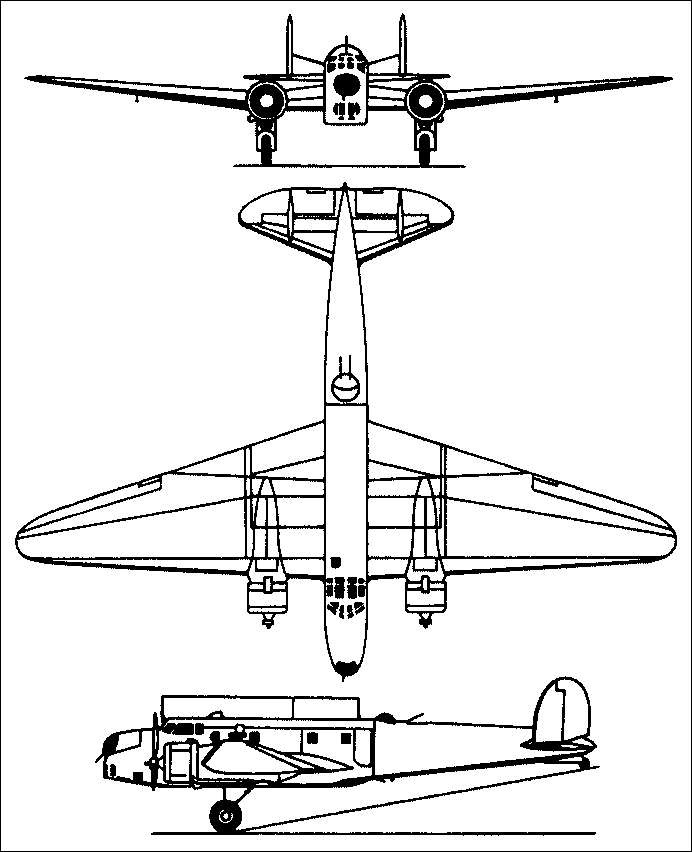


20
reply