|
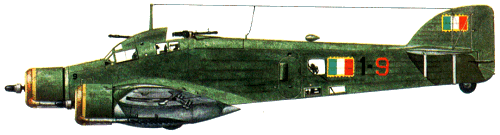
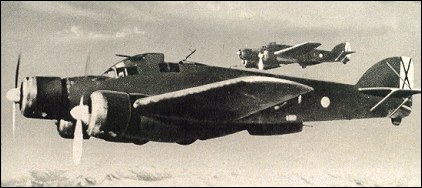
| Developed from an eight-seat commercial
airliner of 1934, the three-engine
Savoia-Marchetti S.M.79 Sparviero
entered service as a conventional
medium bomber with the Regia
Aeronautica in 1937, and served operationally
with the Aviacion del Tercio
alongside the Nationalist forces during
the Spanish Civil War. Also in 1937 the
S.M.79 embarked on trials at Gorizia as
a torpedo bomber, being equipped to
launch a single 450mm naval
torpedo from an offset rack under the
fuselage. The following year trials with
paired torpedoes led to the adoption of
the S.M.79-II aircraft as standard torpedo
bomber equipment. Following Italy's
entry into the war in June 1940,
when Sparvieri (sparrowhawks)
equipped 14 stormi based in Italy, Sicily,
Sardinia and Libya, the aircraft was
constantly in action in the anti-shipping
role, its first action being an attack by
19 S.M.79s of the 9° and 46° Stormi on
French shipping off the Riviera coast
on 13/14 June.
During the invasion of Crete S.M.79s
of the 92° Gruppo and the 28la Squadriglia
were active against Allied shipping
in the Aegean, after which most
aircraft were redeployed to Libya for
operations against British naval forces
and convoys in the Central Mediterranean
as well as the naval base at Malta.
Among the ships of the Royal Navy
sunk by S.M.79s in the Mediterranean
were the destroyers HMS Husky, HMS
Jaguar, HMS Legion, and HMS Southwall,
while the battleship HMS Malaya
and the carriers HMS Indomitable and
HMS Victorious were all struck by torpedoes
launched by the Italian torpedo
bombers; the majority of these
ships were hit during the attacks on the
Operation 'Pedestal' convoy which
sailed with 14 merchant ships and
heavy escort for the relief of Malta.
Among the famous Italian pilots of the
Sparviero were men such as Capitani
Buscaglia, Cimicchi, di Bella and Melley,
An improved version was the
S.M.79-III without the ventral gondola
but with a forward-firing 20mm cannon.
Despite the obvious value of the
S.M.79 to the Axis forces in the
Mediterranean, the aircraft (like so
many Italian aircraft) suffered from
poor servicing facilities, and it was unusual
for even as much as half the available
strength of Sparvieri to be fit for
operations at any given time. Nevertheless
the S.M.79 was acknowledged
as being among the best torpedo aircraft
to serve in the Mediterranean
theatre during World War II.
| MODEL | S.M.79-I |
| CREW | 5 |
| ENGINE | 3 x Alfa Romeo 126 RC.34, 582kW |
| WEIGHTS |
| Take-off weight | 10480 kg | 23105 lb |
| Empty weight | 6800 kg | 14992 lb |
| DIMENSIONS |
| Wingspan | 21.2 m | 70 ft 7 in |
| Length | 15.8 m | 52 ft 10 in |
| Height | 4.3 m | 14 ft 1 in |
| Wing area | 61.7 m2 | 664.13 sq ft |
| PERFORMANCE |
| Max. speed | 430 km/h | 267 mph |
| Ceiling | 6500 m | 21350 ft |
| Range | 1900 km | 1181 miles |
| ARMAMENT | 3 x 12.7mm machine-guns, , 1 x 7.7mm machine-guns, 1250kg of bombs |
 | A three-view drawing (702 x 1139) |
| Bernard Rumbold, e-mail, 07.02.2025 15:53 My father was the clerk of works for Higgs and Hill whilst they were building RAF Middle Wallop in 1940. He told me that the usual Luftwaffe raids were accompanied in a raid one day by several SM79s and CR42s of the Regia Aeronautica. reply | | GrahamClayton, e-mail, 18.02.2024 02:25 The first two SM.79s lost in the Western Desert campaign occurred on the 20th of 1940, during an evening raid against Mersa Matrush by 12 15 Stormo aircraft. One plane was hit by AA fire, before colliding with another SM.79. The first SM.79 hit the ground, killing all the crew, while the second crashed landed near Mersa Matruh, with the crew bring captured. reply |
| Ravenscroft, 24.02.2012 03:48 Interesting this sleeker plane came before the older-looking S.M.81 reply | | Naga, 09.08.2011 21:31 Most likely the Axis, since most Axis-supplied aircraft were flown as part of the insurgency against the British, although I was led to believe the crews were either Italian or German. reply | |
| | Naga, 19.04.2011 21:49 I'm not exactly sure about the Sparviero but some text books call the Pipistrello the Kanguru and vise versa. Heard the Iraqis flew the older model twin-engine variants, which side were they on? reply | | Ben Beekman, e-mail, 19.03.2011 03:13 For those who are interested, You Tube has some interesting newsreel films of Italian aircraft in combat during the war in the Mediterranean. The SM.79 is shown during a torpedo attack, for example. It looks like it was capable of carrying not one but two torpedos! Very interesting films, they show the great enthusiasm and esprit d'corps of the much maligned Italian military. reply | | Barry, 03.12.2010 17:50 The lower profile in the 3 view drawing shows the two engined SM79B which came in various sub-types such as the SM79-JR. This model was powered by two Junkers Jumo 211Da inverted vee 12 liquid cooled engines which were rated at 1,220h.p. It was license built in Romania and served with the Royal Air Forces of Romania on the Eastern Front. reply | | almac, e-mail, 18.09.2010 22:44 I have suspected for many years that the SM79 was one of two tri-motor suspects (the other the JU52)accused by Albania of overflying that Communist Balkan nation in the early 1950s. The Albanians filed several complaints with the United Nations, naming both Italy and Yugoslavia as mounting the operations with three-engined aircraft. An anticommunist agent who was airdropped intothe Albanian mountains in 1950 also said he parachuted out of an Italian trimotor. reply | | antonio valentim, e-mail, 02.01.2010 19:09 E um dos avioes mais bonitos em desiner...e foi uma verdadeira maquina de matar..gostaria de receber mais informacos e fotos deste aviao, fotos do interior da aeronave....e fotos de bat reply | | FRANZ, 11.11.2008 18:37 Its nickname was "Il gobbo maledetto" = "the goddam unchback" reply |
| edik154, 18.07.2007 19:34 You can see it in "Museo Storico dell'Aeronautica Militare", Vigna di Valle - Rome). reply |
|
Do you have any comments?
|
| 
COMPANY
PROFILE
All the World's Rotorcraft
|

 tricci57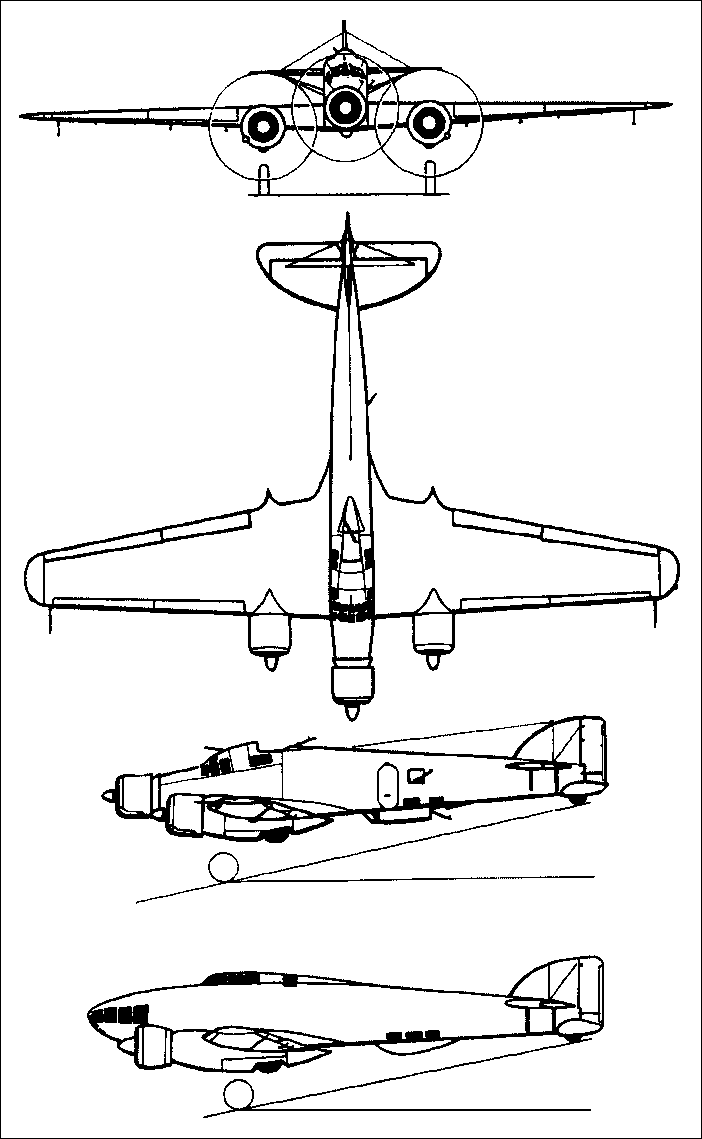


Could you provide the source of this information?
Thanks
reply