|
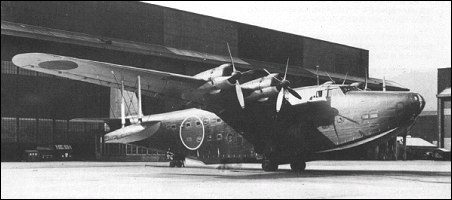
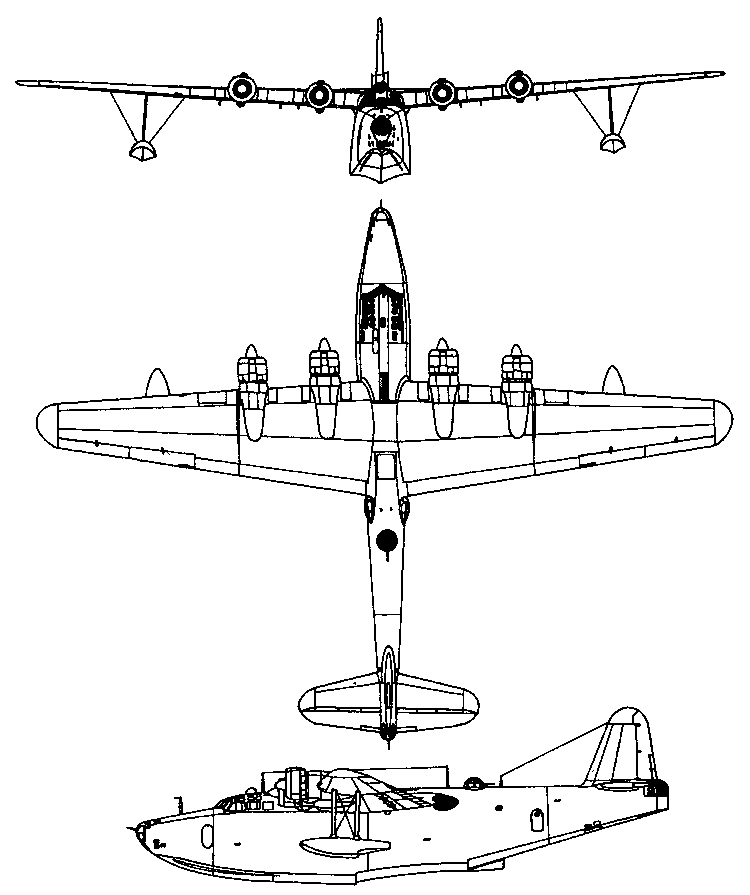
| Although only 167 examples were produced,
the large Kawanishi H8K was
the most outstanding and advanced
flying-boat to achieve production status
during World War II. Designed to
meet a requirement issued in 1938 for a
four-engine maritime reconnaissance
flying-boat superior in all respects to
the British Short Sunderland, the H8K1
prototype was first flown in January
1941, but proved initially to possess
very poor water handling qualities. Extensive
modifications were made and
after successfully completing its service
trials the aircraft was ordered into
production as the Navy Type 2 Flying-
Boat Model 11, powered by four 1141kW Mitsubishsi Kasei 11 or
12 radiais. Armament of these early
aircraft comprised two 20mm cannon
and four 7.7mm machine guns.
With armour protection, selfsealing
fuel tanks and a maximum
speed of 433km/h, the new
flying-boat indeed represented a considerable
advance over the H6K. It
carried out its first operational mission
in March 1942 when two aircraft of the
Yokohama Kokutai set out from Wotje
Atoll in the Marshalls to bomb Oahu
Island (Pearl Harbor), putting down at
French Frigate Shoals to refuel from a
submarine; however, arriving over the
American base, the Japanese crews
found heavy cloud and the raid was
ineffective. Nevertheless as a longrange
maritime reconnaissance aircraft,
the H8K1 (codenamed 'Emily' by
the Allies) with its 7,200km
range, heavy armament and good performance
proved a highly competent
aircraft much respected by the Allies.
The further-improved H8K2, with
1380kW Kasei 22 radials
and armament increased to five 20mm
cannon and four 7.7mm
machine-guns, of which 112 were built
between 1943 and 1945, was unquestionably
the toughest opponent faced
by the Allies in the Pacific. It was also
equipped with ASV radar, being responsible
for the sinking of at least
three American submarines in the
area north of the Philippines during the
last 18 months of the war. Additional to
the maritime reconnaissance version,
36 H8K2-L boats were built in the last
two years of the war, these being
equipped as naval staff and troop
transports capable of accommodating
either 29 staff passengers or 64 fully armed
troops. The progressively deteriorating
war situation for Japan led
to a run-down in production of flying boats
during 1945 in favour of fighters
for home defence, and later versions of
the H8K were accordingly abandoned.
Nevertheless this excellent aircraft
saw considerable service, being flown
by the 14th, 801st, 851st, 1001st, 1021st,
Takuma, Toko, Yokohama and Yokosuka
Chinjufu Kokutais.
| MODEL | H8K2 |
| CREW | 9 |
| ENGINE | 4 x Mitsubishi MK4Q "Kasei-22", 1380kW |
| WEIGHTS |
| Take-off weight | 24500-32500 kg | 54014 - 71651 lb |
| Empty weight | 18380 kg | 40521 lb |
| DIMENSIONS |
| Wingspan | 38 m | 125 ft 8 in |
| Length | 28.13 m | 92 ft 3 in |
| Height | 9.15 m | 30 ft 0 in |
| Wing area | 160 m2 | 1722.22 sq ft |
| PERFORMANCE |
| Max. speed | 460 km/h | 286 mph |
| Cruise speed | 290 km/h | 180 mph |
| Ceiling | 8850 m | 29050 ft |
| Range w/max.fuel | 7050 km | 4381 miles |
| ARMAMENT | 3 x 20mm cannons, 4 x 7.7mm machine-guns, 2 x 800-kg torpedos or 2000kg of bomb |
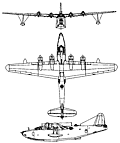 | A three-view drawing (750 x 895) |
| lxbfYeaa, e-mail, 17.01.2026 20:56 20 reply | | ubaTaeCJ, e-mail, 21.02.2025 20:47 20 reply | | lxbfYeaa, e-mail, 14.03.2024 05:51 20 reply | | Mark, e-mail, 18.04.2016 20:50 Can anyone confirm where you can still see 'Emily.' One used to be on display at the Museum of Maritime Science in Tokyo. I can't confirm if it is still there or moved to Kanoya museum way too far south for a Tokyo visit. reply | |
| | Michael lewis, e-mail, 28.02.2016 05:44 The Japanese had a seaplane base on Saipan sat Garapan. In 1977 I spent 6 days on Saipan. A Saipanese guide led us to the seaplane base. We donned our dive gear and waded down the ramp that the Emily's used into the water. In 30 feet of water was an HK8 Emily. The aircraft was in several large pieces but very recognizable as an Emily. The large top turret with the 20 mm cannon was intact as was the cockpit and tail turret. It was a fascinating dive on a piece of history. reply | | Erick Quang, e-mail, 24.05.2014 17:11 It would be quite feaseable that these formidable Japanese flying boats would capable destroying the f4u fighter planes and escape .Emily flying boats in 1942 attacked Northern Australia ,allied fighters including spitfires were sent to intercept these raiders but failed dismally to engage the Emilies .Had the Japanese been able to increase these attacks much of Australia would have had to be evacuated reply | | Naga, 11.04.2012 02:20 Read an account that sounds similar to attacks on Short Sunderland flying boats: an entire flight of F4Us tried to bring a pair of Emilies, lost three planes, and both flying boats survived. Is this true? reply | | wanhua, 21.06.2011 05:42 The aircraft was easily identifiable as an Emily and in sufficiently good condition to allow penetration into the massive hull. reply | | JOSE DOMINGOS TRINTA ALLEN, e-mail, 18.02.2010 13:25 Do you know about a H8K model to download in order to run under FLIGHT SIMULATOR 2004 or COMBAT FLIGHT SIMULATOR 2? Thank you. reply | | Bill Leavens, e-mail, 13.01.2010 06:05 I had the distinct pleasure of diving on an Emily that was sunk off the Dorlon Island seaplane base in February 1944 by US Naval forces during Operation Hailstone. The aircraft was easily identifiable as an Emily and in sufficiently good condition to allow penetration into the massive hull. reply | | LUIZ CAMACHO, e-mail, 26.11.2008 01:36 MISTERS ,
THE EMILY IS BEAUTIFUL ! DOES SOMEONE HAVE PHOTOS OF RADARS , WEAPONS , INTERIOR OF THIS FLYING BOAT ?
RESPECTFULLY,
LUIZ CAMACHO . reply |
|
Do you have any comments?
|
| 
COMPANY
PROFILE
All the World's Rotorcraft
|