|
| In 1941 Kawanishi was still engaged in
design of an attractive float-equipped
fighter, the Kawanishi N1K1, intended
as a naval fighter to support an island hopping
conquest in the Pacific without
dependence on carriers or shore
bases; in due course 98 of these
fighters (Allied reporting name 'Rex')
were produced. However, while their
design was still in progress Kawanishi
undertook a wheel-landing gear version,
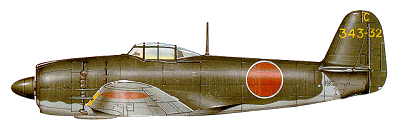
designated the N1K1-J Shiden
(violet lightning). The prototype of the
new fighter was flown on 27 December
1942 powered by the new 18-cylinder
Nakajima Homare radial. Production
got under way in 1943 of the N1K1-J
with Homare 21 radial and an armament
of two 7.7-mm nose
guns and four 20-mm wing cannon (two
of which were carried in underwmg
fairings). Despite being plagued by
constant engine troubles and an inherently weak landing gear, the
Shiden was an excellent aircraft in
combat, proving an equal match for the
Grumman F6F Hellcat; given the reporting
name 'George' by the Allies, it
was widely considered to be one of
Japan's best wartime fighters. Three
other main production versions were
produced: the N1K1-Ja with nose guns
deleted and all cannon mounted inside
the wings; the N1K1-Jb with underwmg
racks for two 250-kg bombs;
and the N1K1-Jc with racks for four
250-kg bombs. A new version,
the N1K2-J, with improved landing
gear, redesigned airframe structure
and cleaner engine cowling,
appeared during the last year of the
war and proved even better than the
N1K1; an instance occurred when a
single Japanese pilot, Warrant Officer
Konsuke Muto, fought off 12 Hellcats,
shooting down four. A total of 1,435 N1K
Shiden landplane fighters was produced,
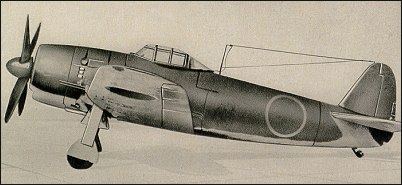
| MODEL | N1K2-J |
| CREW | 1 |
| ENGINE | 1 x Nakajima NK9H "Homare 21", 1365kW |
| WEIGHTS |
| Take-off weight | 4000-4860 kg | 8819 - 10715 lb |
| Empty weight | 2657 kg | 5858 lb |
| DIMENSIONS |
| Wingspan | 12.0 m | 39 ft 4 in |
| Length | 9.35 m | 31 ft 8 in |
| Height | 3.96 m | 13 ft 0 in |
| Wing area | 23.5 m2 | 252.95 sq ft |
| PERFORMANCE |
| Max. speed | 585 km/h | 364 mph |
| Cruise speed | 365 km/h | 227 mph |
| Ceiling | 10760 m | 35300 ft |
| Range | 1700 km | 1056 miles |
| ARMAMENT | 4 x 20mm cannons, 500kg of bombs |
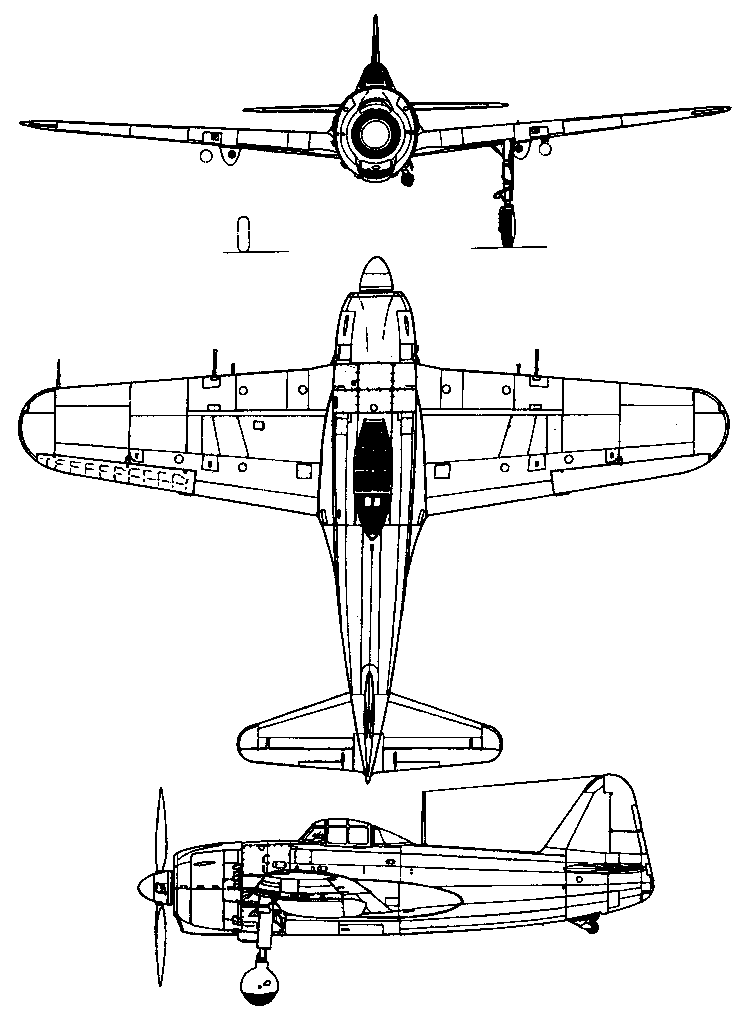
 | A three-view drawing (750 x 1025) |
| lxbfYeaa, e-mail, 14.03.2024 05:52 20 reply |
| Laurelix, e-mail, 05.11.2017 19:36 It's speed wasn't 595km /h and it's rate of climb to 6000m wasn't 7:22
It's speed was roughly 635km /h at 6000m at military power, 656km /h at War Emergency Power. It's rate of climb was roughly 5 minutes 30 seconds to 6000m at military power.
If you look at the Japanese N1K2 manual (created before production N1K2)
Their N1K2 with Ha-45-11 (1800hp) engine achieved 611km /h at 6000m at military Power and 6:20 to 6000m at military Power. Next to it is the Japanese estimate for Ha-45-21 (1990hp) production engine. Their estimate is listed as 644km /h at 6000m at military power and 5:15 to 6000m at military power, but the engine didn't produce as much horsepower as they hoped at 6000m reply | | Ron, e-mail, 29.07.2017 01:57 obviously the dive was 495 mph not 595. My apologies. reply | | Ron, e-mail, 29.07.2017 01:52 The auto-adjusting combat flaps tightened the turn radius much more with up to 30 degrees flaps!
The manual flaps of the float-plane were tested in 1942 with 22% tighter radius from 180m, more than it cut the time (6% from 15.5 sec).
The turn of the N1K floatplane with 19 degrees of flaps @ 174 mph took 14.5 sec. Radius was 140m @ 4.1 g.
Loop with 19 degrees also took 14.5 sec. @ 217 mph. Radius was 250m @ 3.9 g with an ascent of 95m!
The N1K2-J LB6015512 wingtip had been 'slightly adjusted' vs LB 620515 airfoil at wingroot, to improve the very unpleasant stall characteristics of the N1K1-J.
Dive was 595 mph.
It climbed 8,202' /2:07 minutes!
I see where Brown's book gets 4,000 fpm.
369 mph max level speed.
It could roll up to 360 mph. But most aerobatics were best under 320 mph. reply |
|
| | ron, e-mail, 10.07.2017 02:14 The 360 turn for an 8,378 lb N1K2 Shiden was 18 seconds clean.
The combat flaps tightened that radius by around 35% in turns and loops with little speed lost! 11.7 seconds turn time I estimate, give or take. But don't quote me. This is not a small plane. It just turns like one.
Stall dirty was 85 mph, 100 mph clean.
So, with wheels up but flaps down, somewhere in-between those speeds, the port wing stalls without warning.
But if the cowl flaps were open, vibration would give warning.
Stall recovery was poor, as was accelerated stall performance. reply |
| scott, e-mail, 11.07.2016 05:58 there was a Shiden at the Naval Air Museum at naval Air Statoion Pensacola. it's been about 10 years since I was there, but I plan to go back this July. reply | | Ron, e-mail, 23.05.2016 10:54 A Japanese documentary puts the dive speed limit at 495 mph for the Shiden. reply | | ron, e-mail, 25.04.2016 03:52 Perhaps if the Shiden had been carrier borne I don't think the carriers would have been sunk so soon. It could have filled the gap until the MK9 powered A7M2. reply | | Brian Agron, e-mail, 07.12.2015 01:32 I have heard that only four N1K2 fightere now exist. One is in the Smithsonian museum and the other in the National Naval Aviation Museum in Virginia. Do you know where the other two are located and are there more than four that now exist? reply | | Ron, e-mail, 26.09.2015 03:05 Klaatu, Don't forget the earlier N1K1 in larger numbers.
Of course your point is still valid.
I found the N1K2 dove to a speed of 493 mph in one test flight. reply |
| Klaatu83, e-mail, 21.12.2014 15:56 The Shiden holds the rare distinction of being probably the only land-based fighter to have been derived from a seaplane. It was a very formidable fighter but, as was the case with many Japanese WW-II developments, yet another case of too little and too late. For example, it is often emphasized that this fighter was superior to the Grumman F6F Hellcat. However, the Hellcat became operational in 1943 and over 10,000 were produced. In contrast the Shiden-Kai did not become available until late in 1944, only a few hundred were ever completed and few qualified pilots were available to fly them. reply | | Ron, e-mail, 01.11.2014 00:13 From Lance of the Samurai
"343rd Kokutai at Matsuyama in December of 1944. This group contained the best of Japan's remaining fighter pilots which were personally selected for participation. Consisting of three squadrons the 301st 407th and 701st hikotai this fighter unit was Japan's most proficient during the latter months of the war. The effectiveness of this unit was not solely attributable to the skill of its pilots but also resulted from the aircraft which it flew. All three squadrons were equipped with the Kawanishi N1K2-J Shiden-kai ("violet lightning") model 21 fighter. These were fast highly maneuverable and heavily armed fighters. Unlike most earlier Japanese designs these aircraft also provided better armor protection for the pilot. Nicknamed the "George" by the Allies the N1K2-J was derived from an earlier float plane the N1K1 Kyofu. Entering service in late 1944 the George was capable of 365-MPH armed with its four 20-mm wing mounted cannon. In the hands of experienced combat pilots the N1K2-J was the equal to the American-made Hellcats and Corsairs it faced and was vastly superior to the aging Mitsubishi A6M5 Zero. About 400 N1K2-Js would be produced before the end of the war. The efficacy of Genda's idea was demonstrated on March 19 1945 when fifty-four aircraft from the 343rd attacked an unsuspecting and overconfident carrier strike group of F6Fs F4Us and SB2-Cs in the Kure area. In a matter of minutes the American force was shredded by Genda's elite group. The Japanese claimed the destruction of forty-eight U.S. fighters and four dive bombers vs. the loss of only sixteen of its own aircraft. On June 2 1945 a force of twenty-one N1K2-Js attacked a similarly-sized force of Corsairs. In this battle the Japanese claimed 18 victories. It was estimated that during the six month period in which the 343rd operated that a total of 170 American aircraft were downed compared to the loss of 74 Japanese pilots." reply |
| Ron, e-mail, 24.09.2014 16:17 The fuselage was lengthened with the N1K2-J. Perhaps this addressed the autorotation vice of the old N1K1-J.
The tail heaviness was to be corrected by moving the engine forward or adding 2x13.2mm Type 3 MGs in the cowl but not in time for production before the war ended.
Other fighters had combat flaps, but on the Shiden they worked automatically to help avoid stalling in turns.
This ingenious system freed the pilot and gave excellent manueverability. Shidens were coming back to base with popped rivets and wrinkled surfaces after dogfights, often causing even worse results on their opponents airframes in high g combat. They could also use vertical energy tactics equally well.
It's 4 cannons were all Type 99-II high velocity weapons for great harmonized ballistics. If the N1K2-J was made after May, 1945, they were potentially the faster 750 rpm Mk 5 version. reply | | Ron, e-mail, 12.10.2013 10:17 "Following the fall of the Philippines to US forces, the Shiden was met in large numbers during the invasion of Okinawa. A Japanese military communique reported an engagement in which a unit of 34 Shidens met a force of 70 Allied fighters, destroying 20 of them against a loss of only twelve of their number." (- Pilot Friend site)
Obviously this report is from the Japanese side and Allied losses may well have included damaged as well as lost fighters. Still, the fact remains that the 'George' fighters earned the respect of their US adversaries in short order.
It would be good to find out the details of that engagement.
I don't want to assume they were Hellcats that suffered that defeat but experienced Japanese Shiden pilots are known to regard the F6F as a relatively easy kill. If someone has some info I'd be interested.
Some say the improved N1K2-J Kai was a match for the late models of the P-51! If so that would have to be with the exception of high altitude combat.
Only 415 of these were built in addition to the 1,000 plus N1K1-J Shidens before them. reply | |
| | Ron, e-mail, 14.04.2013 06:32 Summary of N1K1-J allied flight test evaluation:
Rudder trim controls were excellent, but elevators were too light and ailerons too heavy (over 360 mph especially), so controls were unbalanced. The stick was too far forward and high for comfort. Controls for flaps, wheels and brakes were not desirable but cockpit vision was good.
Stall was 100 mph clean. If cowl flaps were closed, a serious port wing stall came without warning resulting in accelerated stall and risk of inverted spin.
Dive speed was high. It rolled and turned well for its size, but immelmans were sloppy.
It didn't handle with the confidence inspiring stability of say, a J2M Raiden.
The later N1K2-J Kai was an improvement, addressing many of the faults of the N1K1-J in this flight test. reply | | Ron, e-mail, 28.02.2012 03:13 Gerhard,
I hadn't heard anything about the the cannons on the Shiden jamming. Can you explain? Maybe it's only when fired in turns where all planes with wing cannon had this tendency.
Beyond that, I would appreciate more info. reply |
| Gerhard Frenz Jr., e-mail, 26.02.2012 17:58 One of Japans top 3 fighters. I would say A6M, KI-84, N1K2 in that order, I rate it that way considering all aspects of aircraft mentioned. N1K2 had 3 main problems, weak landing gear, engine problems, and guns prone to jamms. If the plane worked perfectly, it may have been the best Japan produced. Over all I would rate the plane at a 8.5 rating. reply |
| dafag, 21.06.2011 05:44 I can perhaps excuse it with US pilots misidentifying them as Tojos or something but that's embarrassing to me. I simply can't believe that. reply |
| Ron, e-mail, 27.04.2011 10:19 The oft mentioned combat of Muto in the above text begs comment.
It is more accurate to add that he was not alone. N1Ks and F6Fs of comparable numbers were engaged and he did have 4 victories as related but his unit had his back. reply |
| Ron, e-mail, 19.03.2011 23:32 Gus,
It was a great book for it's time. I read it in the 60s. I venture to say I'm not the only one here who already read it.
Today it has its detractors (not directed at Sakai so much as the co-author). This is true of many books from that period, like William Green's series, etc... reply |
|
Do you have any comments?
|
| 
COMPANY
PROFILE
All the World's Rotorcraft
|


 lxbfYeaa

20
reply