|
| The Kawasaki Ki-61-II with the company's
Ha-140 engine was seen as an
interim high-altitude interceptor to
tackle the USAF's Boeing B-29s at their
cruising altitude of some 9000m. However, development of
the Ha-140 as a reliable powerplant
was terminated finally when the
Akashi factory where the engine was
built was destroyed during an air raid.
With the requirement becoming daily
more urgent, Kawasaki was instructed
to convert the 275 Ki-61-II airframes
gathering dust in the Kagamigahara
factory with alternative powerplant.
No other similar engine was available
and adaptation of the slender fuselage
of the Ki-61 to allow installation of a
large-diameter radial engine at first
appeared impractical. However,
Kawasaki's design team converted
three airframes to serve as prototypes,
installing a Mitsubishi Ha-112-II engine
which had the same power output as
the unreliable Ha-140. When the first of
these was flown, on 1 February 1945,
Kawasaki discovered that it had a first class
fighter, one that some commentators
have described as Japan's premier
fighter aircraft of the Pacific war.
By the end of May 1945 all of the remaining
272 Ki-61 airframes had been
converted to the new configuration,
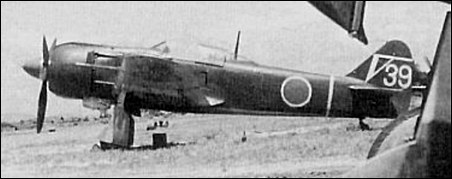
entering service as the Army Type 5
Fighter Model 1A, which was identified
by the company as the Kawasaki
Ki-100-Ia.
With the Ki-100 proving such a success,
it was decided to initiate production
of this aircraft, the resulting Ki-100-Ib differing only by having the cutdown
rear fuselage and all-round-view
canopy that had been designed for the
proposed Ki-61-III. A total of 99 of this
version was built before production
was brought to an end by the growing
weight of USAAF air attacks. A more
effective version had been planned, to
be powered by the Mitsubishi Ha-112-
Ilru engine which incorporated a turbocharger
to improve high-altitude
performance, but only three of these
Ki-100-II prototypes had been built
and flown by the end of the war.
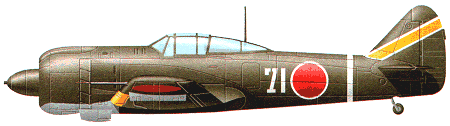
| MODEL | Ki-100-I |
| CREW | 1 |
| ENGINE | 2 x Mitsubishi Ha-112-II, 1125kW |
| WEIGHTS |
| Take-off weight | 3495 kg | 7705 lb |
| Empty weight | 2525 kg | 5567 lb |
| DIMENSIONS |
| Wingspan | 12 m | 39 ft 4 in |
| Length | 8.82 m | 29 ft 11 in |
| Height | 3.75 m | 12 ft 4 in |
| Wing area | 20 m2 | 215.28 sq ft |
| PERFORMANCE |
| Max. speed | 580 km/h | 360 mph |
| Cruise speed | 400 km/h | 249 mph |
| Ceiling | 11000 m | 36100 ft |
| Range w/max.fuel | 2200 km | 1367 miles |
| Range w/max payload | 1400 km | 870 miles |
| ARMAMENT | 2 x 20mm cannons, 2 x 12.7mm machine-guns |
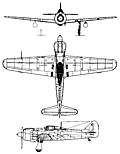 | A three-view drawing (752 x 963) |
| lxbfYeaa, e-mail, 07.11.2025 00:58 20 reply | | ubaTaeCJ, e-mail, 21.02.2025 20:53 20 reply | | ubaTaeCJ, e-mail, 21.02.2025 17:14 20 reply |
| Jim McCurdy, e-mail, 27.03.2023 00:06 There were reliability problems around due to having to draft unskilled workers but with everything right the Kinsei was solid but didn't have that remarkable power output that the High RPM, High compression Homare Ha-45 got out of only 2187 cubic inches with water methanol injection. That's on a par with any single stage supercharged P&W 2800 The first Ki 84 that we got from Clark Feild in the Philippines is where that 427 mph comes from as tested by us on water methanol injection. We also are on record as assessing the Ki 84 as on a performance level with the P51D except at high altitude. As fond as I am of the Ki 100 and it's advantages I don't think speed in level flight is going to be one of them. That insane dive speed should pull away from a P51D alright but if the Ki 100 manages not to compress and the pilot pulls out of that he is eventually going to lose energy to that P 51D in any level run for it. I'm guessing he'd want to go vertical while out of the range of those Brownings. reply | |
| | Ron, e-mail, 07.04.2020 10:05 4.8 was the powerloading for the Ki 100, not 5.1 lbs per horse. I used the 1620 WEP hp of the Ha-112 II engine. This improves the acceleration even more vs the Ki 61-II, not to mention the F6F-5 at 5.7 ...etc. reply | | ron, e-mail, 11.08.2017 00:52 The Mustang had inferior dive characteristics to the
Ki 100.
The Type 5 could hold off 2 P-51s due to it's agility.
It could do aerobatics at speeds above 400 mph!
How many Japanese fighters could match that? reply |
| Ron, e-mail, 24.12.2015 13:46 3 fighters installed the Ha-112-II engine at the end of the war. The Ki 100 is the one that saw combat.
The A6M8 was meant to be the A6M5 but red tape killed it then. Mid-war is when it should have debuted. Failing that, the Ki 100 would have benefited more at that time. The Ki 100 had more armor than other fighters of WW2 but still managed to out-dogfight all comers. It did not have the flutter in a dive like the Ki 84 over 491 mph. So it could compete vertically or horizontally with the Allies. The A6M8 couldn't hope to dive that fast.
The 3rd fighter was the Ki 116. The Ki 84 tried the reliable Ha-112 as an alternative to the Ha-45. The result was the Ki 116 prototype. In one respect it stood out. I was so much faster than the other 2. 385 mph! Also, it was within a 100 lbs of the A6M8 for Zero-like agility at the same time. Curiously, the climb rate remained like the Ki 100. Still, it must have closed the gap with the Type 5 as a dogfighter. reply | | Ron, e-mail, 13.07.2015 02:58 From 3 /1945 272 of the 365 mph Ki 100-Ia Type 5s had resulted from authorities outside Kawasaki, forcing them to stop using the inline engine and use a reliable Radial on the Tony.
It's tail controls thus lost some effectiveness by the width of the motor and the wake of it's slipstream, but the biggest problem was gone now.
6 /1945 began production of 118 Ki 100-Ib Type 5s with bubble top. This cost a little speed at 360 mph and climb to 5Km /6 min.
If new pilots didn't stray, they had a fighting chance now.
After Okinawa fell, US and soon RNAF fighters flooded the skies of Japan. reply | | Ron, e-mail, 07.11.2014 09:58 This fighter is a top contender from Japan because it has better success against both B-29s and fighters.
Even though it had some bugs to work out, it had a reliable engine.
What it lacked in top level speed, it had in dive and pullout zoom speed retention.
The J2M3 was also a good interceptor but only the J2M5 was reliable and they were only one tenth the number of Ki 100s. Besides, the Raiden's occasional random disintegration was unsolved.
The unreliable Shiden Kai and Ki 84 were not so good up high. The Shiden required experience to control.
The Ki 84 was faster and in good quantity but more sluggish than the Ki 100.
The Ki 61-II shines at high altitude but has the most unreliable engine of the lot.
Also, not many built. Could lose a few pounds too.
The Ki 44 was reliable and in some quantity but could barely intercept B-29s.
Most were armed for dueling fighters. Too few had 20mm cannons.
P-51s could turn with it.
It's relatively less protected than the late-war fighters mentioned already.
So, if the robust Ki 100 had come earlier for more production and utilised acceleration and dive to compensate for modest top speed, it can compete.
It's also a pilot's plane unlike the others. reply | | Ron, e-mail, 01.10.2014 09:49 The Nate was in such strong numbers vs the Navy's Claude. It saw more combat after Pearl Harbor until the Ki 43 took over. The Zero started with 400 vs 40 Ki 43s, so the Claude was replaced much sooner.
If only the Ki 43 could have 4 guns like theZero.
The Army didn't suffer the loss of so many veteran pilots like the Navy did at Midway, so when Nakajima kept up with the Americans with the Ki 44 and Ki 84, the Ki 43 remained their favorite....in production for the duration.
They should have at least added a cannon or two around the Oscar's cowl, mid-war.
When the Ki 61 stumbled with engine issues in the tropics, the reliable Ki 44 should have picked up the slack in New Guinea ...etc. It deserved more production. How many Tony flights with losses of 2 /3 their number non-combat, do you need to make a change?
The other new fighters were also unreliable like the Ki 61, Army and Navy. So the competant Ki 44 in mass quantities would have been timely. True, it had short legs but with drop tanks the Tojo was ok. I like the bomber killer Ki 44-IIc with 4 Ho-3 high velocity 20mm cannons. Slow RoF but the heaviest 20mm shell in the war! They were a match for the B-29.
Of course, had the Kawasaki team not been so stubborn for the inline motor, and contemplated a mid-war Ki 100, that would have been a reliable world-beater in the right time-frame. Meantime the Ki 84, J2M, and N1K engines could have matured. As it was, the hoped for Ki 61-II proved worse than the first Tony in reliability.
Can you imagine say, 3,000 - 5,000 Ki 100s!
Just a tenth that number made quite an impression in 1945! reply | | Ron, e-mail, 05.03.2014 05:16 I'd like to see more about the type 5 Ki 100.
I know it is easy to dismiss for its slow level speed. However its terminal dive speed is 528 mph vs 496 mph for the fleet footed type 4 Ki 84 Frank! (Although the Hayate has the better dive acceleration).
I believe this is due to its slight coke bottle fuselage and stronger build as well as high speed stability advantage.
If the Kawasaki Goshikisen strayed from level flight during combat, this slow handicap was easily eclipsed by acceleration, turn ...etc.
If the Ki 100 engaged combat after pulling out of a dive the disadvantage is erased. Do you agree?
Tell us more about its boost capability per altitude (610 kph).
I know about the Japanese mock dogfights with these 2 fighters with the resulting opinion that the Ki 100 was the champion. Can you tell us something about that? I understand the post-war F8F Bearcat was the first to match it in a mock dogfight.
The Ha 112 bomber engine was around for years, imagine if it had been utilized earlier by fighters when its level speed was more competitive (the Raiden for example had an unreliable engine of similar hp. This may have made it more reliable untill the J2M5 at least. My guess is the streamlined cowl would not be wide enough). Instead the late war fighters are virtually all unreliable under the hood except for the Ki 100 and maybe the Ki 44! reply |
| Ron, e-mail, 12.10.2013 11:07 1 on 1 how would I rank this fighter?
Among Japanese fighters the Ki 100 is the most reliable and best at high altitude combat all around. Just slow but fastest in sustained dive speed. Probably the toughest too.
Then the J2M5. Also reliable finally. Fast too.
However only about 34 made.
Next I would say the N1K2-J Kai Shiden 21. About as good as the Ki 100 but not up high.
Still unreliable powerplant.
The Ki 84 may equal the Shiden Kai because of it's speed and quantity makes up for any handling that less superlative.
I shares the same kind of engine trouble and high altitude limitations.
Then come the J2M3 unfortunately unreliable but more (a few hundred) produced than the J2M5 which isn't saying much.
Next the Ki 61-II Hien Kai. Good up hi but unreliable power.
Fast and tough but limited numbers.
Then the N1K1-J Shiden 11. Tended to lose control if stalled. Otherwise a great dogfighter. But alas, unreliable and poor at high altitude.
Then the A6M Zero, Ki 44 Shoki, Ki 61-I Hien, and Ki 43-III Hayabusa. reply | | Ron, e-mail, 17.03.2013 03:44 I found a couple of comments lately.
First that the Type 5 (Ki 100) was thus compared to the unreliable Ki 61-II: "It had a much better rate of climb than the Ki-61-II and was much more maneuvrable at high altitude."
This is interesting since potentially the Ki 61-II sparkles up high if it's a good one.
The other comparison I ran across was that the Ki 100 Type 5 outmaneuvered any contemporary US fighter and matched the post-war F8F Bearcat! There was no mention of altitude so I assume the post-war testing was maybe 10,000' as typical.
I know the Ki 100 lost some performance with altitude but not as sharply as other Japanese fighters, or so I've read.
In combat with P-51Ds they Ki 100s would end up down low, even successfully diving away.
Some units were capable of trading losses equally even though heavily outnumbered. Attrition was very high anyway. The 57 plane 111th regiment lost almost 100 Type 5s in a few months time (150 fighters were supplied them in total). reply | | Barry, 02.03.2012 16:44 There was one at the RAF museum in Hendon, London, but this is currently at the museum at Cosworth undergoing refurbishment. reply | |
| | Ron, e-mail, 25.02.2012 04:29 When Japanese pilots of the Akeno school tested the Goshikisen against the Hayate, it could hold it's own even when out-numbered 3 to 1 in mock combat!
That doesn't show up in the spec sheet.
Only so much can be conveyed on paper where the Ki84 looks so good. The Nakajima only had the advantage of top level speed and dive rate up to 496 mph (the Ki100 could then keep diving another 30+ mph faster, however) due to it's streamlined design but the Kawasaki was stronger and more stable at terminal speeds (the Ki 84 also had more trouble with aerobatics especially at high speed than the Ki 100 with it's lighter controls as well as better climbing turns).
Still, 3 to 1 says a lot (when they rotated planes and all were among the best pilots). reply | | Mike Wolf, e-mail, 22.12.2011 00:33 The Japanese used the airframes from the KI-61's, whose engines were totally unreliable, and had plans from Germany sent to them on their Focke Wulf 190A fighters which incorporated a BMW 801 radial onto a narrow fuselage. When the Japanese used this technique they found that with the Kawasaki Ha 140 engine giving 1500 horsepower, they had a real thoroughbred on their hands. True the cowling was large, but the radiator was offset and narrowed and with the narrowness of the fuselage along with a narrow to wide spinner cap the aerodynamics was much improved. The K-100 was easy to fly and gave even the most novice pilot a fighting chance. Problem with the KI-84 considered by many to be the best Army fighter of the war was that she suffered from fuel line clogs and ruptures and since as the war was turning badly much fuel the Japanese used was unrefined, as evident by the Carrier Taiho tragedy, the true beauty of both fighters couldn't be appreciated until they were bought to the states and tested with Imperial fuel. In these post war tests the Ki-84 was 3 mph faster than the P-51 , 17 mph than the P-47 and 22 mph faster than the P-40. This considered that pilot armor and self sealing tanks were used the KI-84 was judged the best Japanese army fighter and the KI-100 the best Jap fighter of the entire conflict. Amazing feat for a aeronautical industry being bombed daily as the Japanese were building these fighters in underground factories right till the end of the war! reply |
| Mike Wolf, e-mail, 21.12.2011 23:38 The Japanese used the airframes from the KI-61's, whose engines were totally unreliable, and had plans from Germany sent to them on their Focke Wulf 190A fighters which incorporated a BMW 801 radial onto a narrow fuselage. When the Japanese used this technique they found that with the Kawasaki Ha 140 engine giving 1500 horsepower, they had a real thoroughbred on their hands. True the cowling was large, but the radiator was offset and narrowed and with the narrowness of the fuselage along with a narrow to wide spinner cap the aerodynamics was much improved. The K-100 was easy to fly and gave even the most novice pilot a fighting chance. Problem with the KI-84 considered by many to be the best Army fighter of the war was that she suffered from fuel line clogs and ruptures and since as the war was turning badly much fuel the Japanese used was unrefined, as evident by the Carrier Taiho tragedy, the true beauty of both fighters couldn't be appreciated until they were bought to the states and tested with Imperial fuel. In these post war tests the Ki-84 was 3 mph faster than the P-51 , 17 mph than the P-47 and 22 mph faster than the P-40. This considered that pilot armor and self sealing tanks were used the KI-84 was judged the best Japanese army fighter and the KI-100 the best Jap fighter of the entire conflict. Amazing feat for a aeronautical industry being bombed daily as the Japanese were building these fighters in underground factories right till the end of the war! reply |
| Ron, e-mail, 05.07.2011 08:11 Additional note from the Akeno flying school:
The ascendency in the turn and climb was the edge over the Ki 84. How this could be is puzzling because the climb per minute goes to the Frank (unless it suddenly lost power to the unreliable engine). The straight leading edge wing design helps in the turn for the Ki 84 also. But the Ki 100 was less work to trim for the pilot and was much more stable. Though less powerful, it may have had better roll and reflexes in the first seconds of a climb or turn I guess.
In addition to losing the 6-700 lbs in trading engines of equal power, it also shed the ballast in the tail. So the Tony was feeling it's oats now and the pilot could be confident in the reliable motor. reply | | huawuke, 20.06.2011 06:42 From what I have read to date, roll rate, acceleration and high altitude performance are what set this Kawasaki apart from the other Japanese fighters. reply | | bombardier, e-mail, 24.05.2011 21:06 Relatively slow for the period but manouverable,reliable and easy to fly reply |
|
Do you have any comments?
|
| 
COMPANY
PROFILE
All the World's Rotorcraft
|


 Ron
Ron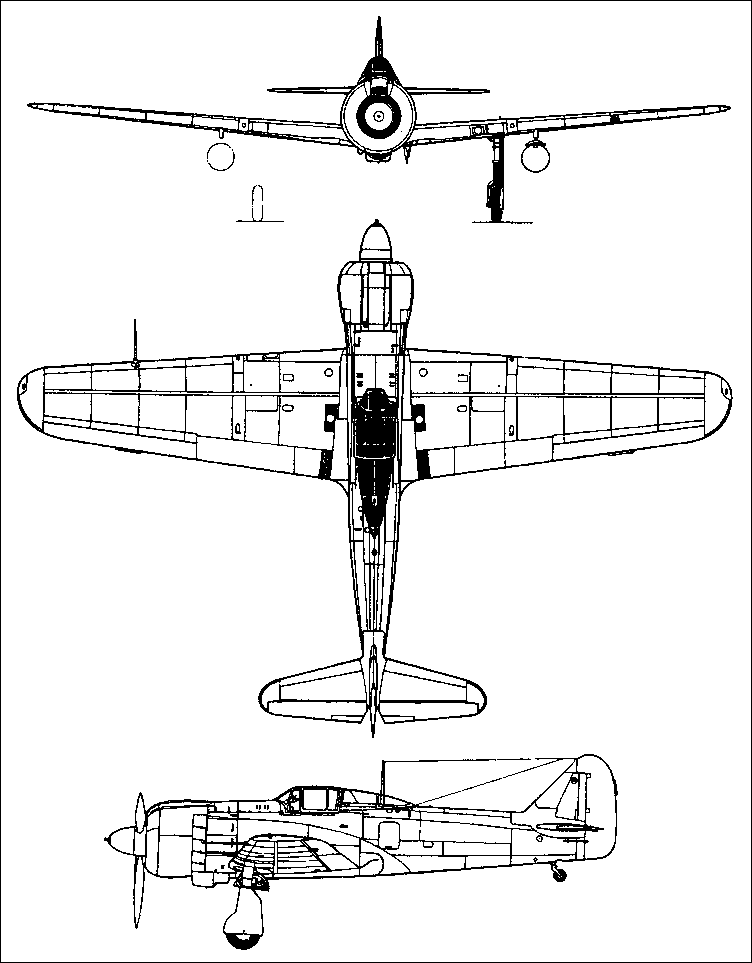


20
reply