|
| Imperial Japanese Army aircraft confronted
by the Soviet-built Tupolev SB-2 bomber, providing support for the
Chinese during 1937, were rudely surprised
by its capability, its maximum
speed being such that Japanese army
fighter aircraft were virtually unable to
intercept it. Almost at once the army
instructed Kawasaki to begin the design
of a twin-engine light bomber of
even better capability, specifying a
maximum speed of about 485km/h. Work on what was to become
known as the Kawasaki Ki-48 began
in January 1938, the result being a
cantilever mid-wing monoplane with
conventional tail unit, retractable tailwheel
landing gear and, in the type's
prototype form, two 708kW Nakajima Ha-25 radial engines
mounted in nacelles at the wing leading
edges. The fuselage provided
accommodation for a crew of four (the
bombardier, navigator and radiooperator
each doubling as gunners)
and incorporated an internal bomb
bay.
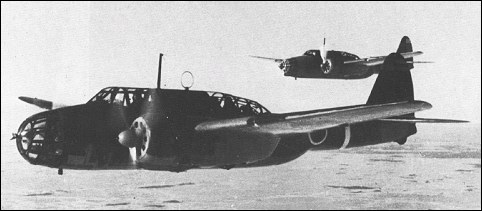
Ki-48s entered service in the summer
of 1940, becoming operational in
China during the autumn of that year.
In China their speed gave the Ki-48s
almost complete immunity from
enemy defences, but their deployment
against Allied aircraft at the beginning
of the Pacific war revealed that
their superior performance was illusory.
Codenamed 'Lily' by the Allies,
this initial production version had a
number of deficiencies for the different
kind of operations then required,
and it was fortunate for the Japanese
army that an improved version was
already under development. This had
the company designation Ki-48-II and
differed from the earlier model by introducing
a slightly lengthened fuselage,
protected fuel tanks, armour protection
for the crew, increased bombload
and more powerful Nakajima Ha-
115 engines.
Unfortunately for the Japanese army,
when the Ki-48-II was introduced into
operational service its speed was still
too low and its defensive armament
inadequate. Attempts to increase
armament merely upped the overall
weight and speed suffered proportionately:
it was clear by the summer
of 1944 that the day of the Ki-48 had
passed, and in October it was declared
obsolescent.
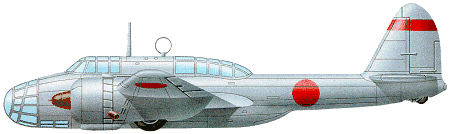
| MODEL | Ki-48-IIb |
| CREW | 4 |
| ENGINE | 2 x Nakajima Ha-115, 850kW |
| WEIGHTS |
| Take-off weight | 6500-6750 kg | 14330 - 14881 lb |
| Empty weight | 4550 kg | 10031 lb |
| DIMENSIONS |
| Wingspan | 17.45 m | 57 ft 3 in |
| Length | 12.75 m | 42 ft 10 in |
| Height | 3.8 m | 12 ft 6 in |
| Wing area | 40 m2 | 430.56 sq ft |
| PERFORMANCE |
| Max. speed | 505 km/h | 314 mph |
| Ceiling | 10100 m | 33150 ft |
| Range | 2050 km | 1274 miles |
| Range w/max.fuel | 2400 km | 1491 miles |
| ARMAMENT | 3 x 7.7mm machine-guns, 800kg of bombs |
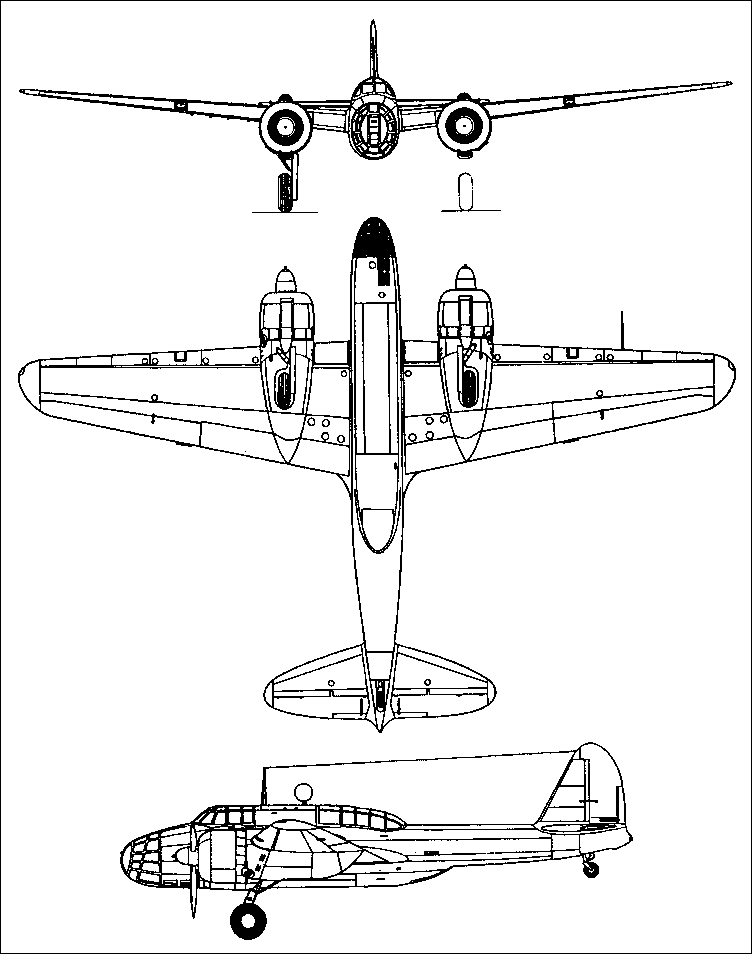
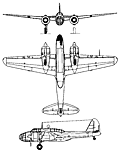 | A three-view drawing (752 x 954) |
| ubaTaeCJ, e-mail, 21.02.2025 16:19 20 reply | | Klaatu83, e-mail, 24.01.2021 17:22 This looks a bit like a Douglas A-20 Havoc but was actually designed as a counterpart to the Soviet Union's Tupolev SB-2, a high-speed, light-bomber. Unfortunately for the designers of the Ki-48, the SB-2 was a 1930s design that was already pretty much obsolete by the time WW-II began. Like its' British and Japanese counterparts, the Bristol Blenheim and Kawasaki Ki-48, the SB-2 continued to be used operationally during WW-II. All three types were out of date and suffered heavy losses. reply | | paul bonnici, e-mail, 07.06.2012 09:47 light green reply | | Angela, 20.06.2011 06:44 He builds models and his interests include japanese planes in world war 2. This info seems hard to come by. Can anyone help. reply |
|
| | y.k, e-mail, 03.01.2011 08:36 isas.ac.jp /ISASnews /No.239 /GIF239 /ken-kyu-z56.jpg reply | | Bill McKinley, e-mail, 14.12.2010 22:49 Where was the I-1 Missile attached to this plane? reply | | DebtMan, e-mail, 01.10.2010 06:55 The Ki-48 was a unautorized copy of the Tupolev SB reply | | Philip Venson, e-mail, 30.01.2010 02:06 Mrs.Mitchell, my money would be on a light khaki color, as that is what many other Japanese aircraft's interior were painted in. ANother guess would be "Mitsubishi Grey". reply | | VANHOVE, e-mail, 30.12.2009 17:48 GOOD NEWS TO HAVE NOW THIS PLANE AT A DECENT SCALE !!
as for the interior color I think it is the same shades as the Hien reply | | CHINESE, 14.06.2009 19:41 THE CHINESES WAGED THE BATTLES TO DESTROY THE EVIL FORCE OF THE JAPS! reply | | lesley mitchell, e-mail, 03.03.2008 12:01 Can anyone tell me the exact shade of the interior colours of the Kawasaki Ki 48 'Lily' Bomber. My husband is keen to find out this information. He builds models and his interests include japanese planes in world war 2. This info seems hard to come by. Can anyone help? reply |
|
Do you have any comments?
|
| 
COMPANY
PROFILE
All the World's Rotorcraft
|




20
reply