|
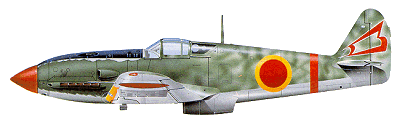
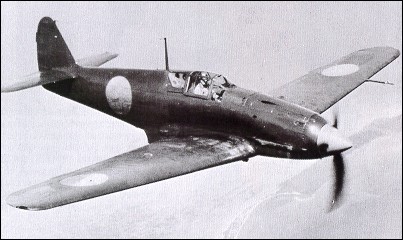
| Sometimes described as a cross between
a Messerschmitt Bf 109 and a
North American P-51 Mustang, the
Kawasaki Ki-61 certainly had the distinctive
nose shape associated with an
inverted V-12 inline engine, the Kawasaki
Ha-40 being in effect a Daimler-
Benz DB 601A built under licence. The
Ki-61's designers, Takeo Doi and Shin
Owada, had moreover worked under
the German Richard Vogt, In December
1940 they were instructed to go
ahead with the Ki-61, and one year
later the prototype was flown. The first
production Ki-61-I fighters were deployed
operationally in April 1943
when the 68th and 78th Sentais arrived
in New Guinea. Named Hien (swallow)
in service (and codenamed 'Tony' by
the Allies), the new aircraft proved
popular with its pilots, being unusually
well-armed and armoured, and the
type was at least a match for opposing
American fighters. Its armament (of
four 12.7-mm machine-guns)
proved inadequate to knock down
enemy bombers, however, and the Ki-
61-I KAIc was introduced with a pair of
20-mm cannon in the nose, these being
replaced in a small number of Ki-61- I
KAId fighters by two 30-mm cannon.
The Ki-61- I and Ki-61-I KAI remained
in production until 1945, but in 1944
they were joined in service by the Ki-
61-II with more powerful Kawasaki Ha-
140 engine (producing 1119-kW); with a top speed of 610km/h
this would have been an excellent
fighter but for constant engine
problems; yet when fully serviceable
the Ki-61-II was one of the few
Japanese fighters fully able to combat
the Boeing B-29 at its normal operating
altitude, particularly when armed with
four 20-mm cannon. Excluding prototypes
and development aircraft, production
totalled 1,380 Ki-61-Is, 1,274 Ki-
61-I KAIs and 374 Ki-61-Ils.
| MODEL | Ki-61-II KAIa |
| CREW | 1 |
| ENGINE | 1 x Kawasaki Ha-140, 1125kW |
| WEIGHTS |
| Take-off weight | 3780-3825 kg | 8334 - 8433 lb |
| Empty weight | 2840 kg | 6261 lb |
| DIMENSIONS |
| Wingspan | 12 m | 39 ft 4 in |
| Length | 9.16 m | 30 ft 1 in |
| Height | 3.7 m | 12 ft 2 in |
| Wing area | 20 m2 | 215.28 sq ft |
| PERFORMANCE |
| Max. speed | 610 km/h | 379 mph |
| Cruise speed | 400 km/h | 249 mph |
| Ceiling | 11000 m | 36100 ft |
| Range w/max.fuel | 1600 km | 994 miles |
| Range w/max payload | 1100 km | 684 miles |
| ARMAMENT | 2 x 20mm cannons, 2 x 12.7mm machine-guns, 2 x 250kg bombs |
 | A three-view drawing (1650 x 1183) |
| lxbfYeaa, e-mail, 17.01.2026 19:47 20 reply | | lxbfYeaa, e-mail, 17.01.2026 19:44 20 reply | | lxbfYeaa, e-mail, 17.01.2026 19:44 20 reply | | ubaTaeCJ, e-mail, 21.02.2025 16:22 20 reply |
|
| | Ron, e-mail, 10.09.2017 06:50 Some say Ichikawa had his Ki 61-I'd Kai with the 30mm Ho-155-I cannons in the cowl with successintercepting B-29s. If true, the only problem would be the 58 r /m or so rate of fire each. The already slow rate of fire at 120 r /m would be cut by over half to synchronize through the prop. But at least it would be accurate vs the wing mounted 30s that damaged the spar with it's recoil. Putting the 20mm Ho-5s in the wings instead works fine and is very fast firing at 850 r /m each. But still better would be putting only one 30mm cannon in the hub fire half the weight of 2 and still the rate of fire of 2. This cuts out the weight of the interrupt or gear too.
Lighter on it's feet but with the same punch, his Hien would've been a better dogfight as well as B-29 slayer.
Then there is the fast and light 30mm Ho-155-II in 1944.
It did 600 r /m! The perfect motor-cannon for the 1944 Ki 61-II. reply |
| ron, e-mail, 16.08.2017 03:18 I like the fact that the Japanese at least had the potential to overcome the main faults of the Ki 61-I.
The 20mm Mausers cannons could've been in the cowl or wing-roots at 630 r /m RoF. Their drawback was only an OK 800-850m firing-range. The Mineshell was their plus, in addition to the synchronized RoF advantage vs Browning-based Japanese cowl guns and cannons.
Japanese copies could keep Japanese fighters in good supply beyond the imported batch.
The 30mm Ho-155 could've been in the hub with good 900m range vs the faster 30mm MK 108 cannon.
This suite of 3 cannons would leave the wings unweighted for agility but still great firepower.
The speed /climb penalty could be more than offset with triple ventral rocket boosters like the Judy D4Y4 used!
The wingloading penalty could be addressed with the automatic combat flaps used on the N1K1 for a 30% tighter turn radius!
Then, the unreliable engine could've been beefed up. If chromium was not available, why not add more supports with slider-bearings so the drive shaft wouldn't fail around 200 hours run time, for example...etc?
The Ki 61-II could entertain the bigger DB 603 or Jumo 213 based engine and the long-range 37mm Ho-204 hub-cannon or fast 30mm Ho-155-II with the Mauser-based 20mm cannons.
Of course the bubble canopy for this new Tony would've been sweet.
The Hydraulics and electronics would've needed to be addressed too, perhaps by crossing over from IJA to IJN suppliers if necessary.
The Ta 152H was received by sub in Japan. The Ki 61-II Tony could've been effectively the equivalent, potentially. reply | | ron, e-mail, 10.08.2017 03:46 The 20mm Mauser wing cannons hurt the turn radius but putting the Ho-5 cannons in the cowl tightened the radius again. Electric gun fuses were prone to blow at inopportune times.
Against the USN F6F the Tony pilots adopted hit-and-run tactics with relative effectiveness.
Against B-29s, the Tony would be stripped of armor and perhaps all but one cannon for better altitude.
The Tony was prone to stall on take-off, landing, and pullout. The Ki 61-II prototype still had a very weak crankshaft and an unreliable engine. The revised airframe was weak and the new wing was rejected.
The Ki 61-II had frequent failures of main bearings and superchargers, oil and coolant systems. But when working right, it held it's own if well piloted. reply |
| ron, e-mail, 04.07.2017 01:12 Fighter Gun kg Wt R /S GP kg /s M /V m Range GP /Gun Wt
_________________________________________________________
Ki 61-Ib Kai 130 39 471 3.228 775 /727 900 /850 3.6
Ki 61-Ic Kai 120 43 285 2.324 775 /820 900 2.4
Ki 61-IIa 120 43 261 2.324 775 /703 900 /600 2.2
Ki 61-IIbKai 148 41 437 4.040 703 600 3
These are my estimates. Take with a grain of salt.
These don't include Tony fighters without 20mm cannons.
The Ki 61-Ia and -Ib with only 7.7mm and 12.7mm MGs aren't in this comparison.
As a B-29 interceptor, the 20mm cannon was key in the Tony. The first is with the Mauser MG 151 /20; next version has the cowl Ho-5 twins; then the same but after the Ho-5 was degraded; finally the Ho-5 quartet.
If you wonder about the discrepancy between the WoF and the GP of the Maser version, the potent HE /M shell is included in the ammo belt in my opinion.
But remember, these were in limited supply and may have been gone by the time the B-29s arrived.
These Tonys did not utilize hub-cannons like their German brother, the Bf 109 Gustav with mostly 30mm cannons in the hub. These were the very short range 30mm MK 108 cannon. The IJA had a better one, the 30mm Ho-155 cannon. This was called for when Ki 61s were intercepting B-29s, which the Gustav never had to face.
No other Japanese fighter could have a motor-cannon, only the inline engine Tony (and fighter version of the inline D4Y2-S Judy perhaps). It would be curious to know how such a Ki 61 would've done in WW2.
The Ki 61-Id had this 30mm cannon, but only in the wings. Thus accuracy was non-existant and the wingspar cracked from the recoil, so these were sidelined at training bases. Putting it in the spinner would've avoided these drawbacks. Thousands of Tonys were available to be converted to dragon slayers. They would only need 2 Ho-5 cannons to compliment it. 118-124kg for gun weight. The Ho-155-II was only 44kg and about as fast as the MK 108!
Both versions of the Ho-155 had more than twice the firing range at 900m vs 365-400m! And the MK 108 was also more prone to jam!! reply |
| ron, e-mail, 29.06.2017 03:21 I like the idea of a motor-cannon in the Ki 61.
The 30mm Ho-155 cannon outperforms the MK108 in the nose of 17,000 Bf 109 Gustavs in the Luftwaffe.
The Ha-40 and 140 should accommodate it since the DB 601 is the parent engine. (It is interesting that the RLM considered the DB 605 a sick engine) Anyway, the Gustav made heavy use of motor-cannons.
Does anyone know why the Tony didn't use it? reply | | ron, e-mail, 15.06.2017 08:38 1. The Italian versions of the DB 601 and 605 should've been built in Japan instead of the Japanese versions which proved so much more unreliable.
2. The Ki 61 was lacking the advantage of a motor-cannon. Why? The Bf 109 and Fiat G.55 had motor-cannons with basically the same inline engine. Perhaps over 80,000 fighters of WW2 utilized this advantage. But not Japan!
P-39s, P-63s, MiGs, LaGGs, Yaks, Reggianes, Fiats, Bf 109s, Fw 190Ds, and Ta 152s had hub-guns and cannons firing through the spinner.
The best 20mm, 30mm, and 37mm cannons of late-WW2 were arguably Japanese. Perfect as world-class motor-cannons. The 400 r /m 37mm Ho-204 was the fastest 37mm and out-ranged the defensive fire of US bombers.
The 30mm Ho-155-II was lightest at 44kg and fast at 600 r /m and had good range. Everyone knows about the fastest 20mm cannon of the war, the 850 r /m Ho-5. The IJN had good ones too.
These 2 changes could've made the Tony so much better.
Of course this is the advantage of hindsight.
As it was, the biggest production version of the Ki 61s only had 4x12.7mm HMGs, and all versions were unreliably powered! It's no wonder the Tony had the worst loss ratio vs the USN (28 /1) of all Japanese fighters in the last year of WW2!
On the other hand it was a good B-29 interceptor. reply | | ron, e-mail, 21.02.2016 08:03 About 30 Ki 61-IIKai were produced with 4x20mm cannon. The remaining 69 had HMGs in the wings as well as the 2x20mm nose-cannon the wings. Another 25 were preproduction.
The 30mm wing-cannon in some Ki 61-Is had no accuracy besides warping the wing and cracking the spar. So they were sidelined.
In my opinion, a dorsal mounting of the 30mm on an angle ala Zero night fighter would have worked.
Ki 61s were successful at ramming B-29s due to their strong build vs all other Japanese fighters. Pilots would many times survive and ram again.
On one raid, over 900 interceptors rose to combat the B-29 force. reply |
| Ron, e-mail, 08.11.2015 02:06 Kawasaki biuld quality was superior to Nakajima. Maybe the best in Japan. Of course I'm not talking about the engine, hydrolics, or electrical. Just everything else. Stronger and protected. reply |
| Ron, e-mail, 13.07.2015 01:28 That brings us to 6 /1944 and the Ki 61-II in response to the bitter complaints of mechanical nightmares near and far. The cockpit was roomier. All the better to quickly bailout when ramming B-29s and do it again on the next raid.
26were built. Then came 69 of the Ki 61-IIa from 8 /1944, followed by 30 of the 4x20mm Ki 61-IIb starting from 9 /1944. Reason for the slow production? The new high altitude Ha-140 engine production.
You guessed it, the engines were more unreliable than before. Another big problem now was frequent electrical system breakdowns.
The weight was increasing and since the new wing was rejected, the old wing bore the burden. 1929 lb increase from the tight-turning Ki 61-Ia to the heavily armored 4 cannon Ki 61-IIbKai. that's about a ton!
Still it could climb to 5Km /6min.30sec. and top speed was 373 mph unboosted. The main 2 cannon Ki 61-IIa did better at 379 mph and 6 min. 5 sec /5Km climb. reply | | Ron, e-mail, 13.07.2015 00:47 The comparison test of the captured Ki 61-Ib by the Navy vs late and post-war navy fighters is misleading in my opinion.
The -Ib of 1942-3 is hardly a contemporary of the 1944-46 USN fighters even if it was in good repair and it wasn't. I can see why it was captured.
Anyway, a properly working Ki 61-Ib had a top speed of 368 mph at 5km altitude which it could reach in 5 min 31 sec. Few US fighters could climb better in 1943. Normal loaded weight was 6900 lbs. 4x12.7mm Ho-103 HMGs.
Then in August came the Mauser armed Ki 61-IbKai. It was slowed to 360 mph. But those cannon were good.
Hydrolics was one of the biggest problems for the Ki 61-I.
The prop, guns, flaps, undercarriage, all involved.
Then in January 1944 the Ki 61-Ic weighs in, at 7650 lbs normal load. Climb to 5Km /7 min! But it had the cowl mounted 20mm Ho-5s.
Probably heavy enough to dive with a P-40.
Don't forget, the early Ki 61-Ia at 6504 lbs could out-dive a P-39 and turn almost as well as an Oscar from 8 /1942. Of course it only had double the guns (2x7.7mm & 2x12.7mm) of the typical Ki 43. reply | |
| | Ron, e-mail, 12.07.2015 23:54 The 30mm armed Tony was the Ki 61-Id Kai. They were unsatisfactory and few were made. So these were largely relegated to training duty. reply | | Ron, e-mail, 02.07.2015 22:19 The early Italian MC.205 and Re.2005 overheated in sustained climb but the G.55 was no problem. I don't know if they fixed the others.
The faster, more agile Re.2005 dove at 609 mph but rudder balance was easily abused causing flutter and fuselage deformity.
An example of the Re.2005 was bought by the Germans who installed a boosted domestic DB 605 and VDM prop of the Bf 109 attaining speeds of 437-447 mph! So it was a world-beater but iffy.
I wonder how the Ki 61-II would have done with that version of the DB 605 and prop instead of the weak, lightened, unreliable Kawasaki version?
It could probably compare favorably or beat the 417 mph (boosted) G.55 but with much better max range.
I'd add a hub-cannon to the Ki 61 like the 30mm Ho-155 with 900m range to best the MK 108 of the Bf 109 low velocity 30mm (even in a trade-off with the cowl Ho-5s). Swap the Ho-155 for the reliable German DB 605 in exchange.
Worthy of tackling B-29s, this could have been the best DB 605 powered fighter. If wing loading is too high given the failure of the new lareg Kawasaki wing, copy the wing of the Re.2005 or G.55 and hold off on adding the tail ballast and drop tanks to save weight.
The Allies were fortune things didn't go this way. reply | | Ron, e-mail, 26.09.2014 19:01 I often wondered why the Japanese had so many of their Broning derived guns installed in the cowl when synchronising reduced the RoF so much more than others (like the MG 151 /20 cannon).
The Tony imported Mausers for wing mounting but when the nose was lenthened to replace the Ho-103 with cannons in the cow, The up-sized the Browning 0.50 Cal to 20mm for the H0-5. Why not a Mauser derivative? The synchronised HMG and cannon designs on most Japanese fighters were Browning-based, cutting RoF in half. Note this post on synchronised Brownings:
"A practical example of the effect of synchronisation is graphically provided by comparative tests held by the USN in 1926 /7 of the .30" M1921 and .50" M1921, both on a test stand and in synchronised mountings. These also shed some light on the differences between claimed and actual rates of fire, and between different installations of the same gun. The .30" had a claimed RoF of 1,200 rpm, but proved capable of between 800 and 900 rpm on the test stand. When synchronised, the RoF went down to an average of 730 rpm (a fall of about 15%), with a range of between 667 and 818 rpm for different installations and propeller speeds. The .50" had a claimed RoF of 600 rpm, and did rather well to achieve between 500 and 700 rpm, depending on the recoil buffer adjustment (although a contemporary British report put this at 400-650 rpm, the difference possibly caused by belt drag when installed), but this fell to an average of 438 rpm when synchronised, varying between 383 and 487 rpm. As the synchronised guns were adjusted for maximum RoF, this represented a reduction of around 37%. There is no inherent reason why a larger calibre weapon would suffer a bigger reduction in RoF, so the synchronisation conditions must have been better suited to the .30" gun's natural RoF."
The Mauser was synchronised with much success by the Luftwaffe electrically for a 10% reduction in RoF!
The Type 3 and Ho-103 HMGs as well as the Ho-5 cannon all got 400 or so RoF synchronised. All Browning style designs.
Imagine the Tony with 4 Mausers!
One reason the synchronised LMG persisted in Japanese fighters so long was their rapid RoF since they were not Browning-based. reply | | Ron, e-mail, 23.09.2014 00:35 Unfortunately with episodes like the one where 2 /3 of the Tonys transfering from one base to another were lost in flight, pilots were wishing they had their Oscars back.
With Ki 61 losses like that due to engine trouble, you don't need enemies.
Tropical climates didn't help either. They should have been kept in temperate climates close to maintenance depots. At least until they could get reliable engines ala Ki 100 but in 1943 at the latest. It's not like they had to wait for the inline engine factory to be bombed to have the Ki 100 engine. It existed mid-war.
Failing that, put the reliable Tojo on fast track production to take up the slack, at least in the tropics. reply |
| Ron, e-mail, 08.03.2014 00:29 The odd tail was the P-40K. But the Gypsy Rose Lee was the P-40L stripper with various degrees of undress, reducing guns, armor, and fuel loads for performance and handling. 720 built. Still the Ki 61-I was much lighter without sacrificing firepower, range, and armor. At least the Ki 61-II weighed more perhaps but it had much greater firepower than the Gypsy's 2 MGs! reply | | Ron, e-mail, 07.03.2014 23:13 Biair,
Are you speaking of the P-40 version with the odd tail?
That's the only plane I know of by that name if I'm not mistaken. reply |
|
Do you have any comments?
|
| 
COMPANY
PROFILE
All the World's Rotorcraft
|


 ron
ron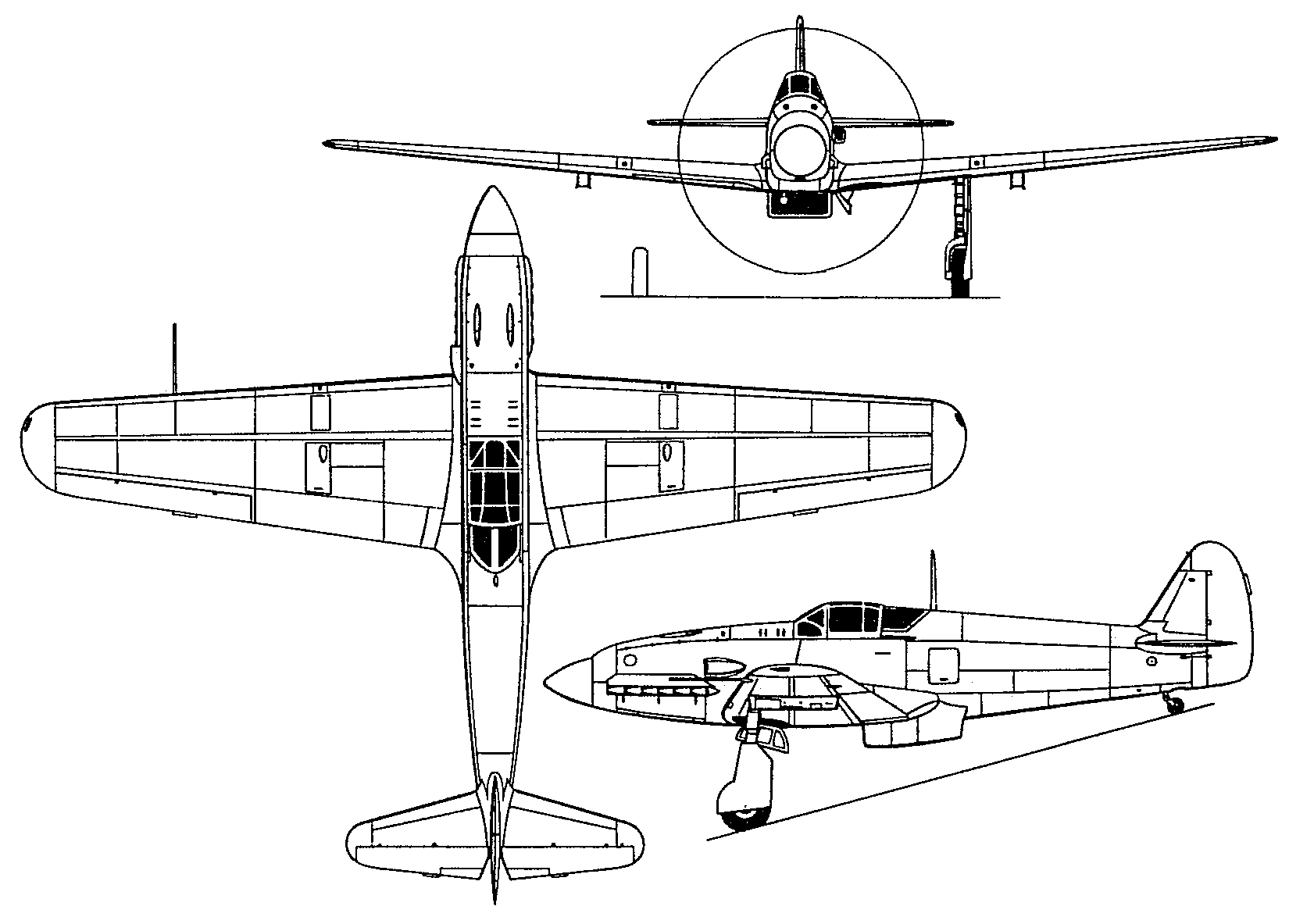


20
reply