|
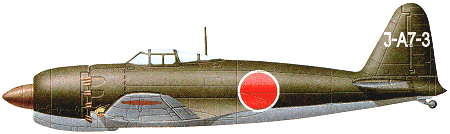
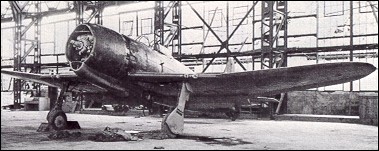
| The design by Mitsubishi of a carrier-based fighter to supersede the A6M Zero-Sen had been planned by the Japanese navy as early as 1940, but was frustrated, by the company's involvement in urgent development and- production programmes. It was not until 1942 that design of the M-50 Reppu (hurricane) began, but the continuing pressure on Mitsubishi for developments of the ABM meant that it was not until 6 May 1944 that the first prototype, which by then had the company designation Mitsubishi A7M1, was flown for the first time. A cantilever low-wing monoplane with retractable tailwheel landing gear, the A7M1 soon revealed excellent flight characteristics, but as predicted by Mitsubishi the type's maximum speed on the power of the installed Nakajima NK9K Homare 22 engine was below specification. Further testing was abandoned until availability of the 1641kW Mitsubishi MK9A radial engine made it possible to build seven A7M2 prototype and service trials aircraft, the first prototype being flown on 13 October 1944. Clearly a potent fighter that could meet Allied opposition on equal terms, the Reppu had a maximum speed of 630km/h at optimum altitude and was ordered into production as the Navy Carrier Fighter Reppu Model 22.
Unfortunately, by then it was too late for the Japanese navy, Allied air attacks and an earthquake limiting production to only one aircraft. Development of similar land-based fighters was planned under the designations A7M3 and A7M3-J, but neither was built before the war ended.
| MODEL | A7M2 |
| CREW | 1 |
| ENGINE | 1 x Mitsubishi MK9A, 1650kW |
| WEIGHTS |
| Take-off weight | 4720 kg | 10406 lb |
| DIMENSIONS |
| Wingspan | 14 m | 46 ft 11 in |
| Length | 11 m | 36 ft 1 in |
| Height | 4.28 m | 14 ft 1 in |
| Wing area | 30.86 m2 | 332.17 sq ft |
| PERFORMANCE |
| Max. speed | 620 km/h | 385 mph |
| Cruise speed | 410 km/h | 255 mph |
| Ceiling | 10900 m | 35750 ft |
| ARMAMENT | 4 x 20mm cannons, 2 x 250-kg bombs |
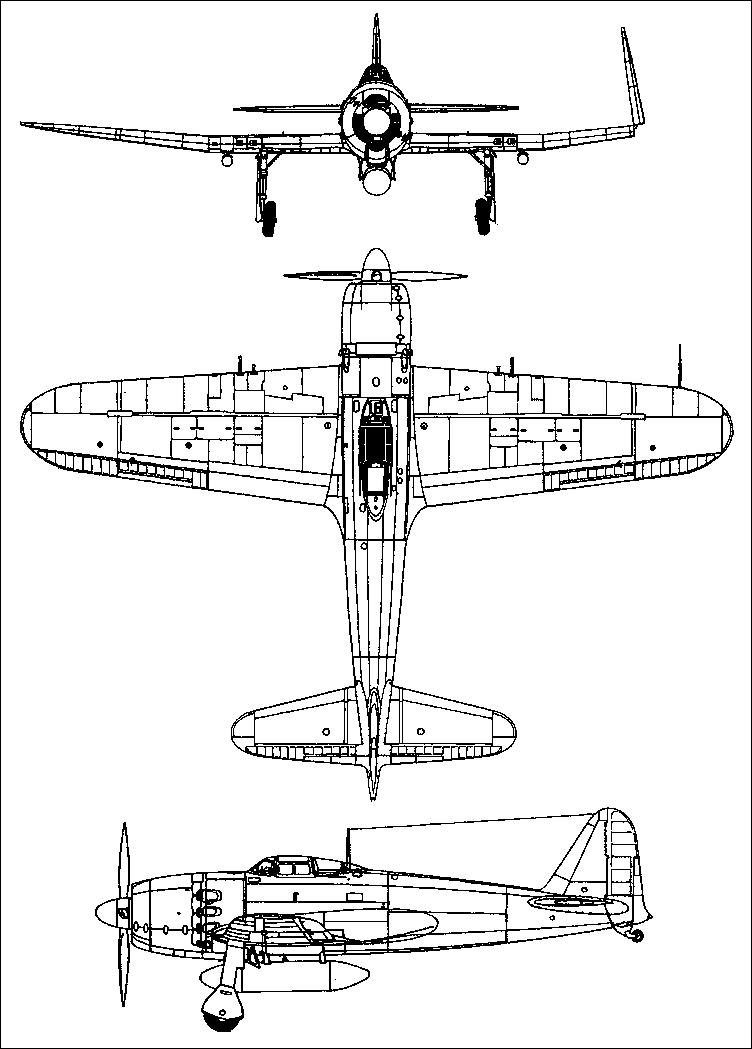
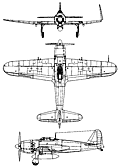 | A three-view drawing (752 x 1049) |
| ubaTaeCJ, e-mail, 21.02.2025 20:35 20 reply | | ubaTaeCJ, e-mail, 21.02.2025 17:30 20 reply |
| ubaTaeCJ, e-mail, 21.02.2025 17:23 20 reply | | mgbovdemdq, e-mail, 09.03.2021 23:05 Muchas gracias. ?Como puedo iniciar sesion? reply | |
| | ron, e-mail, 29.03.2017 11:00 The Reppu A7M1 was powered by the NK9K which had it's top speed at an altitude of 6190m (20,310') was 357 mph.
A7M2: the altitude was 6600m (21,650') for 390 mph.
Even though this was not the high altitude version, it still did much better up high than the NK9A powered A7M1.
The 2200 hp MK9A had some vibration but the 2000 hp NK9K was unreliable.
The MK9A should have been in the Shiden and Hayate. They would have been even better! reply | | ron, e-mail, 16.05.2016 20:42 The reliable 2,200 hp MK9 was the engine the design team planned for the big Reppu. It was too heavy to stay within the W /L requirement but met all the other specs close enough. It was supplied by just one factory and was delayed. It was not yet accepted by the IJN.
The Other choice was the unreliable 2,000 hp NK9. It met the W /L requirement but not all the others. It was already accepted by the IJN and was ready without further delay. The IJN was spurred by the Midway defeat to convert the Reppu to the NK9 although the Reppu was designed for the more powerful MK9.
This conversion wasted any time saved by this choice.
The expected underpowered flight results proved most disappointing, stopping the whole program. This cost more time.
The design team gained permission to convert it back, to demonstrate the MK9. 6 months later it flew and the Reppu was back on, but at what priority? An earthquake, bomb raids, and a prototype crash did the rest. The J2M5 Raiden and Kamikazi A6M7 Zero were in front of it already. reply | | Ron, e-mail, 10.05.2016 07:41 The MK9C is called MK9S on some foriegn language sites. That is a quirk of translation I guess. Maybe C and S sound alike in Russian for example.
Another note after reviewing my posts:
The 13.2mm Type 3 HMG compares favorably against the Luftwaffe 13.1mm MG 131 until it is cowl mounted to synchronize with the prop. It's RoF is halved, while the electric German HMG is reduced by only 10%.
I didn't mention this in the case of the Reppu since the A7M1 /2 has them in the wings and not the cowl like the A6M5 Zero.
Disregard the occassional jumbled sentence please. I'm sure everyone has experienced computer mischief due to the curser. It is well named. You have to keep a close eye on where it is. reply |
| Ron, e-mail, 27.04.2016 22:13 Both the A6M8 and the A7M2 were held up by the IJN for the same 2 reasons:
1. Engine size.
2. Engine weight adversely affecting W /L.
They preferred less power and doomed Japan.
The alternate history is for the IJN to be more farsighted like the IJA and listen to their engineers. help
HP at altitude was needed to keep up with the USA.
Combat flaps could compensate for lost W /L.
The Zero with the Ha-112-II should have equiped the carriers mid-war!
This should have filled the gap until the Ha-43 (MK9) powered Reppu could replace it starting in 1944 at the latest.
These were both reliable Mitsubishi engines.
Most latewar fighters were unreliable. This drawback was also more important than size or weight, along with low hp at altitude.
This was where Mitsubishi could have the advantage against the IJA Ha-45 (NK9) for example.
Just another opportunity lost. reply | | Ron, e-mail, 27.04.2016 14:36 If the estimated climb of the A7M3 to 10km altitude was 13 min. 7 sec, then I estimate 6km is within 5-1 /2 minutes. No production Japanese fighter can climb that fast.
I base this on the flight test ratio of the A7M2 which was real. It climbed 6km in 6 min. 7 sec, and 10km in 15 min. 20 sec.
The J2M2 comes close by about 10 seconds.
That Reppu version was amazing if the Japanese estimate is right.
Reliable 2,250 hp A7M3. 11,111 lbs loaded.
Better agility than the A6M7 Zero!
Six 750 rpm 20mm wing cannons!!
Full armor and good wheel struts.
Faster than the Ki 84!
It has it's cake and eats it too. reply |
| ron, e-mail, 25.04.2016 04:37 If the NK9 powered Shiden could fly in Dec 1942, so could the A7M1, had it not been delayed so much since 1940.
If the tricky landing gear of the Shiden kept it from carrier service, it should have borrowed them from the Reppu. Failing that, the A7M1 should have been on carriers as soon as possible in 1943 in place of the A6M5 as soon as this failed to be granted the Ha-112 engine. Of course, the brass had their way on both and Japan suffered for it.
What if the engineers had their way on both the 1500 hp Ha-112 powered A6M5 and the 2200 hp MK9 powered A7M1 instead?
They would both grace the carriers in 1943 onward potentially. The brass wouldn't have regretted it.
As it turned out, the brass got around to seeing things the way the engineers did and approved them both but the war ended before they saw action! They were only a year or 2 late! The engineers were ready mid-war. reply | | Ron, e-mail, 24.04.2016 10:35 after the A6M5 flew in Aug 1943, I belive until the MK9 was ready, the NK9 powered A7M1 should have shared the Zero production lines to phase in the Reppu. At 356 mph and with better agility than the faster climbing 351 mph Zero, it would be a much less vulnerable stable mate. This may have been significant in 1943 until the reliable MK9 powered A7M2.
If the serious work on the Reppu had not been delayed in the beginning, the 390 mph A7M2 could have flown in late 1943. It was reliable, tough and climbed better now.
Most of the 5,000 A6M5s could have been Reppus, at least on Mitsubishi lines. The Turkey shoot wouldn't have had just turkeys. The A7M2 Reppu would have been a contemporary with the N1K1 but faster at altitude. And the A7M3 with the N1K2 with even a better altitude margin in 1944! This Reppu had Raiden like climbing performance. reply | | ron, e-mail, 20.04.2016 13:43 It's true that the 1800+ hp NK9 powered A7M1 was only as fast as the A6M5 so it was dropped in 1944.
But handling, roll and turn was better and it had armor.
The A7M2 had the newer 2200 hp MK9 in Oct, 1944 but could have flown 6 months earlier, since the underpowered A7M1 delayed it.
But I was thinking, If the almost 2 year delay between 1940 and 1942 had been reduced by 6 months, the A7M1 could have flown in 1943 before the vulnerable A6M5 was using up all the resources. It's performance may not have looked as bad as it did in 1944, a year later.
What if the resources were utilized to produce and supply these A7M1s to the carriers while they still had some afloat, instead of the obsolete Zero?
Then, mass produce the 2200 hp MK9 at multiple factories for the A7M2 as soon as posible in 1943. This engine came after the NK9 (which would be just a stopgap).
With reduced delays, the A7M2 would be in full swing production earlier by a year. Then in 1944, the A7M3 could have flown as the land-based version. These were great climbers and had good altitude performance to attack B-29s.
This was doable.
6 months at the start was wasted, after Horikoshi finished the Zero and before he started serious work on the A7M. Another 6 month delay when the IJN halted work because by this time it's performace was no better than the A6M5. Then of course another 6 months is wasted to redesign the long-nose A7M3-J for super high altitude performance. But by 1946 it wasn't so super.
Instead of the prodigeous A6M5,
Late 1943 the A7M1 could have been a much tougher customer on the carriers.
1944 the up-engined A7M2 could have followed on. The best pilots could have protected the carriers.
Late 1944 the A7M3 could have joined the fray against the raids on Japan, packing 6x20mm cannons!
1945 the A8M Rifuku (30mm packing A7M3-J with new engine) could have debuted, intead of 1946 as planned.
That wasted year and a half could have resulted in a reliably powered A7M3 when other late-war fighters were unreliable, in place of the slow A6M5 and slower 340 mph A6M7!
The delays due to earthquakes, bombs, the sole MK9 engine factory put out of action, and prototype accidents were bad enough but the IJN added the most delays. This required the A6M5 mass production by default. reply | | ron, e-mail, 31.03.2016 01:10 The A7M2 could have faced the US earlier by stopping the A6M at Mitsubishi and putting the Reppu in full production with the MK9 engine when Horikoshi asked for it to start with, instead of wasting time on the unreliable NK9
(Nakajima made most A6M Zeros anyway). The brass should have learned their lesson with the A6M5 losses when they didn't listen to him before.
I would put a cannon in the tail of the Reppu too, just to give pause to Allied pilots on it's 6. They may restrict attacks to low % deflection shots vs the Reppu. As good as the A7M is, it is slower than many Allied fighters so this defensive measure seems prudent.
I also like the dorsal 30mm cannons of the later 3-J model. One would do on the A7M2. This would make it a threat to B-29s earlier. The A7M3 should have preceeded the redesign of the A7M3-J to save time. It was just about as good overall. This could have been in action before the end, with most of the high altitude performance of the postwar A7M3-J and climbed quicker to 10km by about 2 minutes (estimated) in the bargain too. The A7M3 had 6x20mm faster Type 99-II /5 cannons (750 rpm) with a range of 1,000m. Slow 30mm cannons with a 900m range weren't called for really when it required a bigger wing and still lost most of it's W /L advantage.
Strip the carrier capable A7M2 and 3 of their tailhook and folding wing mechanism... etc, and they are even better, sooner. reply | | ron, e-mail, 29.03.2016 22:33 So the calculated 479 mph dive speed of this A7M1 prototype number 5 is between the early and late model Hellcat and Corsair in this windtunnel test. The F8F Bearcat is equal to the F4U-4 and not as fast as the F6F-5.
The F6F-5 was in stronger numbers and thus the principle foe of the Reppu in this test. reply | |
| | ron, e-mail, 29.03.2016 22:01 Jananese wiki saya:
"For dive speed limit is 450 knots (833.4km / h) is a plan requisition, after had been somewhat asked to cut is to 425 knots (787.1km / h). However, A7M1 prototype immediately after completion because the strength of the wing was insufficient, the reinforcement of the main wing is carried out while performing a test cut in the time being 350 knots speed limit (648.2km / h). Thereafter, the strength improvement of the wing is confirmed by the vibration test using the A7M1 prototype five Unit reinforcement has been performed, (the same calculation method as the dive speed limits Zero Fighter) dive speed limit calculated from wind tunnel tests on the required performance was almost has reached 416 knots (about 770.4km / h). By the way, the body scale is close to the same carrier-based fighter F6F Hellcat dive speed limit of -3 type is 415 knots (768.6km / h), - 5-inch 430 knots (796.4Km / H), F4U Corsair -1 type system is 400 knots (740.8km / h), - in the type 4 is 425 knots (787.1km / h), more new and small F8F Bearcat was even 425 knots (787.1Km / H) [1] ." reply | | ron, e-mail, 28.03.2016 07:39 Japanese wiki shows more ammo for the Reppu; 250 rpg for the 20mm, 60-75 rpg for the 30mm wing guns, and 125 rpg for the dorsal 30mm cannons.
It concurs that the Type 99-II was the slow Model 4 in the A7M2 and the fast Model 5 in the A7M3.
It also says the 2130 hp MK9 engine was reliable.
The A7M3 was still carrier capable.
Even the A7M2 was better at altitude than the A7M1. reply | | ron, e-mail, 23.03.2016 07:41 2503 fpm (763mpm) is the estimated average sustained climb to 10Km altitude for the A7M3. It's the best climbing version of the Reppu. Better than the A7M3-J /A8M as well as the A7M1 and A7M2.
That's another reason it is my favorite version. reply | | ron, e-mail, 22.03.2016 21:27 2 games put initial climb for the Reppu at 4,803 fpm (24.4 m /s). Which model? Must be for A7M2, but one has speed of A7M1.
The 2180 fpm (my last post) is very close to the (estimated) average sustained climb rate from sea level to 10Km for the A7M3-J: 2188 fpm.
The A7M2 climbed to 6Km in 6 min. 7 sec.= 3225 fpm sustained average. And 2139 fpm average to 10Km.
The A7M1 sustained climb to 6Km was 9 min. 54 sec.= 1988 fpm.
Initial climb rate is much better than sustained climb rate.
Should we trust the 24.4 m /s (4803 fpm) rate from the games? reply |
| ron, e-mail, 22.03.2016 19:48 2,180 fpm was the climb for the A7M2 according to one site.
I don't know if that is average or initial climb. It is so low, it could be a mistake and belong to the disappointing A7M1 perhaps. reply |
| mark, e-mail, 15.03.2016 11:44 "I still see the Type 99-II called low velocity by many. It had a firing range comparable to the Hispano! These folks are obviously confused with the early 99-I. Big difference!"
Japanese Type 99 was the same gun as MG FF but using the orginal 20x72 cartridge, while FF used 20x82 99-2. Both were versions of Oerlikon FFS that used 20x110 cartridge. Type 99-2 was also Oerlikon based using more powerful 20x101 cartridge. If belt fed, versions were 99-1-Model 4 and 99-2-Model 4. reply |
|
Do you have any comments?
|
| 
COMPANY
PROFILE
All the World's Rotorcraft
|


 Ron
Ron

20
reply