|
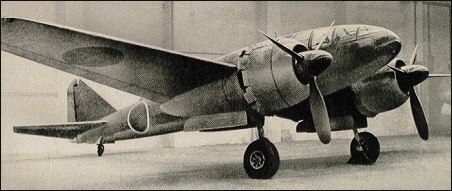
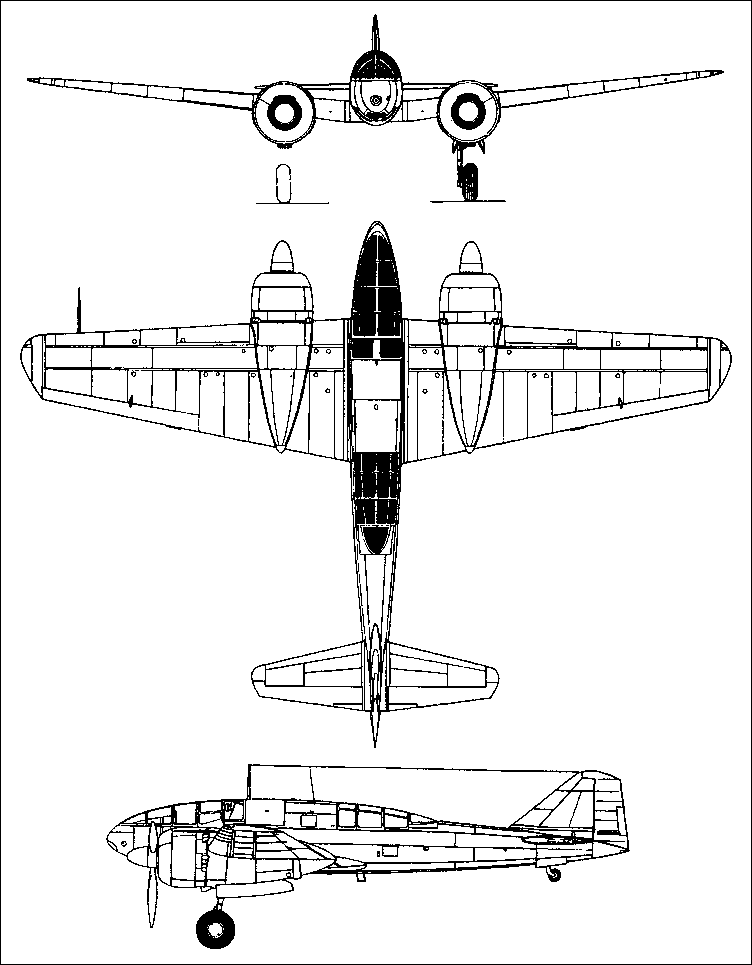
| One of the best-looking Japanese aircraft of World War II, the Mitsubishi Ki-46 was designed to meet an Imperial Japanese Army requirement of 1937 for a higher performance reconnaissance aircraft to supersede the Ki-15. A cantilever low-wing monoplane with retractable tailwheel landing gear, powered by two 671kW Mitsubishi Ha-21-l radial engines, the two-seat Ki-46 prototype was flown for the first time in late November 1939. Early testing showed that maximum speed of the Ki-46 was some 10% below specification, but as its speed and overall performance was better than in-service army and navy aircraft the type was ordered into production as the Army Type 100 Command Reconnaissance Plane Model 1 (Ki-46-l), later allocated the Allied codename 'Dinah'. Early operational problems with the Ki-46-l resulted in production of the improved Ki-46-ll with 805kW Mitsubishi Ha-102 engines, this powerplant giving a maximum speed slightly in excess of the original specification. The Ki-46-ll was the major production version, with more than 1,000 built, a number of which were converted later into three-seat radio/navigation trainers under the designation Ki-46-ll KAI. Subsequent variants included the faster and improved Ki-46-III of which 609 were built, a small number being converted later as Ki-46-lll KAI fighter interceptors and Ki-46lllb ground-attack aircraft. Ki-46-IV prototypes, with 1119kW Mitsubishi Ha-112-ll Ru turbocharged engines to give improved high altitude performance, were under test when the war ended.
In service from the beginning to the end of the Pacific war, the Ki-46 proved to be an important aircraft for the Japanese army, but the growing capability and number of Allied fighters resulted in unacceptably high losses of Ki-46-IIs. However, the improved performance of the Ki-46-lll meant that this
version was virtually free from interception until the final stage of the war. Production of all versions totalled 1,742, all built by Mitsubishi.
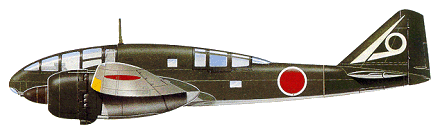
| MODEL | Ki-46III |
| CREW | 2 |
| ENGINE | 2 x Army Type 4, 1125kW |
| WEIGHTS |
| Take-off weight | 5722-6500 kg | 12615 - 14330 lb |
| Empty weight | 3831 kg | 8446 lb |
| DIMENSIONS |
| Wingspan | 14.7 m | 48 ft 3 in |
| Length | 11.0 m | 36 ft 1 in |
| Height | 3.88 m | 13 ft 9 in |
| Wing area | 32.0 m2 | 344.44 sq ft |
| PERFORMANCE |
| Max. speed | 630 km/h | 391 mph |
| Ceiling | 10500 m | 34450 ft |
| Range w/max.fuel | 4000 km | 2486 miles |
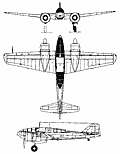 | A three-view drawing (752 x 965) |
| ron, e-mail, 13.04.2017 07:59 correction: I meant 1110-1170m range not m /s.
M /V for the Ho-203 was 570-576m /s. Not an estimate.
Some say M /V for the Ho-203 was 400m /s estimated. Based on what, I don't know.
710m /s for the Ho-204 was not an estimate. reply |
| ron, e-mail, 13.04.2017 07:49 The Ho-204 had a M /V of 710m /s because the smaller shell (same as Ho-203) was used. The heavier shell had a much lower M /V (430m /s or so) than the Ho-203 and that was unsatisfactory. This may explain why some say M /V was 450 m /s (est).
Fracillion said firing range for the Ho-203 was 900m. I don't know the range of the Ho-204. I estimate it was 1110-1170m /s based on that 900m range for the older Ho-203 cannon. I estimated it based on the increased cartridge length, and secondly based on the increased M /V. This resulted in that spread. Of course, I could be wrong.
If someone has more than an estimate, let me know. reply | | Ronald, e-mail, 04.10.2016 23:14 The new 37mm Ho-204 was installed in 75 Ki 46-IIIs with up to 60 r /g of ammo. That's 9 seconds of ammo.
The Ki 102 Randy had it in the nose. 50 were made.
How these fared is unknown.
-airwar,ru reply | | paul Scott, e-mail, 27.01.2015 22:23 Fine-looking and excellent performance aircraft. something like the equivalent of the Mosquito or the P-38 Lightning and, the JU 88 reply | |
| | Ron, e-mail, 21.10.2014 22:26 The Ho-203 heavy 37mm cannon fired 120 rpm with a good range of 900 meters. Of course the sustained recoil is too much for such an oblique angle. It would do just fine on the Dinah's centerline along with the twin Ho-5 20mm cannons if there is room. If not, the twins can do very well obliquely angled 30 degrees in the dorsal position. Make it a single-seater day fighter or add a radar operator for night interception with a flexible 20mm rear cannon.
The Ki 46-III Kai could have been a terror against B-29s after October 1944 instead of such a disappointing interceptor and easy meat for US escort fighters. reply | | Ron, e-mail, 06.10.2014 11:22 Once the oblique 37mm was proven unsatisfactory, why didn't it just trade places with the twin 20mm canons in the nose?
This was successful in other twin engine interceptors against the B-29s. Additionally a nose located 37mm cannon would have the least recoil problem. Then a sufficient burst could make a dent. The dual threat of the oblique twin 20mm cannon efficacy is proven. To me it's a no-brainer. The Gekko and Nick interceptors that used twin 20mm oblique cannons would then be eclipsed by the faster, more potent Dinah interceptor. If only... reply | | SS, 11.02.2014 07:41 This plane was called "ShinShiTei" it did not have a fancy nickname like the other fighters. It meant "new commanding surveillance. Though it is called surveillance plane towards the end of the war it was also used for "kamikaze". Sad to see such a beautiful plane be handled in such way. reply | | Phelan Wolf, 19.09.2012 21:23 That is one seriously sleek airplane...it's almost mesmerizing reply | | Joe Ihnat, e-mail, 17.11.2011 04:25 The Mitsubishi J2M3 was called the Raiden, translated 'Thunderbolt', the Kawanishi N1K1-J was called the Shiden, translated 'Violet Lightning'and the Aichi B7A was called the Ryusei, translated 'Shooting Star'. But what was the Mitsubishi Ki-46 called? I'm not referring to its Allied identification codename,'Dinah', either. reply | | jamie burgoyne, e-mail, 24.05.2011 21:15 The last surviving 'dinah' is displayed at raf cosford, with the only complete ME410 reply | | Ronald, e-mail, 21.06.2009 04:57 I read someplace that the Luftwaffe was interested in this plane. Imagine if something had come of that! reply | | leo rudnicki, e-mail, 28.04.2009 02:04 Like the Italian SVA-5 of WW1, Dinah could elude interception in the recon role but failed all attempts to achieve a combat role, such as done by by the Mosquito. As such, it could only provide the news that Japan was losing the war. Sure was a looker, tho. reply | | Aero-Fox, 17.03.2008 22:00 It is a beautiful aircraft...if there's one thing Japan knew, it was how to design a striking airframe (at least as much so as the Germans).
If tests of the turbo-equipped engine had been completed, the allies could have had problems... reply | | ken nizam, e-mail, 17.11.2006 16:03 This warbirds were extensively used over Malaya, the current Malaysia. It holds a significant degree in defining the todays Malaysia. It would be invaluable if any parts of the original 2 seaters Dinah can be obtained and displayed in the country. Any party with such information of such parts of Dinah is highly sought after by us, really. Regards reply |
|
Do you have any comments?
|
| 
COMPANY
PROFILE
All the World's Rotorcraft
|




20
reply