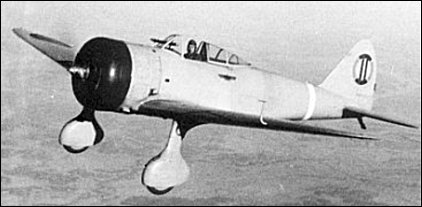
When in mid-1935 Kawasaki, Mitsubishi
and Nakajima were instructed by
the Imperial Japanese Army to build
competitive prototypes of advanced
fighter aircraft, Nakajima responded
with a single-seat monoplane fighter
derived from the company's Type P.E.,
which it had started to develop as a
private venture. Service trials proved,
the Kawasaki Ki-28 to be fastest of the
three contenders, but the Nakajima Ki-
27 was by far the most manoeuvrable
and, on that basis, 10 pre-production
examples were ordered for further
service evaluation. Following further
testing m late 1937 the type was
ordered into production as the Army
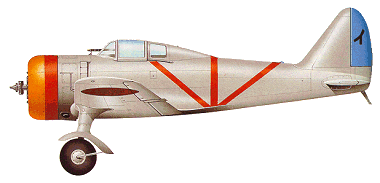
Type 97 Fighter Model A (Nakajima
Ki-27a). Late production aircraft which
introduced some refinements, including
a further improved cockpit canopy,
had the designation Ki-27b.
Nakajima could not have guessed
that 3,399 aircraft would be built, by
Nakajima (2,020) and Mansyu (1,379),
before production came to a halt at the
end of 1942, but the type's entry into
service over northern China in March
1938 gave an immediate appreciation
of its capability, the Ki-27s becoming
masters of the airspace until confronted
later by the faster Soviet Polikarpov
I-16 fighters. At the beginning
of the Pacific war the Ki-27s took part in
the invasion of Burma, Malaya, the
Netherlands East Indies and the Philippines.
Allocated the Allied codename
'Nate' (initially 'Abdul' in the China-
Burma-India theatre), the Ki-27 had
considerable success against the
Allies in the initial stages before more
modern fighters became available.
When this occurred they were transferred
for air defence of the home islands,
remaining deployed in this
capacity until 1943 when they became
used increasingly as advanced trainers.
As with many Japanese aircraft,
their final use was in a kamikaze role.
Nakajima Ki-27 "NATE" on YOUTUBE
Specification
MODEL
Ki-27a
CREW
1
ENGINE
1 x Nakajima Ha-1b, 529kW
WEIGHTS
Take-off weight
1790 kg
3946 lb
Empty weight
1110 kg
2447 lb
DIMENSIONS
Wingspan
11.31 m
37 ft 1 in
Length
7.53 m
25 ft 8 in
Height
3.25 m
11 ft 8 in
Wing area
18.55 m2
199.67 sq ft
PERFORMANCE
Max. speed
470 km/h
292 mph
Ceiling
12250 m
40200 ft
Range w/max.fuel
625 km
388 miles
ARMAMENT
2 x 7.7mm machine-guns
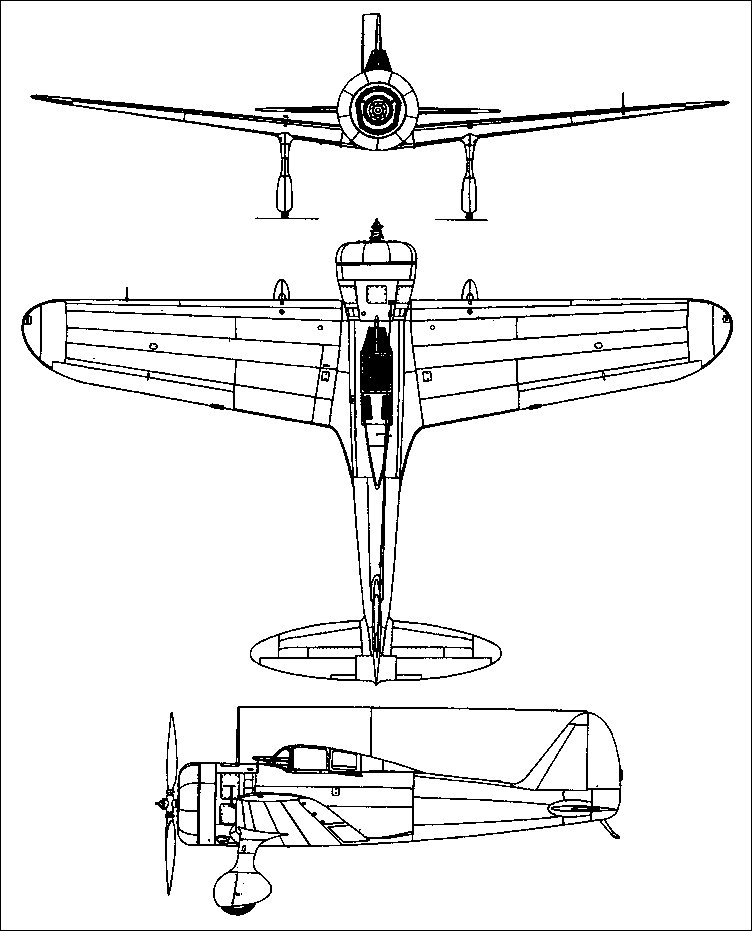
3-View
A three-view drawing (752 x 931)
Comments
Johann Reiter, 23.04.2017 19:12
Have a picture of my friend Mitsuharu Nagase at age 17 standing in front of his "Nate" while a member of the "Young Cherry Blossoms" kamikaze squadron near Nagoya. I am glad that the war ended before he had his opportunity to die for his emperor. He always told me "I did not want to die". I am proud to have known him. Lost him last year...
As with other Jap planes, I have this worthy aponent hanging from my ceiling! This was truly a worthy aponent & was the end of many stupid american pilots who didn't listen to the wisdom of Claire Lee Chennault!!
As usual, the Chinese don't want to admitt that the American AVG, saved thier yellow Asian Asses from TOTAL EXTINCTION!!! Now thanks to that Democratic asshole Franklin Delano Roosevelt; China belongs to the Commie Chinks now!! All the Nationalist Chinese (Chinese friendly to the US) are now crammed on the island of Taiwan!! No thanks to the damned Democrats!!
I also forgot to add that Chennault, warned American officials that quote "It climbs like a skyrocket & menuevers like a squirrel. Chennaults doctrine of NEVER turn with Jap planes." Saved many an AVG pilots life. Chennault was brilliant but, like General Billy Mitchel, he was never taken seriously. America had to find out the hard way that trying to turn with Nates & the immortal Zero, was suicide!
Those "chinese" guys need to get their facts strait! All during the Japanese invasion /assault of China, the Japanese exacted terrible losses of the fledgling Chinese Air Force. The Chinese were flying obsolete aircraft against a better trained, & more modern Japanese Air Force. They have also forgot, & /or just don't want to admitt that it was not until Claire Lee Chennault, creator of the famed AVG in China, that the Chinese didn't have a chance in Hell against the Japanese. The "Chinese" comentators would do well with reading up on their history!
I have seen the Ki.27 listed as THE most manueverable modern fighter ever produced. I have seen statements from ex-AVG pilots saying that it was respected. The Ki.27 was a full generation ahead of the P-26 in performance.
The P26 Peashooter was a much beloved airshow fighter of the thities. They were based in the Phillipines in 1941. they were no longer there in 1942. The I-16's didn't fare well against the KI27. Chennault's tactics was bounce 'em out of the sun, shoot and run. Don't stick around. Dogfighting the nate was suicide. That worked because the P40 had speed & dive. I too have an unknown Scottish laird, tinsnips and a rivet gun.
Ki-27(Type 97) was the main fighter of the JAAF in the beginning of the invasion in China.But our heroic Chinese pilots can also shot down them.Our heroic Army soldiers can even capture their airbase. tw.youtube.com /watch?v=WWt7irSIr2Q&feature=related
I would love to have seen a duel between this little number and a Nationalist Chinese Boeing P-26, roughly its contemporary in preformance. Both were potent little aircraft!
When my (as yet unkown) distant relative Scottish Lord falls off his perch and leaves me his HUGE fortune, I am going to build a replica of this plane! I cannot think of a more desirable warbird! Fabulous little aeroplane!
I'm doing research on this plane, but the only piece we have acquired is the propeller. I need to know the spec's of it and the attachment housing to the hub.




20
reply