|
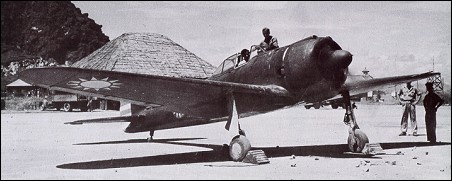
| With its relatively low-powered radial
engine, two-blade propeller and twin
rifle-calibre machine-gun armament,
the Nakajima Ki-43 Hayabusa (peregrine
falcon) was the most dangerously
underestimated Japanese fighter of
the early months of the Pacific war; yet,
with its outstanding manoeuvrability, it
gained complete mastery over Brewster
Buffalos and Hawker Hurricanes
in Burma. It was the result of a 1937
design which emerged as a light-
weight fighter-bomber that required
no more than its 709kW to
meet its speed demands. In common
with other Japanese fighters of the
time, however, its armament was puny
by RAF standards, and it possessed
neither armour nor self-sealing fuel
tanks. As the Allied air forces pulled
themselves together after the first
shock of defeat, the Ki-43-I's weaknesses
were discovered and increasing
losses suffered, resulting in the introduction
of the Ki-43-II (codenamed
'Oscar' by the Allies), with pilot
armour, rudimentary self-sealing fuel
tanks and reflector gunsight; the engine
was also changed to the 858kW Nakajima Ha-115 radial
which increased the top speed to
530km/h, roughly the same
as that of the Hurricane Mk II. The
Ki-43-IIb entered mass production in
November 1942, first with Nakajima
and six months later with Tachikawa.
Final variant was the Ki-43-III with 917kW engine and a top speed
of 576km/h, but relatively
few examples reached operational units.
The Ki-43 was numerically the most
important of all Japanese army air
force aircraft, production totalling
5,886, plus 33 prototypes and trials aircraft.
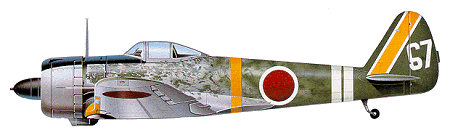
| MODEL | Ki-43-IIb |
| CREW | 1 |
| ENGINE | 1 x Nakajima Ha-115, 858kW |
| WEIGHTS |
| Take-off weight | 2590 kg | 5710 lb |
| Empty weight | 1910 kg | 4211 lb |
| DIMENSIONS |
| Wingspan | 10.84 m | 36 ft 7 in |
| Length | 8.92 m | 29 ft 3 in |
| Height | 3.27 m | 11 ft 9 in |
| Wing area | 21.4 m2 | 230.35 sq ft |
| PERFORMANCE |
| Max. speed | 530 km/h | 329 mph |
| Ceiling | 11200 m | 36750 ft |
| Range w/max.fuel | 3200 km | 1988 miles |
| ARMAMENT | 2 x 12.7mm machine-guns, 2 x 250-kg bombs |
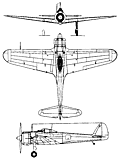 | A three-view drawing (752 x 1003) |
| ubaTaeCJ, e-mail, 21.02.2025 17:19 20 reply |
| ubaTaeCJ, e-mail, 21.02.2025 17:19 20 reply | | ron, e-mail, 16.03.2017 22:50 When the Germans sent 20mm Mauser cannons to Japan, what if a pair was installed in the cowl of the Ki 43?
Perhaps it would have been made in Japan if it was demonstrated as superior in the Ki 43.
10% reduction in RoF is so much better than 60% for the IJAAF 20mm Ho-3 or Ho-5, synchronized with the prop. Even the 12.7mm Ho-103 of the Ki 43 had a similar penalty, also being Browning based like the 20mm cannons. If the tropics were unfriendly to electric firing Mausers, at least they could work in temperate zones of Asia. I would give up the less effective twin 103s for even just one 20mm Mauser with more firepower. If there was not room for it on top of the nose, it has ample space underneath. In fact the Ki 43 has wingloading to spare. So, 4 Mausers under the belly and sides, with ammo on the 'cg' would do nicely! If that is too much weight, up-engine to the Ha-112-II with 1,500 hp and increase W /A again if necessary. The Mausers were used only in the wings of Ki 61s. Another opportunity lost. They did well, but they should've been mass produced under license in Japan. Then installed on every Japanese fighter even without the electronic firing for reliability, they would do better than Browning based designs in the nose. reply |
| francis dec, 24.09.2016 01:26 1988 miles range insane.. if Germany had some Oscars in Battle of Britain who knows? German planes had crummy range for sure. reply | |
| | ron, e-mail, 13.06.2016 06:34 Correction.
It was Tommy McGuire not Jimmy. reply | | Ron, e-mail, 11.06.2016 03:05 The 'light' MG 7.7mm Type 89:
12kg
7.7x58mm SR Cartridge
657 sync / 900 rpm
600m Range
810mps M /V
Ball 13.15g
AP 10.5g
T 10.04g
I 10.5g
HE 10.5g PETN /RDX
10.9gpr Ave
Sync / 119.8g /s
CP 1
GP 11
These persisted on the Ki 43 beyond mid-war due to it's reliability and RoF. Accuracy may have been a problem though. reply | | ron, e-mail, 10.06.2016 10:51 At first, most of us are put off with the lack of speed and guns of the Oscar, but then you find out no other Japanese fighter shot down as many Allied planes. Go figure!
That warrants a second look.
As for speed, the rival A6M5c Zero added guns and actually got slower while the Ki 43-IIIa passed it in speed.
Of course by this time both were way too slow. I have to give the Ki 43 credit for having seat armor protection long before the Zero did.
As for the guns, the Ki-43-IIIb with 20mm cannons didn't see action. But most of us don't know about this:
(5001st Toku - Tokko Tai Dokuritsu Chutai) had been originally equipped with two 12.7 mm MG;s but these were replaced by 20 mm at Gifu before departure for SWPA, to test suitability of 20 mm. These hydraulicly operated canons were shorter than the Ho-5 and still protruded 4". I think they were perhaps the 20mm Ho-3 cannons. Ammo was 200 rounds each. The planes were Ki 43-IIs. 5001st Special Attack Unit, Independent Squadron was formed at Kagamigahara, Gifu on 25th December 1943. It was sent to SWPA as a test unit which if unsatisfactory, would be dissolved and pilots and airplanes sent to other units. Unit was equipped with 15 Oscar 2 fighters - four flights of three airplanes each, and three airplanes in reserve; according to the J.Aircraft site.
January 7, 1944 Jimmy McGuire was shot down over Negros, central Philippines. He was the US ace of aces with a score of 38. These Oscars of the 5001st were still in Formosa, but was it close enough for the
Ki 43? A 20mm shell was found in his wrecked P-38. He was in combat with 1 Oscar and 1 Frank. I was sure the Ki 84 Frank did it, before I knew about these special Oscars. The 20mm cannon armed Special Unit of Oscars arrived in Manila January 9, 1944. Now I wonder who really did him in. Was Akira Sugimoto in the 5001st? reply |
| ron, e-mail, 03.06.2016 10:49 The IJAAF
7.7mm Type 89 MG
7.7x58mm Cartridge
900 rpm / 657 rpm sync
600m Range
810mps M /V
10.54gpr Ave
On my last post the Red and Blue Italian HEI shells are 2, not one shell with 2 bands. The Red is 36.935g and the Blue is 36.854g to be exact, but when I rounded it off, this could be misunderstood as one and the same. The heavier Red banded shell was self destructive. reply | | ron, e-mail, 03.06.2016 04:00 The last post is based on the ammo aboard a captured fighter, detailing the colored bands on the shells.
Other APT rounds had red tracer instead of white.
Untill 1943 Italian ammo was also used by the Japanese like the Red and Blue band 36.9g 'HEI' shells; 0.6g PETN; M /V 770mps. Japanese 12.7mm guns often misfired with Italian made ammo. reply | | ron, e-mail, 01.06.2016 12:07 The ammo of Japanese manufacture for the 12.7mm Ho-103
Type 1 HMG was:
35.5g APT with green & white bands. (0.2g) white T. 760m /s.
34.5g HEI with white band. (2g) RDX+I. 770m /s.
32.9g HEI with purple band. 0.8g PETN, (1.4g) RDX+I. 796m /s.
The numbers in parenthesis are approximate, from seperate sources.
The white band shell was called HE and the purple band shell was called Incindiary by the Allies (RAAF in this case). reply | | ron, e-mail, 18.03.2016 07:04 When the Ki 43-II debuted, it should have added a 20mm cannon under the cowl with a long barrel and the ammo on the cg.
More than one would be better but the power would need a serious upgrade. I'd be curious about testing a 40mm H0-301 in the tail to give assailants pause if they get on it's 6.
The range of 150m would be perhaps compensated for by the speed of the Allied plane closing from behind. In any case it could force lower % deflection fire. At best, one 40mm hit from the stinger could kill an Allied plane.
Failing that, any normal range rear firing gun would be a deterrant. After the tide of war turned, it needed some defensive measure. At least I'd be curious to test it.
The IJA lost so many pilots in NG and the Solomons, these Oscars needed more firepower but without losing the advantage in agility altogether. If the 20mm was too big for the upper cowl, why not just put it down under?
No other WW 2 fighter still had only 2 MGs till the end of the war in front line service like the Oscar! reply | | francis dec, 13.03.2016 00:37 nearly 2000 mile range! me109 had 400 mile range and lost battle of britain as a result reply |
| Ron, e-mail, 26.12.2015 10:44 Let me quote an excerpt:
"And here is the special thing - armament.
Guns : Two 20 mm cannon. Airplanes of PW's unit (5001st Toku - Tokko Tai Dokuritsu Chutai) had been originally equipped with two 12.7 mm MG;s but these were replaced by 20 mm at Gifu before departure for SWPA, to test suitability of 20 mm. Other Type 1F Oscar Mark 2, as far as he knew, did not have 20 mm cannon.
Ammunition : 200 rounds per gun.
From the other section.
"He was then shown three different types of 20 mm cannon viz: Oerlikon type, old and improved models (most likely Navy Type 99-I and Type 99-II - Hiro), and the MG 151 /20 from Tony. He doubted that cannon installed in his airplane were similar to any of these. He showed great interest in the MG 151 /20 and was definitely of the opinion that it was not of Japanese manufacture. He explained that cannon in his airplane were operated hydraulically and therefore could not possibly have been MG 151 /20s. However, throught his statements he frequently added that he had never inspected his cannon very closely and therefore could never be positive should he be shown one.
He explained that the muzzles of the guns of his plane protruded approximately 3-4 inches forward of the top portion of the blast tubes.
When shown smaples of 20 mm amunition from the older type Oerlikon and from the high velocity 20 mm cannon installed in Type 2EB Helen, he stated that the ammunition used by the cannon in his airplane was a size between these.
(PW was definite in his statements regarding installation of cannon in Type 1 fighter Oscar Mark 2).
This is sort of revelation, however not all his descriptions were accurate or true. For instance the top speed of his Ki-43 was largely exaggerated, even Model 3 was not supposed to reach the speeds of 600 kph TAS in level flight. His dive limit was also exaggerated, as Model 2 Oscar was not supposed to exceed 650 kph Indicated. Lastly the fuel capacity exceeded that given in the manual by 200 liters. He either did not know his aircraft, which does not seem probable considering he was educated person, with a great flight experience but also important duties. As a flight instructor he most certainly knew his aircraft.
In this case the question about 20 mm armed Oscar is open. As we know Model 3 to be equipped with Ho-5 20 mm cannon required a construction changes, namely increasing the length of the nose to accommodate larger armament and ammunition boxes. Could ordinary Oscar 2 be equipped with those ?
Do we know anything about 5001st Special Attack Unit and its aircraft ? If all Oscars of his unit were equipped with 20 mm cannon as PW claims than it would be a very important unit at that time.
PW informed that 5001st Special Attack Unit, Independent Squadron was formed at Kagamigahara, Gifu on 25th December 1943. It was sent to SWPA as a test unit which if unsatisfactory, would be dissolved and pilots and airplanes sent to other units. Unit was equipped with 15 Oscar 2 fighters - four flights of three airplanes each, and three airplanes in reserve.
On 8th January 1944 entire unit flew to Tachiarai and stayed one hour for refuelling. Same day they proceeded to Kagi, Formosa. They left it on January 9th and arrived Nielson Airfield, Manila where they remained for 3 days.
On January 12 they arrived Manado, only to leave it next day stopping for a few hours at Babo to finally arrive to Wewak on January 14, 1944.
In his day when shot down (January 16, 1944) 12 airplanes left Wewak at 09:00, and were joined over Boram by 18 Oscars and Tonys. Together they proceeded toward Saidor to engage Allied fighters protecting Allied landings. He flew at approx 4500 meters at speed of 350 kph. At some point they were intercepted by 24 P-40s rising from a height of 2500 /3000 meters. Four Allied airplanes broke formation to attack Japanese flank, Pw intercepted and shot down one of them and hit another which he claimed, he saw smoking badly. During combat PW was hit and crashed."
-J-aircraft site.
650 kph= 404 mph.
600 kph= 373 mph.
15 custom armed Oscars. Piloted by pros. Special indeed! reply | | TORBJÖRN KAMPE, e-mail, 18.10.2015 22:51 this aircraft has lot of good maneuverability.
better than the Spitfire. reply |
|
| | Ron, e-mail, 23.09.2015 21:55 Reference:
J-aircraft Forums General Category Japanese Army Aircraft Message Board Topic: 5001st Special Attack Unit Oscar Mark 2 armament reply | | Ron, e-mail, 23.09.2015 21:36 1150 hp Ki 43-II is said to stall at 81 mph, max level TAS 373 mph, 311 mph IAS, 404-435 mph dive.
15 service test fighters with 2x20mm cannons @ 200 rpg. Early 1944.
Make of this what you will. It sounds to me like Ki 44 info was mixed in, perhaps translation was a factor as well.
404 mph is more credible to me than 435 mph for dive, unless stress of interrigation got this crossed with the Ki 44 Dive and Max level speed which matches up.
This was unofficial info from a captured instructor who piloted one of these 15 special cannon armed Oscars that got shot down. reply | | Ron, e-mail, 13.12.2014 07:23 Axis History Forum is where I got the 8 g fill for the Ho-103 HE shell. I see 0.8 g everywhere else, so I may be wrong. It could be a typo. Sorry.
2.2 g and 2.2% can also be found. Also 2.0 PETN is given for the HE in the HEI shell. Incendiary fill weight not given. So, if it's 0.2 g, that could be the 2.2 g mentioned. As for the 2.2%, it equals 0.8 g of 34.2-37.5 g HE shell, approx. So, it could be either way, 2.2% or 2.2 grams - given incomplete numbers.
For comparison, the A6M5b Type 3 13.2 mm 44.18 g HEI shell has 2.28 g of filler.
The Breda-SAFAT 37.5 g HEIT shell has 0.6 g of fill.
A captured Ki 43 had APT, HE,I belting.
I bet the APT is really an APIT @ 36.7 g @ 760 mps.
The only Ho-103 APT I found is on the Axis site @ 34.2 g @ 760 mps, but it gives that same weight for the APIT and HEIT as well. Perhaps it's the average.
The HE shell could be 33 g or 37.5 g 796 mps.
The I shell is 36.5 g but filler weight isn't given.
Another belting is AP, HE, HET, AP.
AP is 35.4 g @ 760 MPS.
HET must mean the HEIT shell 37.5 g (Breda) @ 770 mps.
HE see above.
Warthunder shows a belting of AP, APIT, HE, HE, I.
Air combat: APIT, HE, I.
There are others too. I don't know what these are based on.
Game modeling is often revised for the players.
So much for my previous simplified post. reply | | Ron, e-mail, 06.12.2014 02:12 This fighter screams for more bite.
The LMG Type 89 was fast enough synchronized but range was only 600 m and was only able to add to the damage done by the HMG Ho-103 which was too slow by itself when synchronized.
So, the vast majority of Ki 43s were of mixed armament in combat.
Type 89-2 7.7mmx58mm
RoF: 657 rpm
M /V: 810-820 mps
10.5 gpr
Range: 600 m
Ammo: 500 rpg
Ho-103 12.7mmx81mm
RoF: 425 rpm
M /V: 760-780 mps
35.4 gpr APT
33 gpr HE (8 g PETN)
Range: 750 m
Ammo: 270 rpg
Once the Italian ammo was made in Japan, it no longer tended to jam (or worse) in the Ho-103 gun.
It had very high chemical content for a 12.7mm HE round. reply | | Ron, e-mail, 23.10.2014 03:53 (A short digest of data on the Ki 43)
Ki 43-I Oscar was accepted after Combat flaps were installed so that it could out-turn the Ki 27 Nate. Wing loading was 19 lb /sq ft and a full turn to the left took 10.8 sec at about 2,000' and 205 mph; radius was around 302-308' left or right.
It could do a double-double Immelmann (4 in quick sequence)!
It could go as slow as 50 mph during aerobatics. It could roll in a dive up to 300 mph.
Care had to be taken on pullout or the wings may fold. Top level speed was only 308 mph /5Km altitude which was attained in 5 min 30 sec climb. P /L was 4.6 lb /hp for excellent acceleration.
Though the pre-production prototype had pilot armor and 12.7mm HMGs these were stripped for production. 716 Ki 43-I Oscars were biult until Feb 1943. Most were armed with twin Type 89 synchronized 7.7mm MGs firing 657 rpm each, mounted in the cowl.
Some 12.7mm Ho-103 HMGs were used but proved unreliable using Italian ammo. These rounds were fine in Italian guns, but eventually this was solved by Japanese manufacture of this ammo. No more miss-firing! These had a synchronized RoF between 400-450 rpm.
From Nov 1942 the Ki 43-II was produced until Oct 1944, Perhaps about 3,440 were biult. It's new engine improved speed to 329 @ 4 Km; 341 mph @ 6 Km; 372 mph in a dive. P /L slipped to 5 lb /hp and climb to 5 Km took 5 min 49 sec. 6 K;m took under 6 min 30 sec. Initial climb rate was 3290 fpm @ SL and about 3400 fpm @ 5 km.
Loaded weight had increased nearly 1200 lbs and the stronger wings were clipped so W /L increased to 28 lb /sq ft! Still good agility and acceleration vs the Allies.
In Nov 1943 pilot armor and fuel tank protection was installed as another reason for the extra weight besides more powerful HMGs and hp...etc.
The final Version to see action in WW 2 was the Ki 43-III. From the prototypes in May 1944 to the end, about 1,727 were built (production: July 1944-Aug 1945). A new engine for better altitude performance now gave a P /L 4.6 lb /hp again and time to climb 5Km took only 5 min 19 sec. Top speed @ 22,000' was now 358 mph (faster than the rival A6M5c or A6M7 Zeros). And W /L improved to 24.5 lb /sq ft. But still no cannons!!
The cannon armed Ki 43-IIIb never entered production.
Can you imagine if the Japanese had made their own version of the imported Mauser MG 151 /20 cannon for synchronized RoF superior to the Ho-5? Most Japanese fighters had cowl guns, Army and Navy. The Ki 43 was most in need of something like this mid-war. The Ki 61 had them. But can you picture over 4,000 Oscars armed with Mauser derived nose cannons, 2 or more each? Not to mention the slow Navy cannons might get a second look, after all the Army fighters are refitted. Just what if? reply | | Ron, e-mail, 04.10.2014 13:05 The Allied pilots spoke in awe of Oscars performing double-double Immelmanns (that's 4 consecutively), horizontal spins, flip-rolls, snaking vertical climbs, as well as extremely tight turns.
Some moves even a Zero couldn't follow much less any of them. reply |
|
Do you have any comments?
|
| 
COMPANY
PROFILE
All the World's Rotorcraft
|

 ron
ron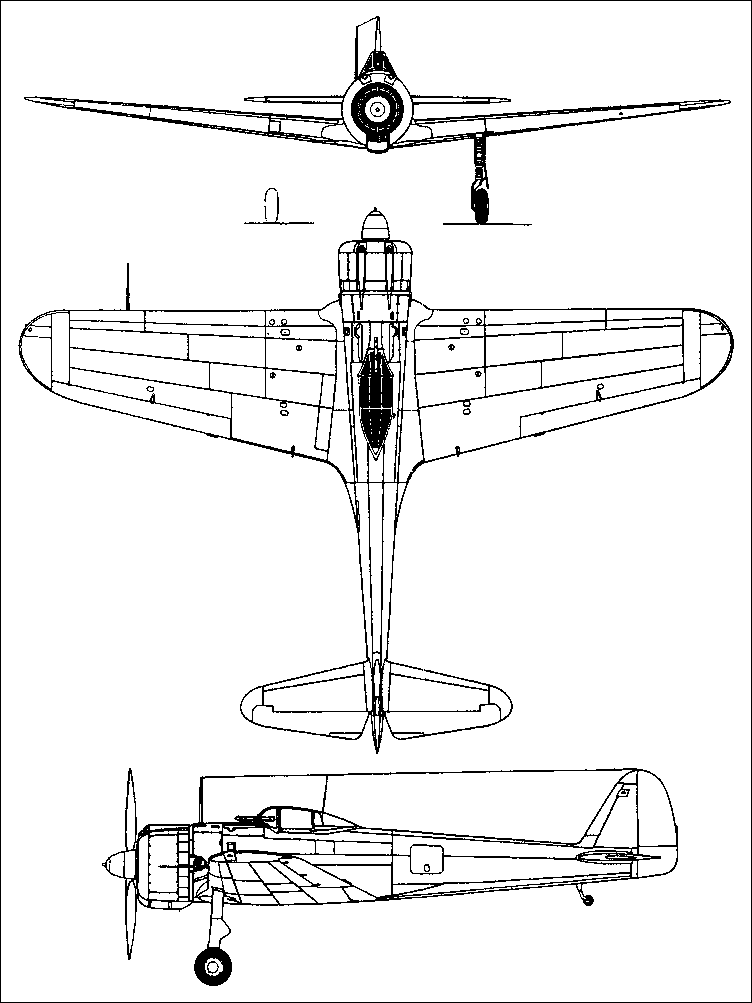


20
reply