|
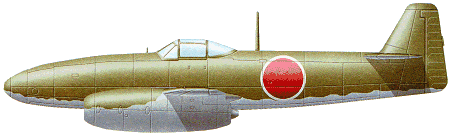
| Encouraged by enthusiastic reports of
the German Messerschmitt Me 262
from the Japanese air attache in Berlin,
the Japanese naval staff instructed
Nakajima to develop a single-seat
attack bomber based on the Me 262,
capable of a speed of 690km/h and able to carry a small
bombload. Design started in September
1944 under the direction of Kazuo
Ohno and Kenichi Matsumur, and the
resulting aircraft resembled the German
design although somewhat smaller
owing to the very low power available
from the early Japanese jet engines.
Initially the first prototype Nakajima
Kikka (orange blossom) was fitted
with a pair of 200kg thrust
Tsu-11 ducted-flow engines, but these
were quickly replaced by 340kg thrust Ne-12 turbojets. These also
proved inadequate and for the first
flight two 475kg thrust Ne-20
axial-flow turbojets were fitted;
however, it was still necessary to employ
an auxiliary rocket for assisted
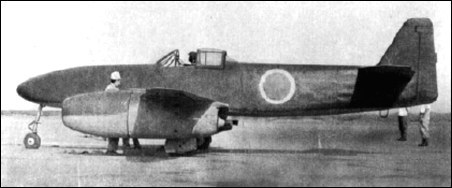
take-off. The Kikka was first flown on 7
August 1945 at Kisarazu Naval Air Base
by Lieutenant Commander Sasumu
Tanaoka; the second flight ended in
damage when Tanaoka abandoned
the take-off owing to the ATO rockets
being incorrectly mounted. A second
prototype was then nearing completion
and manufacture of 18 further aircraft
had started when, on 15 August,
the entire programme was abandoned.
Production, which included
versions for training, reconnaissance
and air combat, had also been planned.
| MODEL | "Kikka" |
| CREW | 1 |
| ENGINE | 2 x He-20 turbojets, 475kg |
| WEIGHTS |
| Take-off weight | 3500-4080 kg | 7716 - 8995 lb |
| Empty weight | 2300 kg | 5071 lb |
| DIMENSIONS |
| Wingspan | 10 m | 33 ft 10 in |
| Length | 8.13 m | 27 ft 8 in |
| Height | 2.95 m | 10 ft 8 in |
| Wing area | 13.2 m2 | 142.08 sq ft |
| PERFORMANCE |
| Max. speed | 700 km/h | 435 mph |
| Ceiling | 12000 m | 39350 ft |
| Range | 940 km | 584 miles |
| ARMAMENT | 1 x 800-kg bomb |
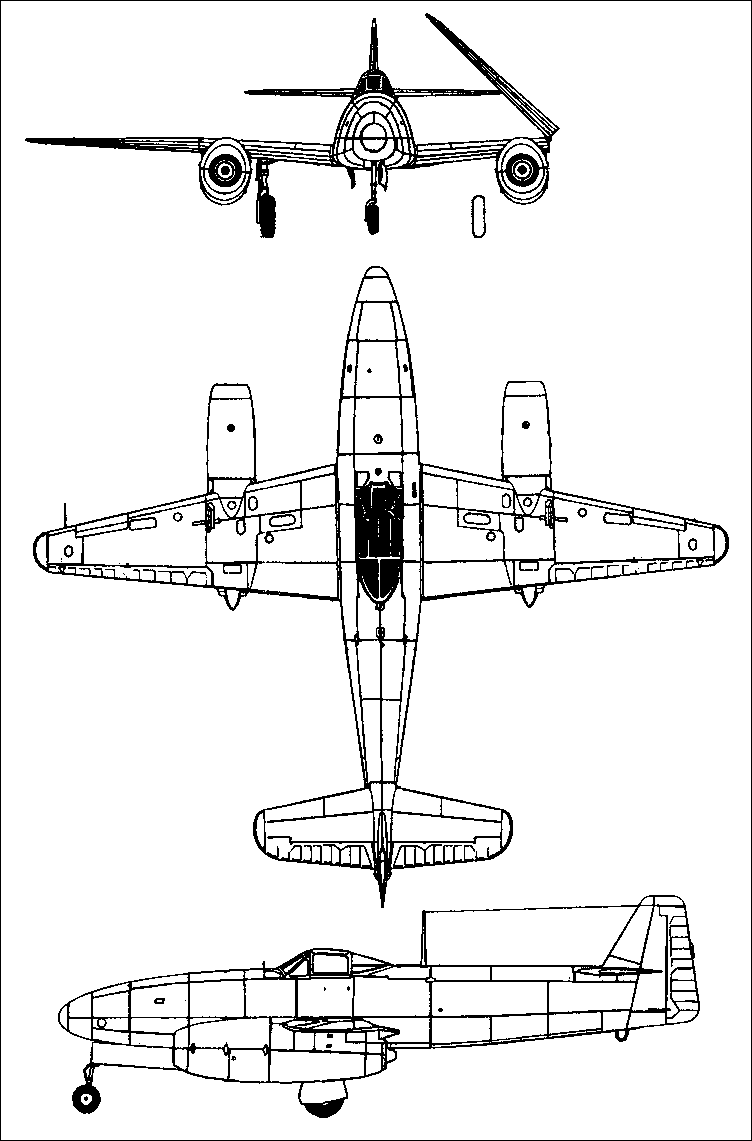
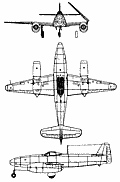 | A three-view drawing (752 x 1141) |
| ubaTaeCJ, e-mail, 21.02.2025 17:26 20 reply | | Eyeball Mk2, e-mail, 31.07.2024 12:03 Lets look at some figures. The ME262 takeoff weight was (as given on this site) 6,400kg, the Kikka is given as (lowest) 3500kg, so it was about half the weight. But the maximum individual engine power given to the Kikka (above) is 475kg, compared to the 262's 8.8Kn (899Kg). Clearly the Kikka would not compare favourably to the 262 unless much improved engines became available, and this is evidenced by the need for rocket assistance on take-off. Further, the Allies were deliberately starving the Axis powers of essential war materials (look at the attacks on ball bearing factories and oil refineries, destruction of heavy water plants, etc.) so Japanese mass production of powerful jet engines was not going to happen. The Kikka is an interesting footnote to the rapid development of aircraft but (like the Me163 Komet) would never change the course of the war. reply |
| sven, 23.03.2018 11:21 This used to be such an interesting place to visit. I think I'll go and put the kettle on and then watch the birds in my garden. reply | | Heinkel Wulf, e-mail, 22.03.2018 11:42 @Richthofen (AKA The Doktor),The person you attacked may be guilty of being a little heavy on the bias, but you're clearly no better, and ironically, quite full of it yourself. reply | |
| | Johann Reiter, 23.11.2016 18:44 Spoken like a true Socialist. reply | | Richthofen (AKA The Doktor), e-mail, 09.08.2016 18:29 Oldgysgt, This is an aviation enthusiast site, not a political forum you arrogant Wad. I suggest you keep that in mind next time you feel the urge to bleat out your I'll informed and poorly researched diatribe. However, since you clearly came hear looking for conflict,thinking no one here would dare contest the "infallible" word of the American "ubermensch", Ill happily procede to poke a few holes in that hot air balloon that is your cranium. Your country is guilty of the exact same "racial arrogance" that you accuse Japan of having, and is every bit as short sided as the straw man Spector you depict with regards to your own nations ill thought out military endevours,from the war of 1812 US invasion of British Canada, where it was routed by a considerably smaller force, to the Vietnam war, where a vastly less sophisticated opponent achieved the same, and the current boondoggle the US has got itself stuck in in the Middle East, where its brash military intervention has like scratching poison ivy, caused otherwise localized extremist groups to spread and breed ever more insane followers. On the topic of Islamic extremism, I find it rather hilarious that you presume to lecture on the actions on non US groups, when your nation is allied with, as well as finances and arms several countries who are fanatically Jihadist, and puts their citizens to death publically on a regular basis. And what of your own nations atrocities? Mai Lai massacre, the extermination of millions upon millions of Native Americans, the enslavement of Africans, as well as rape of foreign civilians who's country you happen to be fighting, (for less than noble reasons at times) as well as the casual execution of soldiers trying to surrender, and amputation of body parts from in some cases live prisoners. Do these things ring a bell? How bout that time when "righteous n noble murica" imprisoned millions of its own citizens based merely on the way they looked? Oh yes, and you mentioned the atomic bombs, indeed, let's discuss that. By now its widely accepted that they had nothing to do with saving lives, and were essentially just a testical comparing act aimed at the Soviets whom most of the military planners assumed they would be fighting immediately after the war with Japan was over. And it was indeed over by that time, with Japan already willing to negotiate a termed surrender, who's requests weren't at all unreasonable. Deny it all you like, but the US had intercepted their surrender attempt to the Soviets. There was no excuse for what happened.Eisenhower admitted it was a mistake, as did MacArthur, and plenty of other prominent US military leaders who in today's age would be classed as conservative. It isn't "revisionist history", its the cold hard reality you've failed to realize. You can bawk about alleged atrocities against your own people all you like, but its still a logical fallacy, as two wrongs dont make a right. Getting back to the topic at hand, you neglect to mention (or just aren't very well versed in this topic) that the Kikkas engines used for the test flights weren't the finalized versions, which would indeed have given it performance comparable to the German jets, and certainly better than that of the overrated Runstang, which wasn't even the best US prop fighter to begin with. I really don't give a damn about the "evaluations" you mentioned, as they were generally heavily biased, and neglected to mention the areas which various Axis aircraft (particularly from Japan) were on par with, or better than their US counterparts. Basically, those so-called "evaluations" which you trot out as some kind of divine revelation, were little more than Yankee war propaganda dressed up to sound "objective." The war between the US and Japan wasn't at all a "foregone conclusion", but a contingency victory, in which had certain things not gone the way they did, the US could easily have lost in the case of Japan fighting a defensive war. You and other Americans would do well to remember this the next time you arrogantly assume you can defeat any nation you go to war with, and keep in mind that no wars conclusion is forgone.Your countrys military isnt nearly as hard as you assume it is. Do YOU understand American? For your country's sake, I hope so. reply | | Ron, e-mail, 18.01.2016 01:24 The Kikka was a good precurser for the promising Karyu which is closer to the Me 262 in appearance. Instead of pouring resources into the Ki 43 to the end of the war, they shouldn't have waited so long to benefit from Luftwaffe jet and rocket research. They lagged behind the progress of their Axis partner too far. reply | | Oldgysgt, e-mail, 16.01.2016 06:29 All of the "What if" people miss the point; there was NO WAY Japan could overcome the combined might of America, Great Britain, and the USSR! No fighter, no bomber, no super submarine, or Kamikaze tactic was going to change that fact. The Japanese military leaders let racial arrogance and belief in the supposed divinity of Hirohito blind them to reality. It took the intense light from Hiroshima and Nagasaki to illuminate the handwriting on the wall. Wars are not won with a few "wonder" weapons, or people who are willing to "Die for the Emperor", (or Allah). They are won by dedicated people with the will, the training, the INDUSTRIAL SUPPORT, and the leadership to carry them to final victory, (are you listening ISIS?). The reason the Barbarians were able to step over the Roman walls is that the Romans let their walls down due to laziness and apathy, (are you listening Obama?). reply | | Oldgysgt, e-mail, 16.01.2016 05:44 Some of the contributors below are touting the virtues of the Nakajima Kikka, including its maneuverability; based on what? The text above indicates it was flown twice, (being damaged on the second flight). Was it evaluated in the US after the war, or do some people "assume" all Japanese aircraft were highly maneuverable? If you look at its performance figures it was hardly a formable aircraft. At 435mph it could be easily be outran by a P-51H, (which was active in the Pacific theater at the time). A jet fighter that needs a rocket assist just to get airborne is hardly a "world beater". To the designers credit, the Nakajima Kikka did make Japan the fourth nation to successfully fly a pure turbojet aircraft, but the Kikka was no more a perspective operational fighter than the Bell P-59 Airacomet of 1942 was. As for carrying a 800kg bomb into combat; just how was it going to do that, when it took RATO just to get in the air with only a pilot for a payload! reply | | Alex, e-mail, 22.03.2014 14:36 Talking with my dad about the ME 262 and we were talking for a while then he mentioned the Kill a so we talked about that and he could not remember most about this plane so looked it up and he was reading it. Very interesting. reply | | beifan, 21.06.2011 05:16 and if a ordinary hurricane can down a 262 then what would happen if a plane better fought one 10 times worse
no question really reply | | Chris, e-mail, 15.06.2010 03:55 First, I totally agree with calum morris, you are right, not to mention the fact that at the time, Japan had no good pilots, all that was left were trainees who don't even have a single hour in piston aircraft! reply | | B7ARyusei, e-mail, 21.08.2010 01:23 Eh,Jack Brown,some,is possible create Kikka replicas with Gloster Meteor aircrafts reply | | Ta-183 Huckebein, 15.05.2010 17:08 Wowwwwwwwwwww...........................................
I didnt even know they could make such a plane....................Or could they? reply | |
| | proudflesh, e-mail, 18.02.2010 01:11 Allied comparisons between the P-80 and Me-262 (after the war) demonstrated the superiority of the Me-262, so it would seem some of the assumptions written here are amiss.
No doubt tactics play a major role in conclusions regarding any aircraft's superiority over another. If one includes things such as difficulty of maintainence in the field and all the other things too numerous to mention here, one would still have to say the Germans had the best jet design of the war and for sometime after(as C. Yeager once said, "we had nothing to equal the Me-262 until the F-86 which was superior"), I think that is a fairly accurate quote. He flew them all, he would know. reply |
| Ne20, 08.10.2009 05:13 Since development of Ne-20 and Ne-20 Kai turbojet was favorable,
it was due to be developed as not only the bomber but also a fighter plane.
Ne-20 Kai
www.youtube.com /watch?v=yw_XY9dl9s0 reply | | Hiroyuki Takeuchi, 30.01.2009 04:27 This, unlike the Me262, was not a fighter plane. A bomber, which, in 1945 Japan, mostly meant a Kamikaze plane. reply | | Joe Bloe, 04.01.2009 23:07 While it did have weaker engines than the more extensively developed Me262, it was much smaller and much lighter.
Furthur developement in the Engines (the only lacking part) might have lead to an impressive airplane. reply | | Maguire, 03.06.2008 16:32 The Kitta may have been more maneuverable but it lacked armor, like most Japanses planes. That along with the unreliable engines means that it was not a great plane, mearly a cheap copy of one. reply | | Aero-Fox, 31.03.2008 05:44 Yes, but it was more compact with bigger tail surfaces. The Me 262 was very vulnerable in the turn (that's how Allied piston-engine machines shot them down), the Kikka would not have been. reply |
|
Do you have any comments?
|
| 
COMPANY
PROFILE
All the World's Rotorcraft
|


 proudflesh

20
reply