|
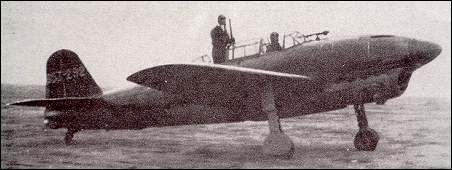
| Well-proportioned and purposeful in
appearance, the Yokosuka D4Y possessed
an excellent performance and
owed much of its concept to the German
He 118, for whose manufacturing
rights Japan negotiated in 1938. Designed
as a fast carrier-based attack
bomber and powered by an imported
Daimler-Benz DB 600G engine, the
D4Y1 was first flown in December
1941; D4Y1-C reconnaissance aircraft
were ordered into production at
Aichi's Nagoya plant, the first of 660
aircraft being completed in the late
spring of 1942. The first service aircraft
were lost when the Soryu was sunk at
Midway. Named Suisei (comet) in service
and codenamed 'Judy' by the
Allies, many D4Yls were completed
as dive-bombers, and 174 Suiseis of
the 1st, 2nd and 3rd Koku Sentais were
embarked in nine carriers before the
Battle of the Philippine Sea. However,
they were intercepted by American
carriers, and suffered heavy casualties
without achieving any success. A new
version with 1044kW Aichi
Atsuta 32 engine appeared in 1944 as
the D4Y2 but, in the interests of preserving
high performance, nothing
was done to introduce armour protection
for crew or fuel tanks, and the sole
improvement in gun armament was
the inclusion of a 13.2mm tramable gun (replacing the previous
7.92mm gun) in the rear cockpit.
This version suffered heavily in the
battle for the Philippines. Problems of
reliability with the Atsuta (DB 601) engine
led to adoption of a Kinsei 62 radial
in the D4Y3, and this engine was
retained in the D4Y4 which was developed
in 1945 as a single-seat
suicide dive-bomber. A total of 2,033
production D4Ys was completed.
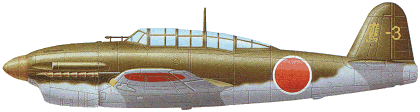
| MODEL | D4Y2 |
| CREW | 2 |
| ENGINE | 1 x Aichi AE1P "Atsuta", 1050kW |
| WEIGHTS |
| Take-off weight | 3840 kg | 8466 lb |
| Empty weight | 2640 kg | 5820 lb |
| DIMENSIONS |
| Wingspan | 11.5 m | 38 ft 9 in |
| Length | 10.2 m | 33 ft 6 in |
| Height | 3.75 m | 12 ft 4 in |
| Wing area | 22.8 m2 | 245.42 sq ft |
| PERFORMANCE |
| Max. speed | 575 km/h | 357 mph |
| Cruise speed | 425 km/h | 264 mph |
| Ceiling | 10700 m | 35100 ft |
| Range | 3600 km | 2237 miles |
| ARMAMENT | 7.92 or 13mm machine-guns, 1 x 500-kg bomb, 2 x 30-kg bombs |
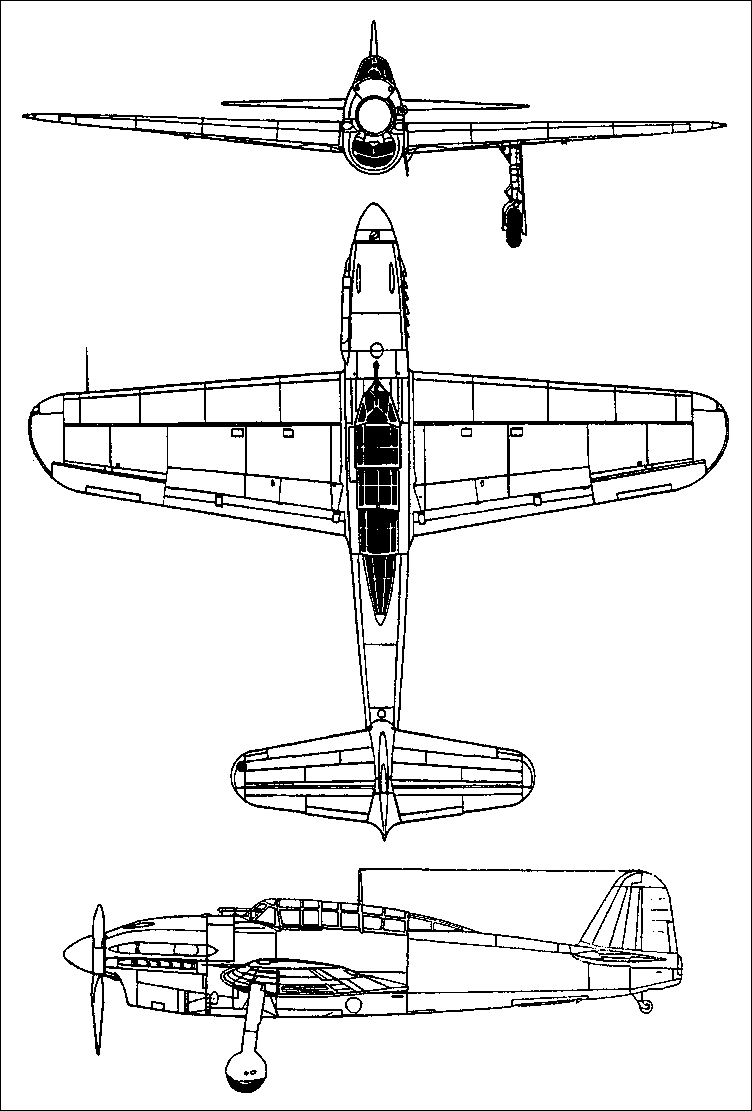
 | A three-view drawing (752 x 1111) |
| ron, e-mail, 14.06.2017 22:16 At least 13 D4Y2-S night fighters were delivered.
They claimed 5 B-29s shot down and 4 more damaged.
That's not bad for a single 20mm cannon.
It should have had 2 to 4x20mm at a 15 degree angle, just enough to clear the prop. Delete the 2nd seat to compensate, but add pilot armor.
Ammo then would be on the 'cg' and the cannon barrels burried in the fuselage with no drag. Enemy pilots would not realize it wasn't a dive-bomber.
If Japanese radar were efficient, keep the observer.
Otherwise why not increase the firepower to that of other fighters? The Judy was already faster than all Zero fighters! So it could be a day fighter too.
I think it had unrealized potential.
The Atsuta engine was more unreliable than the Ha-40 in the Ki 61 Tony. This changed to the radial Ha-112-II in the D4Y3 Judy, before the Tony did the same in the Ki 100.
Yokasuka deserves credit for that. But while it had the inline engine, it could have had a motor-cannon fire through the spinner like the Bf 109 with the same basic motor. reply | | Klaatu83, e-mail, 22.06.2013 02:02 During the war it was alleged that this was derived from the German Heinkel He-118 dive-bomber, which was not true. However, it's engine was derived from the German Daimler-Benz DB-600. The latter proved to be the otherwise-excellent dive-bomber's "Achilles Heel" and was eventually replaced by a more reliable radial engine. However, by that time there simply weren't enough aircraft carriers, or qualified carrier-based pilots. reply | | Hiroyuki Takeuchi, e-mail, 23.03.2012 10:50 >mort_faucheur
Shrage Musik and the Japanese oblique cannon was the same concept but does not share origins. Same conclusion through different channels. IJN's oblique gun concept was IJN Captain Kozono's baby and the first IJN oblique gun victory and the first Sharage Musik victory are both recorded in June 1943. One of the objections against Kozono's recommendation for such gun installation is that "if such gun installation is effective, the Germans must already be using it". So no relation in the origin of these very similar ideas. reply | | duey, e-mail, 31.10.2011 02:24 I am restoring a D4Y_ at Planes of Fame Air Museum in Chino, California. There is only one other D4Y JUDY example we are aware of, it is in a War Shrine in Tokyo. An interesting aircraft with many features. It was built, I believe, with US aluminum, probably purchased before December 1941. We do not have an original engine, either in-line or radial... but we expect to taxi this example. reply | |
| | gooda, 20.06.2011 13:14 upward-firing pair of 20mm cannon in the rear cockpit, after the successful experience the Luftwaffe gained with this installation, 'Schrage Musik'. reply | | DebtMan, e-mail, 01.10.2010 07:13 The Judy was the successor of the Val.Was enter in combat in Guadalcanal,but why a limited use.Latest in 1944 was participied in the Phillipines Sea Battle.In the last monts of that year was used in the Leyte Gulf Battle as kamikaze,dive bomber,assault aircraft and scout plane.During 1945,was used as kamikaze,dive bomber and assault plane,in defence of the Home Islands.The most famous mission of the Judy was in 1945 16 april,when various Judys,both kamikazes and dive bombers,was striked the USS Laffey reply | | Jackie, 08.08.2010 05:21 The Yokosuka D4Y was a successor to the Aichi D3A Val. It was a very fast dive bomber and can sometimes even serve as a fighter. It made its first combat appearance during the Battle of the Marianas. But it was mostly used as a kamikaze aircraft during the closing months of the war. reply | | Tim King, e-mail, 12.11.2009 05:02 12 /11 /09. Can anyone tell me where to get photographs and /or line drawing showing the internal bomb bay arrangements. I want to convert a 1 /72 Fujimi model to have an open bomb bay and depict the bay and bomb shackles as accurately as possible reply | | Xiaohan, 19.10.2008 08:05 However, the lack of proper armament and armour caused 6 to be shot down by one US navy pilot during the famous marine turkey shot using only 360 bullets on one mission reply | | mort_faucheur, 19.08.2007 08:07 The Judy was also an effective night fighter against B-29s owing to its high operational ceiling when properly equipped and fitted with with an upward-firing pair of 20mm cannon in the rear cockpit, after the successful experience the Luftwaffe gained with this installation, 'Schrage Musik'. reply | | mort_faucheur, 19.08.2007 08:03 The Judy was also an effective night against B-29s owing to its high operational ceiling when properly equipped and fitted with with an upward-firing pair of 20mm cannon in the rear cockpit, after the successful experience the Luftwaffe gained with this installation, 'Schrage Musik'. reply | | mort_faucheur, 19.08.2007 07:41 Here is a famous photo of a Judy kamikaze attack on the US Essex, Nov. 25, 1944. Link: en.wikipedia.org /wiki /Kamikaze
For much more information on the D4Y series, try en.wikipedia.org /wiki /Yokosuka_D4Y reply | | mort_faucheur, 19.08.2007 04:50 R.P., there are many photos extant of Judy's being shot down very close to the decks of USN vessels. It's more than likely some successfully managed to hit U.S. warships, particularly during the Okinawa campaign. For confirmation, you'll probably need to review USN combat archives online. reply | | RUDOLPH PUCKETT, e-mail, 03.07.2007 07:47 SIRS. AS A SUICIDE DID IT HIT ANY U.S. WARSHIPS??
AS A SUICIDE WEAPON, DID IT HIT ANY U.S. NAVY SHIPS.. THANK YOU R. PUCKETT. reply |
|
Do you have any comments?
|
| 
COMPANY
PROFILE
All the World's Rotorcraft
|