|
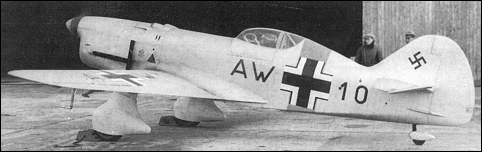
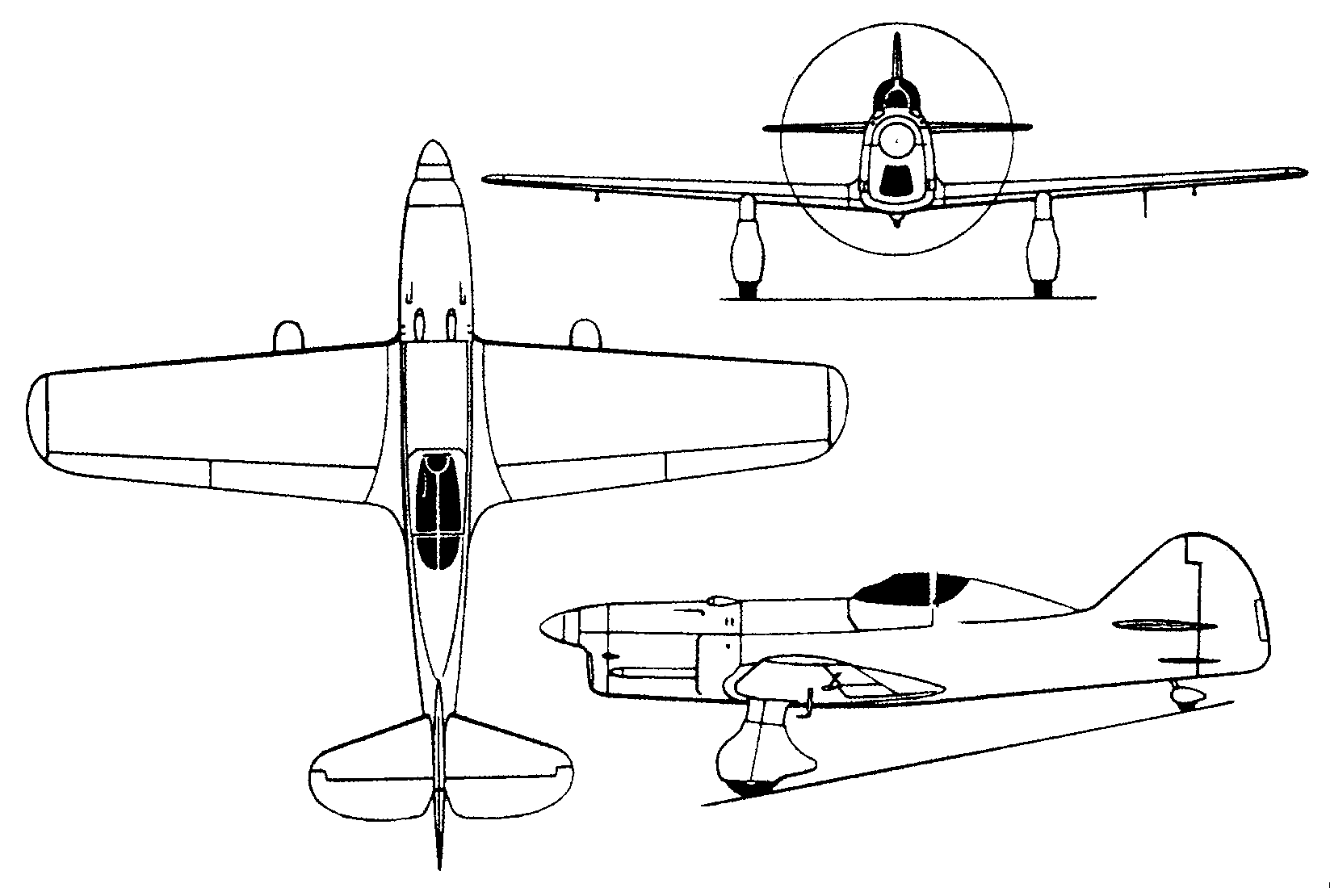
| Owing much to a line of light cabin monoplanes and advanced trainers, the I-16, designed by Karlis Irbitis and built as a single prototype by the Valsts Elektrotechniska Fabrika (State Electro-Technical Factory) at Riga, was a single-seat lightweight fighter. Of wooden construction with plywood skinning and a fixed, faired undercarriage, the I-16 was powered by a 454hp Walter Sagitta I-SR 12-cylinder inverted-Vee engine. It carried an armament of two 7.9mm fuselage-mounted machine guns which could be augmented by two wing-mounted 20mm cannon. The success of initial flight testing of the I-16 in 1939 prompted the Latvian authorities to order prototypes of the heavier and more powerful I-19 air superiority fighter, but this was still on the drawing boards when Latvia was occupied by Soviet forces on 17 June 1940. The sole prototype of the I-16 was subsequently flown in Soviet markings which gave place to Luftwaffe markings when the Wehrmacht advanced into Latvia during the following year.
 | A three-view drawing (1647 x 1110) |
| WEIGHTS |
| Take-off weight | 1540 kg | 3395 lb |
| Empty weight | 1100 kg | 2425 lb |
| DIMENSIONS |
| Wingspan | 8.23 m | 27 ft 0 in |
| Length | 7.30 m | 24 ft 11 in |
| Wing area | 11.43 m2 | 123.03 sq ft |
| PERFORMANCE |
| Max. speed | 483 km/h | 300 mph |
| Range | 805 km | 500 miles |
| lxbfYeaa, e-mail, 17.01.2026 20:05 20 reply | | BiplaneLover, e-mail, 05.08.2015 13:34 For any mod in this website, here's some info about latvian military aircraft - latvianaviation.com /en /index.php?content /AF_Index.ssi reply | | Stephen Round, e-mail, 20.10.2013 23:19 Lightweight fighters had no future in the second world war even the Japanese manufacturers eventually started making heavyweight fighters because even their very best lightweight fighters simply became moving targets for the allied air forces to shoot down at leasure. This was due to the new high energy diving and zooming tactics employing the vertical plane of the sky this utilises the kinetic energy of the airoplane to gain advantages over their opponents in combat which cannot be countered by any lightweight.
As Mr Smith the head of development for the Spitfire project said ..."a good big un will always beat a good small un" and that was that. reply | | sven, 08.02.2012 01:01 Peter has it in one.Its lacking about 100 sq-ft of wing area for even the smallest merlin. Would I like to have one as it is? Oh yes. reply | |
| | Pater, 23.09.2011 15:23 Bigger engine like Merlin for this tiny fuselage is a nonsense. Merlin was at least 300kg heavier than Sagitta + radiator + coolant + bigger propeller = + 450kg at least. Even if you place the radiator somewhere at the back to improve ballance, it will still have too much weight forward. Plus, you need to strenghten and enlarge the whole body and the wing and improve firepower. That makes for a new airplane that will be at least a ton heavier than the original. reply | | napo, 18.06.2011 12:32 If it had been given a bigger engine I would imagine it could've given any Axis or Allied fighter of the day a hard time. reply | | bombardier, e-mail, 25.05.2011 10:01 With retractable undercarriage and a bigger engine a Merlin for example this fighter would have given a hard time to the Soviet fighters reply | | bombardier, e-mail, 25.05.2011 09:58 With retractable undercarriage and a bigger engine a Merlin for example this fighter would have given a hard time to the Soviet fighters reply | | leo rudnicki, e-mail, 05.05.2009 17:42 Karlis Irbitis emigrated to Canada and designed the control system for Canadair CL-84 Tilt-Wing, see rotorcraft section.I don't think Soviets added markings, only the Germans. Upon occupation by Soviets, Soviet Latvians arose like dandelions and took over the factory, sending the Latvian Latvians off to camp. reply | | hichkoks, e-mail, 30.03.2008 23:21 if,same body haw this plane correct drawing, please write me pezo104@mail.ru reply | | Aero-Fox, 30.03.2008 18:12 This is one sexy fighter, I would say. I've always been a fan of the 'civilian-aircraft conversion' school of fighter design, which is what this appears to be. If it had been given a bigger engine I would imagine it could've given any Axis or Allied fighter of the day a hard time. reply |
|
Do you have any comments?
|
| 
All the World's Rotorcraft |