|
| Following an agreement between the Polish and Soviet governments for the design and production of a new large agricultural aircraft, allocated the designation P.Z.L. Mielec M-15, design of this aircraft was initiated in late 1971 and the initial LLP-M15 prototype made its first flight on 30 May 1973. One M-15 prototype and five pre-production aircraft followed, and completion of the development programme was signified by the award of a full certificate of airworthiness on 4 April 1979.
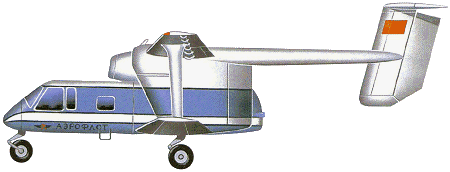
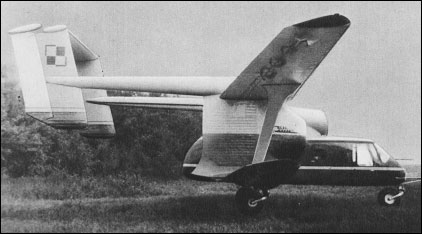
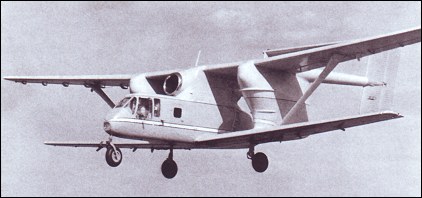
Of unusual configuration, the M-15 had unequal-span biplane wings, twin tailbooms extending aft to twin fins and rudders united by a high-set tailplane and elevator, and fixed tricycle landing gear. A central fuselage nacelle provided accommodation for the pilot and, to his rear, had a cabin to seat two ground crew during ferry flights between operating areas. The single turbofan power-plant was mounted above the fuselage nacelle, and two streamlined chemical hoppers occupied the full gap between each wing, mounted directly beneath the tailbooms, their combined chemical capacity 2900 litres.
Plans had been made to manufacture 3,000 M-15s, which had been given the name Belphegor during 1979, but production ended in 1981 after only 120 had been built because the aircraft was uneconomical in operation, P.Z.L. producing the turboprop An-3 instead. FACTS AND FIGURES © The upper wing was equipped
with a variety of high-lift devices,
while the lower wing had nozzles
for the dispensing of granular or
liquid chemicals.
© The cabin normally housed a
mechanic or two, but could carry
up to 21 passengers for ferry
purposes. These could have been
agricultural workers or perhaps
Special Forces troops. © The chemical hoppers were contained
within the large interplane struts.
Along with the fixed undercarriage
these created a lot of drag and
increased the fuel consumption.
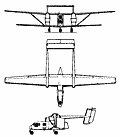 | A three-view drawing (744 x 850) |
| ENGINE | 1 x Ivchenko AI-25 turbofan, 1500kg |
| WEIGHTS |
| Take-off weight | 5750 kg | 12677 lb |
| DIMENSIONS |
| Wingspan | 22.33 m | 73 ft 3 in |
| Length | 13.13 m | 43 ft 1 in |
| Height | 5.34 m | 18 ft 6 in |
| Wing area | 67.9 m2 | 730.87 sq ft |
| PERFORMANCE |
| Max. speed | 200 km/h | 124 mph |
| Cruise speed | 175 km/h | 109 mph |
| Range | 480 km | 298 miles |
| ubaTaeCJ, e-mail, 21.02.2025 19:19 20 reply | | ubaTaeCJ, e-mail, 21.02.2025 19:19 20 reply | | lxbfYeaa, e-mail, 14.03.2024 05:40 20 reply |
| Jim Bowerman, e-mail, 07.01.2011 18:17 There is one of these mounted on a stand at a grass airport just outside of Szolnok, Hungary. reply |
|
| | Waldemar, e-mail, 05.02.2010 05:52 Behind the official agricultural use of this M-15 was plane capable to be used during chemical warfare. At that time Russian didn't care how much fuel plane would burn. They were giving that crazy ideas such as M-15 to Polish engineers to keep them busy and steer away from production of M-18 Dromader and other good independent ideas. I'm not sure how many were build, I was flying one time on a glider cross country flight and have seen well over 30 at the Mielec Airport ready to be shipped to Russia. If I go back to my log book, I may recover the date of that flight over Mielec (I thing it was Sept. 1999)
That was the time when Moscow was telling the PZL factories what they can or can not do do. A friend of mine, Polish born crop duster pilot who flown those planes, may have a first hand and very interested stories on the subject. reply |
| Episofique, e-mail, 11.03.2009 14:01 3000 were ordered, but the soviets changed their mind. Only 750 have been made for Russia. It was too expensive to maintain they gave the jets to Hungary, and others satellite Soviet Republics. reply | | kalrin, 17.05.2008 16:33 onl;y in cracow you say.... ha i saw one in hungary and in russia so i think you have no idea what you are talking about reply | | tiptop, e-mail, 06.05.2008 16:10 The plane was only a prototype. There was no production. If You'd like to see that airplane , come to Cracow. The only prototype is in Polish Aircraft Museum. reply | | Sgt., 19.02.2008 00:02 A jet powered biplane?????
Isn´t the engine too powerful,enough to crack the wings? reply | | Reg Saretsky, e-mail, 06.02.2008 03:14 Actually, in Soviet Bloc three seat cockpit allows collective farm boss & political advisor to ride with ag pilot.
Hmmm- maybe a Forest fire fighting special ?... reply | | wolf, e-mail, 19.10.2007 21:04 Chuck, go see Transavia /australia and if you can coment on Belphegor.... reply | | Chuck, e-mail, 22.09.2007 07:19 Hello, friends:
This is indeed the strangest, aircraft-like flying machine I've ever heard of and seen. Are there more larger photos of it, its details, its cockpit and the like. I'd like to know this rare thing in detail. Seems incredible that it can fly. Should you have the material I've requested make it available for me as soon as you get it, please. I will very highly appreciate your effort.
Yours faithfully,
Chuck reply | | Gerd Naydock, e-mail, 29.08.2007 03:28 A jet-powered biplane as well as cropduster? Now I've seen it all. I wonder what the thinking was behind using this as a powerplant given lack of fuel economy. Fairly slow maximum speed to boot for a jet aircraft. I presume that the large container-looking structures inward from the struts must be chemical storage tanks. Unbelievable. reply |
|
Do you have any comments?
|
| 
COMPANY
PROFILE
All the World's Rotorcraft
|


 Waldemar


20
reply