|
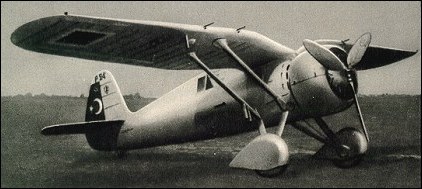
| Because of the terms of licence agreements for the manufacture in Poland of Bristol engines, it was difficult to market export aircraft with P.Z.L.-built versions of these engines. To overcome this difficulty it was decided in February 1932 to develop a new fighter with different powerplant, the airframe of the P.Z.L. P.11 being redesigned to accept a new Gnome-Rhone engine designated 14Kds Mistral Major and rated at 567kW. Availability of the first of these engines delayed until May 1933 the initial flight of the resulting P.Z.L. P.24/I prototype, a flight which ended in a forced landing when the propeller disintegrated. The P.24/I did not fly again until October 1933, showing a need for many modifications which were introduced in the P.24/II second prototype, this aircraft also being known as the Super P.24. On 28 June 1934 the aircraft established an FAI-accredited class speed record of 414km/h. A third prototype flown in 1934, the P.24/III or Super P.24bis was powered by a 694kW Gnome-Rhone 14Kfs and armed with two 20mm cannon and two machine-guns. Exhibited at the 1934 Salon de I'Aeronautique in Paris, this aircraft caused considerable interest and led ultimately to valuable export orders. The first came from Turkey, which not only negotiated a licence for the manufacture of the P.24, but also ordered 40 P.24A fighters generally similar to that shown at Paris, 26 P.24C aircraft with four wing-mounted machine-guns, and components plus raw materials for the assembly of 20 more P.24As. Next came an order from Bulgaria for 14 P.24B aircraft which were similar to the P.24C apart from installed equipment and were delivered from early 1938, followed by 24 P.24Cs and 26 examples of the P.24F, the final development of the type, which introduced a 723kW Gnome-Rhone 14N.07 engine of smaller diameter and had twin cannon and twin machine-gun armament. The P.24E, developed to meet a Romanian requirement, was generally similar to the P.24C: six built by P.Z.L. had 671kW Romanian-built Gnome-Rhone 14Kllc32 engines, but later examples of the 40 or so P.24Es built by I.A.R. in Romania had the 701kW I.A.R.-built 14KMc36 engine. In late 1939 I.A.R.
developed a low-wing version of the P.24E under the designation I.A.R.80. The four machine-gun equivalent of the P.24F had the designation P.24G, and 30 and six respectively were acquired by Greece for service with the Royal Hellenic air force. They comprised almost the entire fighter strength of this last air force and were deployed with considerable success against both the Luftwaffe and Regia Aeronautica.
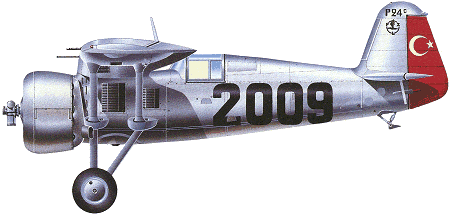
| MODEL | P-24F |
| CREW | 1 |
| ENGINE | 1 x Gnome-Rhone 14N.07, 723kW |
| WEIGHTS |
| Take-off weight | 2000 kg | 4409 lb |
| Empty weight | 1332 kg | 2937 lb |
| DIMENSIONS |
| Wingspan | 10.7 m | 35 ft 1 in |
| Length | 7.6 m | 25 ft 11 in |
| Height | 2.7 m | 9 ft 10 in |
| Wing area | 17.9 m2 | 192.67 sq ft |
| PERFORMANCE |
| Max. speed | 430 km/h | 267 mph |
| Ceiling | 10500 m | 34450 ft |
| Range | 700 km | 435 miles |
| ARMAMENT | 2 x 20mm cannon, 2 x 7.7mm machine-guns |
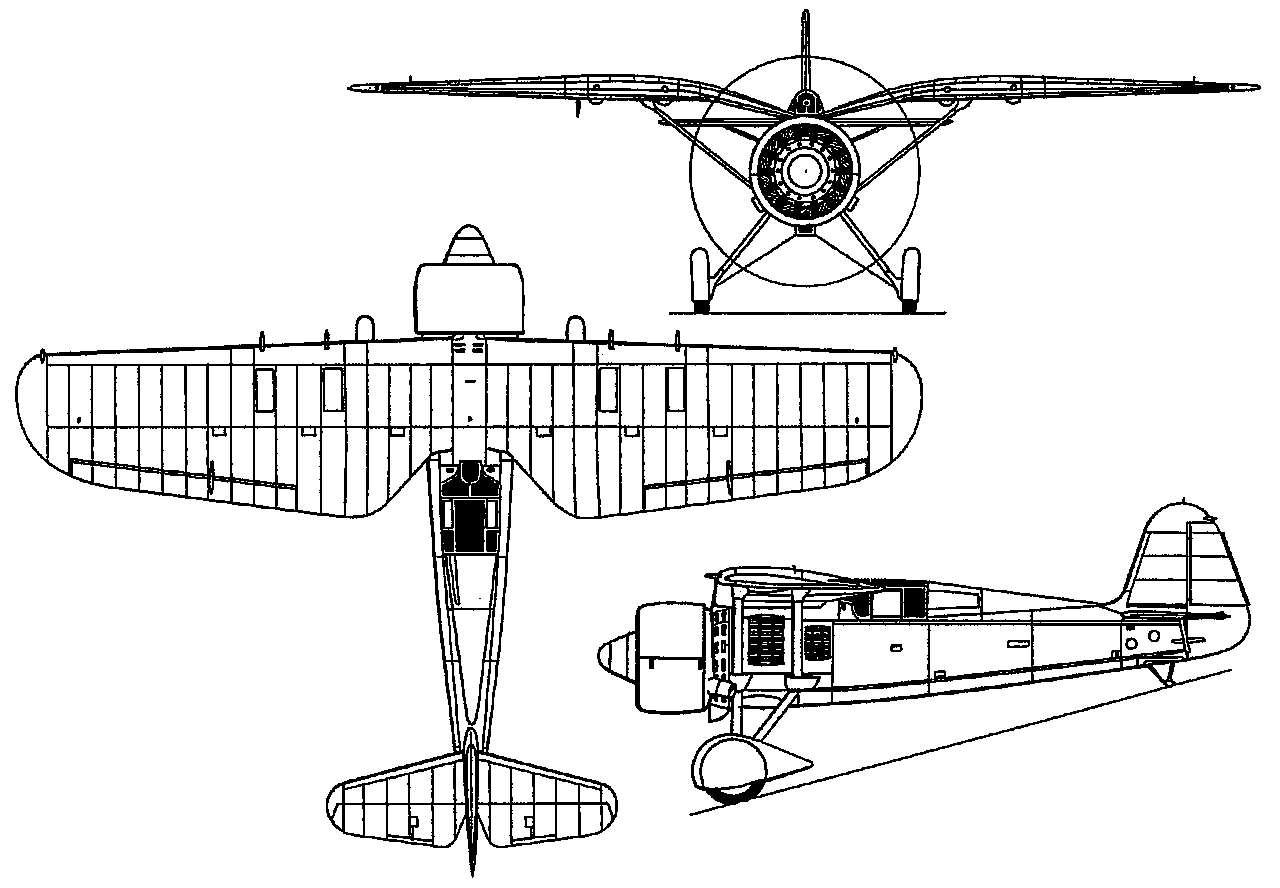
 | A three-view drawing of P.24G (1280 x 888) |
| Andreas Kendristakis, e-mail, 08.11.2026 15:55 The PZL P.24 (specifically variants PZL P.24F and P.24G) served as the primary fighter aircraft of the Hellenic Royal Air Force during the outbreak of World War II.
Greece paid for the PZL P.24 fighters using a barter exchange (clearing system) primarily based on tobacco.
Key Facts in Greek Service
• Acquisition: Greece ordered 36 aircraft from Poland in September 1936 (consisting of 30 PZL P.24G and 6 PZL P.24F models), with deliveries completed by May 1937. They were assigned to the 21st, 22nd, and 23rd Fighter Squadrons.
• Specifications:
- Engine: Gnome-Rhône 14N07 radial engine (950 hp)
- Top Speed: Approximately 430 km /h
- Armament: Fs configured with 2 × 20 mm Oerlikon FF cannons and
2 × 7.92 mm LK32 machine guns and Gs with 4 x 7.92 mm LK32
machine guns.
• Operational History & Combat (1940â€"1941):
During the Greco-Italian War and the subsequent German invasion (November 1940 â€" April 1941), Greek P.24s flew heavily against superior Axis aircraft.
Despite being technically outmatched by modern Italian and German fighters, the 35 active Greek PZL P.24s claimed around 40 enemy aircraft victories (including one achieved via intentional ramming).
All 36 aircraft were eventually lost in combat or destroyed on the ground by April 1941.
The PZL.24F armed with two 20mm Oerlikon FF cannon and two MGs gave the Greeks a temporary edge in combat until lack of ammunition and spares forced EVA to re-arm all P.24Fs with 4x Coltâ€"Browning 7.7 mm MG40 machine guns.
Overall, the PZLs performed gallantly during the early period of the conflict, holding their own against impossible numerical odds and despite the fact that their main target were enemy bombers which forced them to fight at a disadvantage against enemy fighters.
Italian claims of easy superiority over the Albanian front were vastly over-rated and their kill claims even exceeded the total number of operational fighters on the Greek side. reply | | lxbfYeaa, e-mail, 14.03.2024 05:52 20 reply | | axxius, e-mail, 20.02.2013 19:12 the Romanian IAR80 was NOT a P24 version, but a different design. indeed the tail and rear part were "inspired" from the P24 (with some modification), but everything else is different. reply | | aerofan, e-mail, 22.08.2011 23:52 Poland only imported Gnome-Rhone engines. Poland produced engines (for combat aircraft) at Bristol license (for example Mercury VIII). reply | |
| | Barry, 01.07.2011 13:25 To add to William Luther's posting, there are two P24Gs still extent in Turkey. One (2015)is at the Havacilick Museum at Yesilkoy Instanbul and another (2017) is at the Turkish Airforce Museum at Etimesqut Ankara. reply | | Marcin Nevinyrral, e-mail, 13.06.2011 20:50 Poland did not used them, only the P.11 because air forces were waiting for new projest reply | | Bill Clark, 04.01.2011 04:21 Did Poland build the Gnome-Rhone engine for the P-24 or were they imported? reply | | Bill Luther, e-mail, 16.09.2009 23:11 Believe it or not the PZL P.24 was produced for export only and not used by the Polish Air Force. Both the Greek and Romanian air forces used them during World War Two and there is little evidence that the Bulgarian Air Force models saw any combat as by the time Allied aircraft began to appear over their airspace they were already rotated out of front line use. I've read that one example on hand was utilized during 1939 in Poland but to little eefect. reply | | Sgt.KAR98, 22.08.2009 03:13 Wasn´t this plane operated by Poland?
Seems better than the P.11c reply | | William Luther, e-mail, 26.09.2008 22:19 I recently discovered that there is a PZL P24 in existance at the Istanbul Yesilkoy Aviation Turkish Air Force musuem. reply |
| Bill Luther, e-mail, 17.01.2008 18:41 Here is a link to an excellent article on thr P-24 in Greek service against the Italians and Germans:
www.brushfirewars.org /aircraft /pzl_p24_greek /pzl_p24_greek.htm reply |
|
Do you have any comments?
|
| 
COMPANY
PROFILE
All the World's Rotorcraft
|



20
reply