|
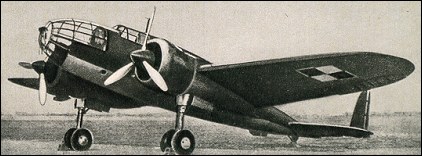
| At the outbreak of World War II the P.Z.L. P.37 Los (elk) was not only one of the most advanced bombers produced by the Polish aircraft industry to that date, but was also the only aircraft in service with the Polish air force that could be regarded as being of modern design. P.Z.L. had proposed the P.Z.L.3 advanced bomber to meet a Department of Aeronautics requirement for an aircraft in this class, but the financial stringencies of 1930 prevented the P.Z.L.3's progress beyond the design stage. P.Z.L.'s next proposal was for a bomber version of the P.Z.L.30 civil transport which, having failed to attract a buyer,
was converted as a bomber prototype by P.Z.L.; it was later developed and put into production by the L.W.S. company as the L.W.S.4 Zubr. P.Z.L. then produced the design for a twin-engine bomber of monoplane configuration, gaining a contract for three prototypes in 1935; the first of them, the P.Z.L. P.31/I, was flown initially in late June 1936. Successful testing of this aircraft, which was powered by two 651kW Bristol Pegasus XII radial engines, led to a contract for 30 under the designation P.37A Los A. Production was completed in 1938, the first 10 having a single fin and rudder, but the
last 20 sporting the twin fins and rudders which had been introduced and tested on the P.37/II prototype. This latter prototype had also been used for development testing of engines in the 746kW class by manufacturers that included Fiat, Gnome-Rhone and Renault. Demonstrated at an exhibition in Belgrade during 1938 and at the Paris Salon in the same year, the P.37A created enormous interest, resulting in export orders for a total of 35 P.37C bombers powered by 723kW Gnome-Rhone 14N.07 engines for Bulgaria (15) and Yugoslavia (20), and 40 P.37D bombers with 783kW Gnome-Rhone 14N.20/21 engines for Romania (30) and Turkey (10). In addition, Turkey ordered components for 15
more aircraft and signed a licence to manufacture. Planned delivery for these export aircraft was from June 1940 and, as a result, none of them was completed. The delivery of Los A aircraft to the Polish air force began in early 1938, and all of these were equipped subsequently with dual controls for use as conversion trainers. Delivery of the ensuing P.37B Los B (which introduced a revised cockpit canopy, twin-wheel main landing gear units, and Pegasus XX engines) began in late 1938. A total of 150 had been ordered, but policy changes that favoured fighters rather than bombers reduced the number to 100, and only about 70 of these had been delivered by the outbreak of war. Even more disastrous for Poland was the fact
that of the Los B aircraft in service only 36 were fully equipped for operational use, though these were supplemented quickly by nine more replacement aircraft. Some 26 of this number were lost in action, and on 17 September 1939 the survivors, plus about 20 other P.37s, were flown to Romania, where they were used subsequently by the Romanian air force. A developed version of the P.37 had been planned under the designation P.49 Mis (teddy bear), intended to be powered by engines of up to 1193kW. A prototype was under construction, but with the German advance on Warsaw it was destroyed to prevent it from falling into enemy hands.
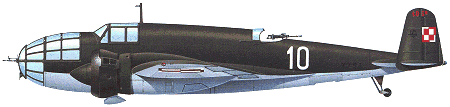
| MODEL | P-37B "Los B" |
| CREW | 4 |
| ENGINE | 2 x Bristol Pegasus XX, 690kW |
| WEIGHTS |
| Take-off weight | 8900 kg | 19621 lb |
| Empty weight | 4280 kg | 9436 lb |
| DIMENSIONS |
| Wingspan | 17.95 m | 59 ft 11 in |
| Length | 12.92 m | 42 ft 5 in |
| Height | 5.09 m | 17 ft 8 in |
| Wing area | 53.5 m2 | 575.87 sq ft |
| PERFORMANCE |
| Max. speed | 445 km/h | 277 mph |
| Ceiling | 9145 m | 30000 ft |
| Range w/max payload | 1500 km | 932 miles |
| ARMAMENT | 3 x 7.7mm machine-guns, 2580kg of bombs |
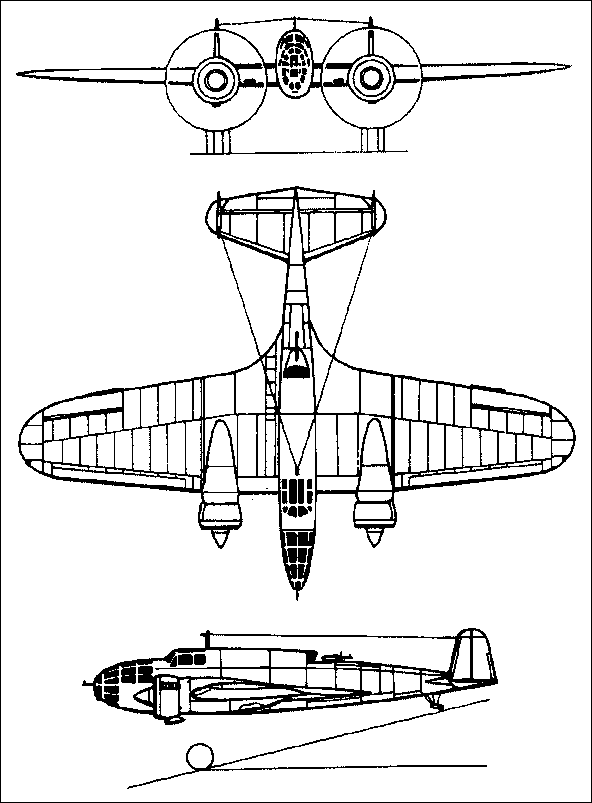
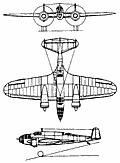 | A three-view drawing (592 x 803) |
| ubaTaeCJ, e-mail, 21.02.2025 19:23 20 reply | | Franco, 22.01.2015 20:50 it's available a polish manual of this the actual data
were (rounded):
empty weight 4,9 ton, max TO weight 9,1
max speed 412 km /h at 2.8 with a 8.6 ton weight
max endurance (1900 rpm) with 945 kg of fuel and 20x100 kg bombs 3 hour and 12 minutes.
bomb load 4x100 kg on bomb bay and 16x100 kg in single wing bays. can change 2 of bomb bay bombs with 300 kg bombs. the common 2580 kg bomb load came from 2x300 + 18x110, 110 was the actual weight of the 100 kg bombs but is uncommon /strange use the actual weight of bombs reply |
| Gilles Pepin, e-mail, 22.07.2014 17:35 Mirage Hobby makes a great 1 /48 scale model of the PZL-37B; decals for 2 Polish and one German versions. I am building this kit in the near future. Look it up on eBay. Or contact me. reply | | jacek rudowski, e-mail, 01.09.2011 18:36 i have a diecast model of the polish los bomber from my father, prior to the war he lived in poland. when the second ww started my fathers family was in bulgaria, i can only speculate that he had this with him & that is why the model survived the war. reply | |
| | bombardier, e-mail, 23.05.2011 15:17 The aircraft was only a little larger than an Electra Model 10 but it could carry a heavier load than the Wellington and it was faster reply | | Funky, e-mail, 04.07.2010 16:24 Hi
There is one part of this air plane which survived. Bend propeller, item is located in main hangar of Air Museum in Krakow Poland it is standing of front of PZL P11C
Cheers reply | | Romuald Antoszewski, e-mail, 01.04.2010 03:03 The orignal plans of this aircraft exist. There were some good publications in Poland with original reprints.
Also just for information, the exact translation of the name PZL 37 Los is PZL 37 Moose not Elk. I am actually putting together couple of models in 1 /72 scale. When I am done I will post some pictures. reply |
| Don, e-mail, 13.03.2010 22:33 An RAF friend of mine used to kid me about the skimpy bomb load of the B-17, which was about 2 tons. That's understandable, since they were designed with so many machine guns to fight their way to the target, a strategy which later proved to be flawed (re: Schweinfurt ). Of course the Elk did not have the range of the B-17, but almost a 3 times bigger bomb load, which was also much bigger than the HE-111. Incidentally, does anyone out there know of any source for a Polish newsreel documentary of their war with Germany? Would appreciate any help. DON reply | | Martin, e-mail, 04.09.2009 23:12 Hi!
does anybody know if there are original construction plans of this plane? Does anybody know if someone is trying to "resurrect" this plane? Write me reply | | Sgt.KAR98, 22.08.2009 03:17 Maybe this plane should been used as a heavy fighter...(?) reply |
| Terry, e-mail, 28.09.2007 23:12 I also met one of the original pilots. He lives in Poland. I met him just by chance (sitting next to me at a restaurant) while I was on vacation there last summer. Really great guy! He told me that there are only a couple of the original pilots still alive. 4 (including him) to be exact and all live in America except him. He actually survived several missions before being shot down. Spent the rest of the war in a one of the prison camps. He must be fairly well known, because he had tons of newspapers over the years with his pictures and stories about him. reply | | bef_hero, e-mail, 08.09.2007 23:57 Roland, what do You want to know about P-37 LO�? I can send You a mail with many documents with Lo�. reply | | ROLAND, e-mail, 23.08.2007 13:29 I am interesting about airplane PZL P-37 £OŒ...is somebody known about this plane? Thanks
Michael J Fowler, e-mail, 11.07.2007
I knew one of the pilots who flew one of these planes to Bucharest. He subsequently went to France and flew Morane 406s against the Germans. reply |
| Crazy_Ivan, e-mail, 21.07.2007 22:25 Those bombers were great, but without covering fighters and good recon many of them were lost. Unfortunately polish pilots managed to destroy some German convoys including tanks and support. To compartment £oœ was better than He-111, which was a middle tactical bomber too. It's needed to say hat Romanians take retreating bombers as a delivery and recovered them. Romanian forces were fighting as Axis country, and none of PZL-37 survived to present times. reply | |
| | Michael J Fowler, e-mail, 11.07.2007 00:29 I knew one of the pilots who flew one of these planes to Bucharest. He subsequently went to France and flew Morane 406s against the Germans. reply |
|
Do you have any comments?
|
| 
COMPANY
PROFILE
All the World's Rotorcraft
|


 Romuald Antoszewski

20
reply