|
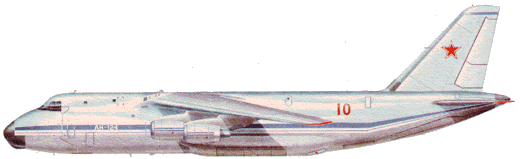
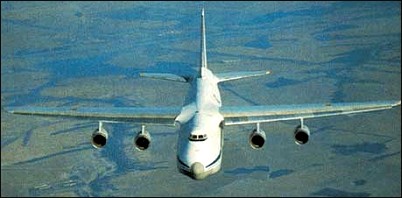
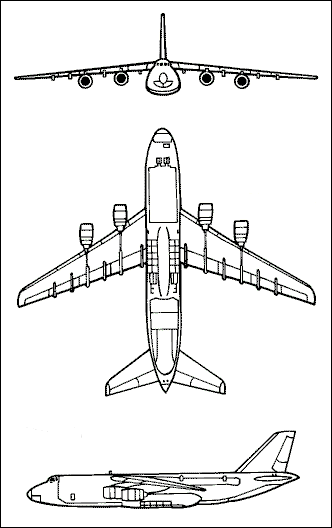
| At the time of its first flight on 26 December 1982, the An-124 was the largest aircraft in the world. Antonov's experience with the huge turboprop An-22 gave it a head start when design began on the new giant, as did knowledge of the slightly smaller Lockheed C-5 Galaxy. Indeed, apart from its low-set tailplane, the An-124 is very similar to the Lockheed product.
Four Lotarev D-18T turbofans power the giant, slung in pods under the large anhedralled wing. Full-span leading-edge slats and large flaps give the An-124 impressive short field capability, while its 20 main wheels allow the type to use rough fields. Two nose-wheel units each have a pair of wheels, and these can be retracted on the ground allowing the aircraft to 'kneel' to assist loading. Like the Galaxy, the An-124 has an upward-hingeing nose visor and rear clamshell/ramp doors to allow front or rear drive-on loading.
Accommodation on the flight deck caters for six crew (two pilots, two engineers, a navigator and a radio operator), and behind this is a rest area. Behind the wing on the upper deck is accommodation for up to 88 passengers. The 36m long main cabin is pressurised and has two electric cranes in the roof, each lifting up to 20000kg. Two winches are fitted, able to pull loads through the cabin. Control of the aircraft is effected by a quadruple-redundant fly-by-wire system.
Following its first flight, with Vladimir Terski at the controls, the An-124 showed few problems, and production aircraft appeared quickly. The second aircraft, named Ruslan, appeared at the 1985 Paris Air Salon. The aircraft entered service with Aeroflot in early 1986, and now serves principally on the Siberian run, carrying outsize items to the oil and mineral exploitation industries. In 1987 the An-124 began service with the air force. Production is reportedly eight to ten aircraft per year, and by 1989 over 25 had been completed. The An-124 was assigned the NATO reporting name 'Condor'.
| CREW | 6 |
| PASSENGERS | 88 |
| ENGINE | 4 x Lotarev D-18T, 229.9 kN |
| WEIGHTS |
| Take-off weight | 405000 kg | 892877 lb |
| DIMENSIONS |
| Wingspan | 73.0 m | 240 ft 6 in |
| Length | 69.0 m | 226 ft 5 in |
| Height | 22.0 m | 72 ft 2 in |
| PERFORMANCE |
| Cruise speed | 865 km/h | 538 mph |
| Ceiling | 12000 m | 39350 ft |
| Range w/max.fuel | 16500 km | 10253 miles |
| Range w/max payload | 4500 km | 2796 miles |
| lxbfYeaa, e-mail, 14.03.2024 05:11 20 reply |
| Barry, 12.06.2012 13:13 You wouldn't want to own one of these, not unless you had a guaranteed income stream on a very regular basis. The engines need a major overhaul every 2000 hours. A modern western engine of similar size /performance takes on a major inspection in six times that time frame. reply | | Ed Knox, e-mail, 24.08.2010 20:53 We've had quite a few of these transit Ft. Campbell & it always amazes me. I work near the flight line & I've seen many of them. I've taken my family out to see it as well. We've been all over it. The crews are very good about showing you around. I've also taken other visitors, as I have an airfield pass. It's quite an airplane. reply | | brian, e-mail, 10.10.2009 22:06 there is on in google earth at 50°28'29.68"N 30°23'0.87"E reply | |
| | henry, e-mail, 28.04.2009 06:04 Have you any info about the AN 224? reply | | Eric Ainge, e-mail, 08.08.2007 12:46 I need information to these questions about Antono An-124 aircraft.
1) What is the vision and mission of the company?
2) What goods or services are marketed in the global economy?
3) Who are the major competitors?
4) What is the company's market share?
5) Has the company been financially profitable over the past three years?
6) Does the company use any hedging techniques to protect itself from currency fluctuations?
7) What is known about the quality of goods or services that the company sells?
8) Which countries or geographic regions does the company operate in?
9) Does the company have a strategic plan and how is it used?
10) What are the human resource management policies of this company to include the recruitment, selection and placement of employees in overseas positions?
11) Does the company have any issues with their employees concerning compensation?
12) Has the company considered any cultural issues in their overseas operations?
13) What future plans does the company have for expansion in the global economy? reply | | Maher Bashour, e-mail, 28.07.2007 08:12 civil transport is it in your scope reply |
|
Do you have any comments?
|
| 
COMPANY
PROFILE
All the World's Rotorcraft
|




20
reply