|
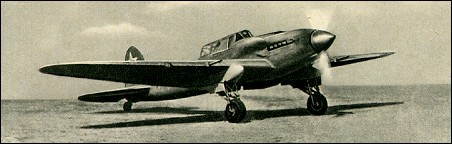
| Though seemingly an ordinary and unexciting machine with superficial close similarity to Britain's Fairey Battle (which proved a disaster), the IL-2 was almost certainly built in larger numbers than any other single type of aircraft. Output averaged 1,200 per month during most of World War II, to give a total of approximately 36,000. When the IL-10 developed version is added the total is reported to amount to 42,330.
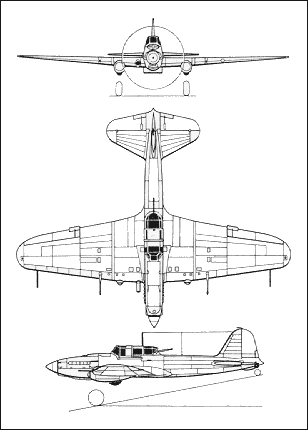
Designed as an armoured ground-attack and anti-tank aircraft, the prototype (designated BSh-2 from Bronirovanni Shturmovik, armoured attacker) flew for the first time on 30 December 1939. It looked like a larger edition of one of the single-seat fighters of the period and was powered by an AM-35 engine. Apart from the wooden rear fuselage it was all-metal, and the area round the engine and cockpit was actually constructed from 700kg of steel armour, offering excellent protection against fire from the ground. On 12 October 1940 the TsKB-57 took to the air with the more powerful 967kW M-38 engine. This improved machine led to the IL-2 which was just getting into service when the Germans invaded in June 1941.
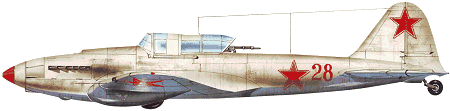
Armament of the original IL-2 was two 20mm ShVAK and two 7.62mm ShKAS guns firing ahead, plus eight 82mm rockets and four 100kg bombs. The need for rear protection resulted in a second crew member being added to man a rear gun, usually a 12.7mm BS, and the forward guns were changed to the hard-hitting 20 or 37mm VYa, and sometimes two of each. Bomb load went up to 600kg, including PTAB armour-piercing bombs. The Shturmovik's weapons could pierce all German armoured vehicles, even the Tiger tank being vulnerable when attacked from the rear. Swarms of these tough aircraft are judged by the Soviet Union to have played the dominant role in air warfare on the Eastern Front. IL-2 remained in operational service in the Soviet Union and with the Air Forces of Czechoslovakia and Poland into the 1950s. Indeed Stalin commented that the IL-2 was 'as essential to the Soviet Army as air and bread'.
| CREW | 1-2 |
| ENGINE | 1 x AM-38F, 1300kW |
| WEIGHTS |
| Take-off weight | 5360 kg | 11817 lb |
| Empty weight | 4200 kg | 9259 lb |
| DIMENSIONS |
| Wingspan | 14.6 m | 48 ft 11 in |
| Length | 11.6 m | 38 ft 1 in |
| Wing area | 38.5 m2 | 414.41 sq ft |
| PERFORMANCE |
| Max. speed | 430 km/h | 267 mph |
| Cruise speed | 320 km/h | 199 mph |
| Ceiling | 6000 m | 19700 ft |
| Range w/max.fuel | 800 km | 497 miles |
| Range w/max payload | 600 km | 373 miles |
| ARMAMENT | 2 x 23mm machine-guns, 3 machine-guns, 400-600kg of bombs or missiles, |
| lxbfYeaa, e-mail, 14.03.2024 06:12 20 reply | | Barry, 16.09.2015 17:31 When the production of this plane started to slow from the Ilyushin and Mikoyan and Gurevich plants, Uncle Joe sent a telegram to both basicly saying that "they had let down the people of Russia and the Red Army....and that the Russian Government would not tolerate any such delays again". Production suddenly increased and there was never a problem again;surprise surprise. reply | | Cliff Olsen, e-mail, 17.01.2014 22:46 Eric Hartmann (The Blond Knight of Germany) shot down many of these. reply | | Skyhogg, e-mail, 26.03.2012 19:38 To provide a possible answer to Leo's question, the IL-2 may have been shot down in the largest number based on the high production numbers (more out there to be shot down), the superiority of the German fighters in the East during the first half of the war (better able to take on a slow moving attack plane plus any Soviet fighter cover) and also considering a US study that concluded that US fighters in the ground attack role were lost at a higher rate than those in the conventional air superiority role (fighter vs fighters or bombers). But given that the primary purpose of air support is to support the tactical (ground) war, this aircraft earned its place as a "Hero of the Soviet Union." reply | |
| | ?????, 31.12.2011 05:03 I LOVE THE GAME IL-2 STURMOVIK BY UBISOFT reply | | Chuck, e-mail, 11.04.2011 17:36 I used to wrench on the A-10 in the USAF; this is the "original" tank killer--incredible aircraft for it's day. As Stalin once remarked "quantity is a quality all it's own." reply | | Griphon_44, e-mail, 07.05.2010 00:32 The IL-2 Sturmovik is one of the unsung heroes of WWII (The Great Patriotic War in Russia). Like most Soviet weapons, the IL-2 and its variants were almost completely overlooked by western military historians, military /history TV shows, and movies. However in the late 90's, Oleg Maddox and his team of Russian developers created what is considered by many to be the best flight simulation game ever created, titled, "IL-2 Sturmovik". It and its sequels were produced by video game giant, Ubisoft. reply | | Leo Rudnicki, e-mail, 20.05.2009 16:36 Are there any statisticians who could determine what aircraft was shot down in the largest numbers? reply | | Joshrv144, e-mail, 26.09.2008 03:48 The most produced aircraft of WWII. Surpassing the Messerchmitt Bf-109. More then 36,000 of those IL-2s were built making the most produced military aircraft in aviation history. reply |
|
Do you have any comments?
|
| 
COMPANY
PROFILE
All the World's Rotorcraft
|