|
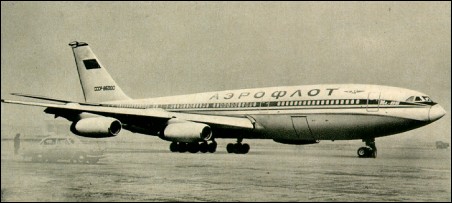
| The llyushin Il-86, which has the NATO reporting name 'Camber', is the Soviet Union's first wide-body civil transport. Of low/mid-wing monoplane configuration, it has a circular-section pressurised fuselage with a maximum internal width of 5.70m, and is powered by four Kuznetsov NK-86 turbofan engines pylon-mounted beneath the wings. Accommodation is provided for a crew of three or four on the flight deck, and there is seating for a maximum of 350 passengers, distributed between three cabins which are separated by wardrobes. Access to this aircraft is unique, being via three lower-deck airstair-type doors which allow the aircraft to be operated without conventional airport loading/unloading bridges. The airstairs reach down to ground level and, after boarding, passengers can deposit their baggage in lower-deck stowage positions before climbing an internal fixed staircase to the passenger cabin.
Construction of two prototypes began in 1974 and the first flew on 22 December 1976. The Il-86 was subjected to rigorous testing and the first production aircraft flew in October 1977. Deliveries to Aeroflot began in September 1979, since when between 80 and 85 have entered service out of an order for 100. Although most former Eastern Bloc airlines, and particularly CSA and LOT, were mentioned as potential export customers, no orders have materialised and the type remains peculiar to Aeroflot. Domestic operations began on 26 December 1980 followed by international services in July 1981. Poor performance, particularly in terms of payload/range, has led to the suggested re-engining of the II-86 with Soloviev PS-90 or CFM56 engines.
| CREW | 5 |
| PASSENGERS | 350 |
| ENGINE | 4 x turbo-jet NK-86, 127.5kN |
| WEIGHTS |
| Take-off weight | 206000 kg | 454155 lb |
| DIMENSIONS |
| Wingspan | 48.3 m | 158 ft 6 in |
| Length | 58.4 m | 192 ft 7 in |
| Height | 15.7 m | 52 ft 6 in |
| PERFORMANCE |
| Max. speed | 950 km/h | 590 mph |
| Cruise speed | 900 km/h | 559 mph |
| Ceiling | 10000 m | 32800 ft |
| Range w/max.fuel | 5250 km | 3262 miles |
| Range w/max payload | 3300 km | 2051 miles |
| ASHFAQ ORAKZAI, e-mail, 09.06.2017 02:05 Hi Iam from pakistan and studied in USSR flown on the board of IL 86 more than 50 times . Its a classic airplane and very comfortable and it fly very smooth even under turbulance conditions. reply | | Sergei, e-mail, 23.11.2010 17:22 some Il-86s are in use by Moscow-based airlines as "Atlant-Soyuz" (VKO) and DonAvia (SVO) on summer and holiday charters to Turkey and Egypt but this year or next seems to be the last for this bird. reply | | Fred alexander, e-mail, 30.07.2010 19:40 No Aircraft manufacturer in civil Aviation history can brag about the safety and Reliability fo their Birds unlike the IL-86. The 86 is the undisputable champ in this arena but what do airlines around the world want??? State of art avionics i bet. so what has avionics and technology brought in store for us??? The recent AirBlue crash involving an A321 tells the tale. The Boeings and Airbus's are lady Birds gentlemen. When is the world's airlines gonna change their mandate and say "passenger safety and aircraft reliability is the predominant factor for aircraft choice?" Saying that is the IL-86 gonna create a tsunami among passengers worldwide with the slogan..."yes to the IL-86" for safety". Graeme and Jewel! Thank you for your fantastic comments on the IL-86. I need guys like you to resurrect this beast. Can we do it???? "Yes we can!!!!" reply |
| Graeme, e-mail, 09.02.2010 04:20 It never has had a fatal accident! Even the Il-86 has one of the best safety records for any airliner. (take that Boeing!) reply | |
| | Delivery Guy, e-mail, 23.12.2009 00:23 flysim server suxx dont go there reply | | Jewel, e-mail, 26.10.2009 18:49 Very nice aircraft, classy, resembles the Airbus A340 but in a unique way! Nice concept on the air stair, very versatile in airport operations!
Is this aircraft still in production? Is this aircraft still in service? What Airline? Are there any future variants? reply | | Bezanti A, e-mail, 18.12.2006 12:55 Cabin photo & gali reply |
|
Do you have any comments?
|
| 
COMPANY
PROFILE
All the World's Rotorcraft
|


 Fred alexander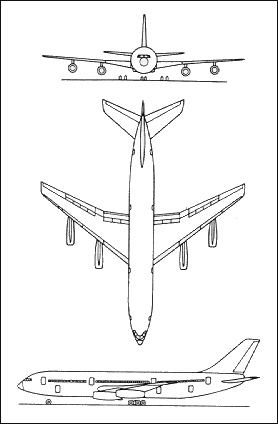


20
reply