|
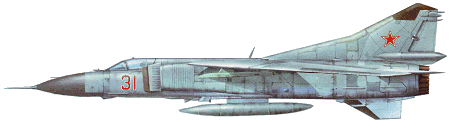
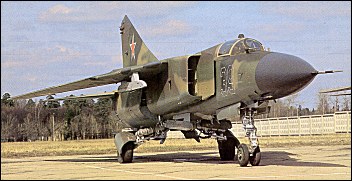
| One of the most important tactical war-planes of the Soviet Union, the Mikoyan-Gurevich MiG-23 (NATO
reporting name 'Flogger') was first flown in prototype form during 1966, entering service for evaluation some four years later. This air comabt fighter, and its ground-attack MiG-27 derivative, was in large-scale production between 1969 and 1984.
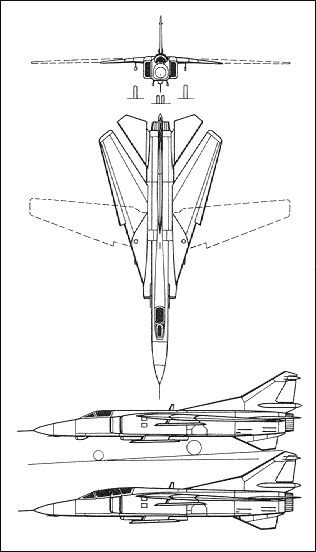
Designed to provide Frontal Aviation with a tactical fighter offering secondary ground-attack capability, and capable of meeting contemporary Western fighters on more than equal terms, the MiG-23 was designed around the primary aim of an aircraft that could operate effectively without being tied to massive concrete runways. The Mikoyan bureau is known to have adopted two approaches to this requirement: first was the Ye-23 (or Ye-230) prototype, which was of tailed-delta configuration and incorporated high-lift .devices to give STOL capability, powered by a single turbofan engine supplemented by a battery of Kolesov lift-jets amidships for VTOL operations; the alternative prototype was the Ye-231, which deleted the lift-jets and replaced the delta wing by a variable-geometry wing very similar to that of the General Dynamics F-111. The prototypes were evaluated during 1966-67, with a decision to develop the swing-wing Ye-231 finalised probably during 1968, resulting in the pre-production MiG-23S 'Flogger-A' which, powered by a Tumansky R-27 turbojet with an afterburning thrust of 10200kg, first entered service for operational evaluation in 1970-71. At about this time it must have been decided to optmise the MiG-23 as an air-combat fighter, and to develop a dedicated ground-attack parallel version, which was allocated the designation MiG-27. In consequence, aerodynamic changes were made to the MiG-23, the fuselage structure being lightened and more advanced avionics being introduced by the time the initial MiG-23M version entered service in 1973. More or less simultaneously the dedicated attack variant was developed and, while having much in common with the MiG-23, this was sufficiently different to warrant the allocation of the separate designation MiG-27. This differs primarily by having a completely redesigned forward fuselage, providing a betterfield of viewforthe pilot, increased armour protection, terrain-avoidance radar and provision to deploy a wide variety of air-to-surface weapons. There appear to be only two versions of the MiG-27, differing in the shape of the nose, avionics and aerodynamics, and these have the NATO reporting names 'Fiogger-D' and 'Flogger-J'
Both the MiG-23 and MiG-27 are in large-scale use with the former Soviet air force, an estimated 3,000 reported being operational. They served with the Warsaw Pact air forces, and were exported to t'he air arms of Algeria, Angola, Bulgaria, Cuba, Czechoslovakia, East Germany, Egypt, Ethiopia, Hungary, India, Iraq, Libya, North Korea, Poland, South Yemen, Syria and Vietnam. The MiG-23M/K 'Flogger J' is also currently in production in India.
| CREW | 1 |
| ENGINE | 1 x R-29B, 120.2kN |
| WEIGHTS |
| Take-off weight | 18000 kg | 39683 lb |
| Empty weight | 11000 kg | 24251 lb |
| DIMENSIONS |
| Wingspan | 8.2-14.3 m | 27 ft 11 in - 47 ft 11 in |
| Length | 16.8 m | 55 ft 1 in |
| Height | 5.5 m | 18 ft 1 in |
| Wing area | 27.3 m2 | 293.85 sq ft |
| PERFORMANCE |
| Max. speed | 2500 km/h | 1553 mph |
| Ceiling | 18600 m | 61000 ft |
| Range w/max.fuel | 3000 km | 1864 miles |
| Range w/max payload | 960 km | 597 miles |
| ARMAMENT | 1 x 23mm cannon, 2000kg of weapons |
| lxbfYeaa, e-mail, 14.03.2024 06:43 20 reply | | Vi hara, e-mail, 10.05.2020 19:23 Buy some soft core corney porn. reply | | Markos, e-mail, 28.09.2016 07:17 This plane regularly makes the top 10 worst fighter list on most websites. reply | | Ray Robert, e-mail, 12.12.2014 03:41 Brad Daft, an appropriate last name. reply | |
| | REDSOUN, e-mail, 23.04.2014 12:25 REDSOUN TYRES Having started as a Company catering to the Aerospace industry, we have now emerged as a Trusted Name for Aircraft Tyres. With our business web extending to all Five Continents, we can assure you the supply of various tyres for Commercial and Defence Aircraft.
REDSOUN TYRES have established reliable business partnership and consistent clients globally, through supply of quality products of International standards. This has been possible only due to our persistent and honest reputation for reliable service of mutual benefit to all our clients
We at REDSOUN TYRES strive to etch a new sales mode with competitive advantages by offering wide range of quality tyres for Russian Aircraft. REDSOUN aircraft tyres are designed to deliver outstanding performance, keeping in mind the heavy work environments in which the Military jets operate.
We endeavour to put forth a new quality level in Tyre production which determines a higher level of efficiency by optimizing the product portfolio. To achieve this, we use imported Rubber of very high quality, to produce hi-tech macro-molecular material that ensures excellent features like High Abrasion and Ageing Resistance, Extra Loading Strength, dependable Performance.
The Military Jets MiG-21, MiG-27, MiG-29, SU-22, SU-24, SU-25, SU-27, SU-30, IL-76, IL-78 are all-weather, multi-role fighters, meant to gain air superiority; besides, these jets operate in various conditions like take-off from unpaved runways, delivery of heavy loads to undeveloped areas in remote locations. The choice of aircraft tyre is very critical, with due consideration to Reliability and Performance.
REDSOUN tyres are manufactured with advanced production techniques, using the best quality raw materials to afford extended life through many extra landings. The salient features of latest innovation and expertise are incorporated to produce tyres that deliver outstanding performance and extended life on the runway. Design and construction are meticulously done to be used in extreme conditions and for longer use preventing early replacement. REDSOUN Tyres are engineered to be light, yet strong and long lasting by resistance to wear and tear.
The important factors critical to ensure Reliability and enhance Performance are expertly woven into the production profile to optimize the Quality. Hi-tech mix of Rubber compounds are used to effectively achieve the goal of producing Tyres that offer extended life with ultra-high Performance. Casing is designed to withstand external effects and extreme conditions, ensuring balanced lateral stability and uniform distribution of stress during high speed take-offs and landings. Excessive Loads and Extra Stress are well handled by the Casing Plys to provide Strength and Stability. The Tread Grooves are specially crafted to build Stability and Safe hold, along with Durability and Dependability. reply |
| Byron Bailey, e-mail, 23.07.2012 11:19 Love the Mig 23. I flew Mirage in ACTs against F4s. The Mig would wax the F4 eay reply | | Brad Daft, e-mail, 08.04.2011 04:21 It has been said that President Nixon was going to use the B-52 to prop up South Vietnam's government at least until the end of his second term,then his successor would have to deal with Vietnam.Thats how powerful a weapon it is,the Mig-23 Flogger's primary mission was to stop this goliath from invading Soviet air space and dropping hydrogen bombs on Soviet targets.The Mig-23 Flogger was the greatest! reply | | Brad Daft, e-mail, 08.04.2011 04:14 The Mig-23's mission was to intercept American B-52 bombers and shoot them out of the sky.That is why the Soviet Union built and deployed so many interceptors far more than America,becouse of the big guy,the B-52.The B-52 could have actually altered the course of a country's history,Vietnam.During the Vietnam war President Nixon used the B-52 to pulverize Hanoi to the bargaining table.It worked,but Nixon was left powerless by Watergate. reply | | Brad Daft, e-mail, 25.02.2011 08:24 Outrage!Biased western propaganda is all it is!Im talking about the new book T-62 vs M-60,i just got it.If your going to lie at least put some effort into it!It says in the book that the m-60 destroyed hundreds of T-62s while only one T-62 destroyed one m-60!Yeah right!The T-62 ruled the battlefield in 1973! reply | | Brad Daft, e-mail, 23.02.2011 05:20 The Soviet T-62 is my favorite tank,it's greatest hour was in the 1973 Yom Kippur war,it was a fine compliment to the Mig-23 reply | | David Earl, 14.02.2011 23:31 I'll keep saying this, if the Nazis were able to continue their plane experiments, the Messerschmitt 162 would have evolved to something far better than this. Not that this isn't a bad plane at any rate. reply | | Brad Daft, e-mail, 30.01.2011 03:31 The Mig-23 Flogger is the greatest interceptor ever period. reply | | Brad Daft, e-mail, 08.12.2010 08:29 Interesting,the F4 Phantom vs the Mig-23,id love to see whod win that one! reply | | Frank, e-mail, 04.12.2010 20:38 I use to track M-23 from U-2 recon photos in vietnam, we
usually knew where they were near the end of the war and we could never get them to come up and fight. reply | |
| | Brad Daft, e-mail, 10.07.2010 05:23 I love the Mig-23 it is my favorite postwar aircraft.I get tired of reading where the Flogger is compared to air to air dogfighters becouse this is utterly unfair and untrue.The Flogger is a air to air interceptor it was not desinged to engage enemy fighters in dogfights,it was intended to intercept American and NATO bombers and shoot them down.Like i said i love the Flogger,it is my favorite aircraft of all time. reply | | Brad Daft, e-mail, 10.07.2010 05:41 And if the cold war had turned hot the F-15s advantages as a dogfighter would have been negated by swarms of Floggers which would outnumber the F-15s and while one F-15 would be twisting and turning to outmanuever one Flogger which it could easily do,it could be hit from any direction by the other numerouse Floggers in the swarm. reply | | Brad Daft, e-mail, 10.07.2010 05:34 And i wish the west would finally admite that the mighty Flogger did shoot down some F-15s.They will not disclose this information becouse they are ashamned that the Flogger did in fact blow their Eagles out of the sky,along with F-16s.It is true anyone who says otherwise is a lier.The west will lie and Israel will swear to it.Israel tried to lie and say their aircraft was mostly lost to SAMS,noo their aircraft also fell to Floggers so now you know the truth your welocome! reply | | Brad Daft, e-mail, 11.07.2010 05:06 And like Desert Storm in 1991 the coalition never mentioned their great Abrams getting knocked cold by a Iraqi T-72 until 2003!Yes they brag and brag about how the M-1A1 Abrams made mincemeat out of Hussien's vounted T-72s,but but they failed to mention that one the Iraqi T-72s used cheap metal for their ammunition.Not the more expensive Tungstan which would have been more effective,and that the Iraqis were abandoning their vehicles to avoid being killed by the coalition air power,so when the coalition ground forces approached they encountered many empty tanks with no crews.The Coalition never mentioned this in 1991 when they easily defeated Hussien's armored divisions.All you heard was our tanks destroyed their tanks well sometimes there was other reasons for this besides our stuff was just better than their stuff. reply | | Brad Daft, e-mail, 11.07.2010 04:34 Ha i found a site online that says the mighty Flogger did in fact destroy 5 F-16s and and and hold your breath 3 F-15s,the invincable Eagle!Yes thats right the 3rd generation interceptor downed 3 count em 3 4th generation supertech dogfighting eagles!Well well well,truth comes out huh? reply | | Brad Daft, e-mail, 11.07.2010 04:21 And remember the Mig-23 was a 3rd generation aircraft who mostly faced 4th generation aircraft.However a Cuban Mig-23 blasted a French MirriageF-1 from the sky.there is pictures to prove this unlike in the middle east where all the proof mysteriously vanished.Yeah Israel where are the pictures of your downed F-15s and F-16s victims of Floggers?Thats right i said it,the Mig-23 is the best interceptor the world has ever seen,i don't care what anyone says. reply |
|
Do you have any comments?
|
| 
COMPANY
PROFILE
All the World's Rotorcraft
|




So you make bike tyres as well
reply