|
| Exigencies of the times precluding fundamental redesign
of the MiG-1 to eradicate the fighter's less acceptable
characteristics, a series of what were, in effect, palliatives were applied to the basic design to result in
the MiG-3. Power plant and (initially) armament remained
unchanged, but some structural simplification
and strengthening was introduced. The engine was
moved forward 10cm; dihedral of the outer wing
panels was increased by one degree; a 250 l supplementary fuel tank was introduced
beneath the pilot's seat; the aft fuselage decking was
cut down; the radiator bath fairing was enlarged and
extended forward; the supercharger intakes were revised;
9mm seat armour was provided, together with
radio, and four wing points were introduced for a maximum
external load of 220kg. The first MiG-3
left the factory in December 1940, 11 being completed
by the end of the month; 140 were produced in January
1941, and, by June, production had peaked at 25 aircraft every 24 hours. The first MiG-3 was delivered to a VVS
regiment in April 1941 - simultaneously with the MiG-1
- and production continued until 23 December 1941
with approximately 3,120 built, but 50 more were completed
from component stocks in the early summer of
1942. Some MiG-3s had a supplementary pair of
12.7mm BK machine guns under the wings - raising
take-off weight to 3510kg - and others were
fitted with two UBK guns of similar calibre in the wings.
Tests were also performed with two fuselage-mounted
20mm ShVAK cannon.
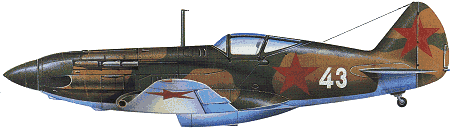
| MODEL | MiG-3 |
| WEIGHTS |
| Take-off weight | 3350 kg | 7386 lb |
| Empty weight | 2699 kg | 5950 lb |
| DIMENSIONS |
| Wingspan | 10.20 m | 33 ft 6 in |
| Length | 8.25 m | 27 ft 1 in |
| Height | 2.65 m | 9 ft 8 in |
| Wing area | 17.44 m2 | 187.72 sq ft |
| PERFORMANCE |
| Max. speed | 640 km/h | 398 mph |
| Range | 820 km | 510 miles |
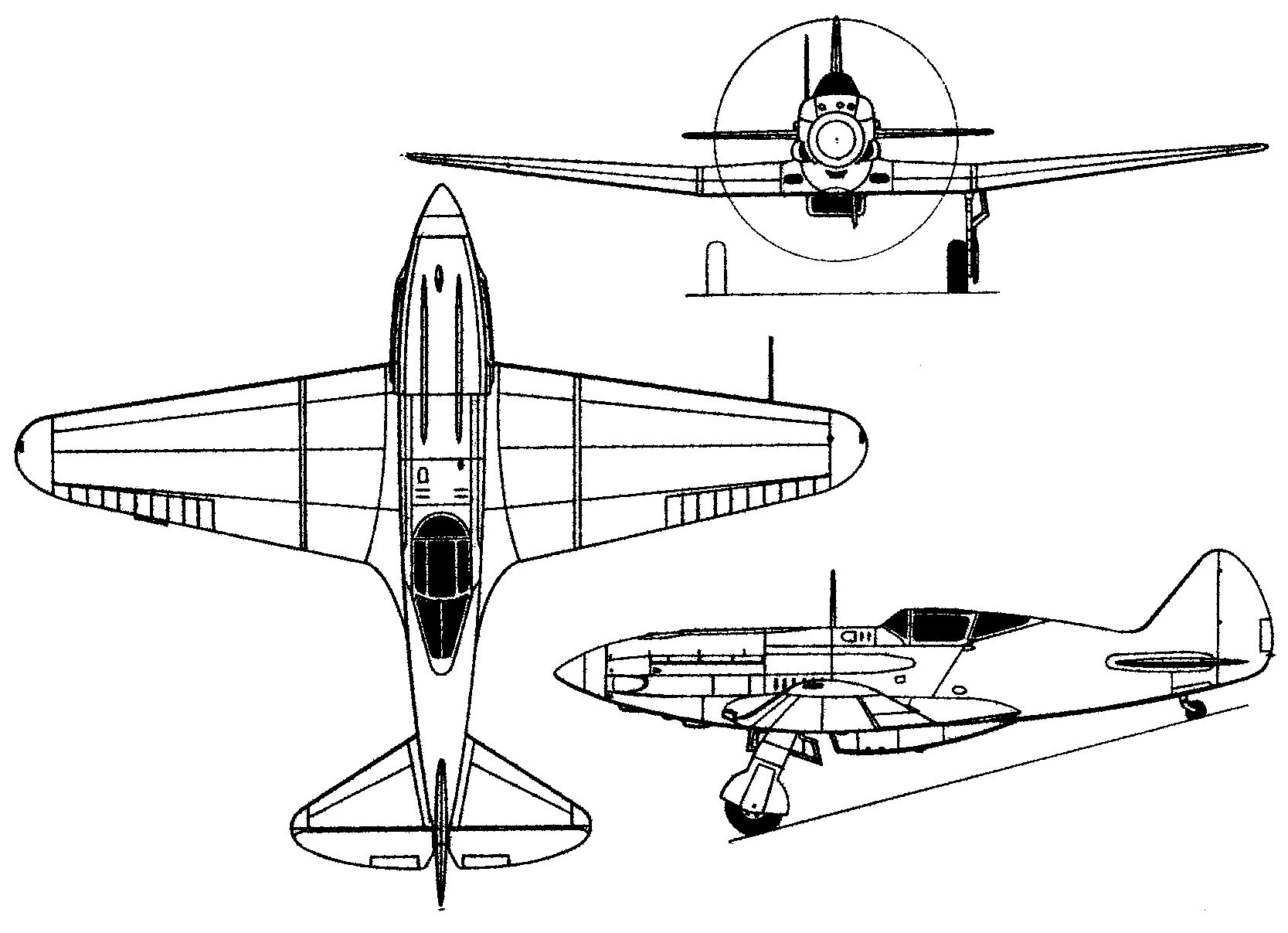
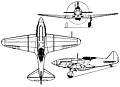 | A three-view drawing (1667 x 1207) |
| Anonymous, 25.08.2022 15:54 The MiG 3 had a prominent role in the defense of Moscow during the Luftwaffe bombing offensive against the city which took place during late 1941-early 1942. Unfortunately, in many instances the MiG 3s were sent out at night to intercept German nocturnal raids. While the RAF countered the German night bombing "blitz" with fighters specially set up as night fighters, and pilots specially trained to fly at night, and had an effective system for directing the night fighters from the ground by radio. In contrast, the Soviets simply sent up standard MiG 3 day fighters which were totally unsuited to night flying. The inevitable result was that more MiG 3s were lost in flying accidents than enemy bombers were shot down. The number of MiG 3s lost during night operations, along with its' reputation as a difficult aircraft to handle, affected the MiG 3's reputation. However, it should be borne in mind that the MiG 3 pilots had no specialized night flying training, the Mig 3 had no night flying instruments or navigation equipment, and the exhaust pipes were not shrouded, which meant that the red-hot glowing exhaust pipes hampered the pilots' night vision. To make matters even more difficult, the Soviets lacked the effective system of radio-controled ground direction for its' night fighters such as the British had. reply | | Ron, e-mail, 05.02.2015 03:55 The UB HMG WoF is about 0.842 kg. unsynchronized for 17.5 rps. reply | | Barry, 08.08.2013 17:19 In view of the time between inception and production it was not surprising that the handling qualities were not of the best, espcially when one considers the length of the engine and the demands that made on the overall design. It has been reported that some 2,100 models of the MiG-1 were produced and production of the MiG-3 was several thousand more. However, these planes were no match to the Luftwaffe and it was only the continual bombing of the German homeland by the Allies which required the return of German assets that gave the communists the ascendancy. reply | | teal, e-mail, 28.11.2011 00:01 Does anyone knows what NACA profiles had MiG-3? reply | |
| | teal, e-mail, 27.11.2011 23:59 czy ktos wie jakie profile NACA mial MiG-3? reply | | Naga, 01.08.2011 05:39 Was it the MiG-1 or '3 that had the tendency to stall out in sharp turns? reply | | lewis paton, e-mail, 27.03.2011 22:20 hi mum and dad not brother i love to learn about ww2 reply |
| paul scott, e-mail, 19.10.2009 02:53 Yeah, nice 'plane but the longitudenal dihedral didn't help (Short body, in English!)And must have been hard to see past that wing - as Ronald said, multi role /ground attack fighter, it ain't! reply | | Ronald, e-mail, 03.09.2008 05:40 While the 360 turn time above was typical, it could range from 22-26.5 sec. With the wing gun boots, firepower was higher but handling became unacceptable and speed fell. The 1.2kg salvo is with the old ShKAS 12.7mm nose gun before the more effective UB 12.7mm replaced it.
The MiG was the lone Russian fighter that was superior at high altitude. Unfortunately that was almost useless on the Russian front. reply | | Ronald, e-mail, 02.09.2008 08:34 Weight of fire / sec. salvo = 1.2-1.44kg[-2.8kg].
Climb to 5km = 5.3-6.8 min.
360 turn = 23 sec. reply |
|
Do you have any comments?
|
| 
COMPANY
PROFILE
All the World's Rotorcraft
|


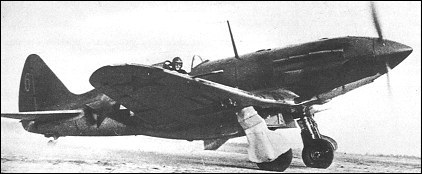


20
reply