 |
Mikoyan/Gurevich I-7U1957 |  |
| FIGHTER | Virtual Aircraft Museum / USSR / Russia / Mikoyan/Gurevich |
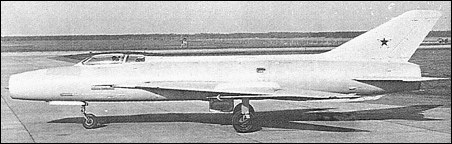 |
Prior to abandonment of the I-3 (I-380) without flight test owing to the Klimov bureau's inability to develop the intended VK-3 engine to an acceptable standard for installation, a further prototype had been completed as the I-3U (I-410). Similarly intended for the VK-3 engine and also destined, therefore, to remain unflown, the I-3U (also known as the I-5) was intended to be part of the so-called Uragan (Hurricane) automated air interception system. When, in the summer of 1956, it became evident to the MiG OKB that the Klimov engine would not be forthcoming, work began on the redesign of the aircraft to take a Lyulka AL-7F turbojet of 6240kg and 9220kg with afterburning. In this form, the aircraft became the I-7U which flew for the first time on 22 April 1957. With quarter-chord sweepback reduced from the 57 deg of the I-3U to 55 deg, the I-7U carried a pair of 30mm NR-30 cannon in the wing roots and had four wing stores stations each capable of carrying a rocket pod containing 16 57mm ARS-57Ms. On 21 June 1957, the sole prototype I-7U suffered damage as a result of the starboard undercarriage leg failing when the aircraft landed following its 13th flight. After repair, the test programme was resumed but involved only six more flights, the last of these taking place on 24 January 1958. The I-7U was then re-engined with an AL-7F-1 to become the I-75.
|  COMPANY PROFILE | |||||||||||||||||||||||||||||||||||
|


|