|
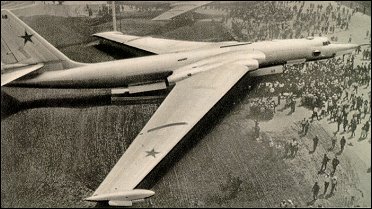
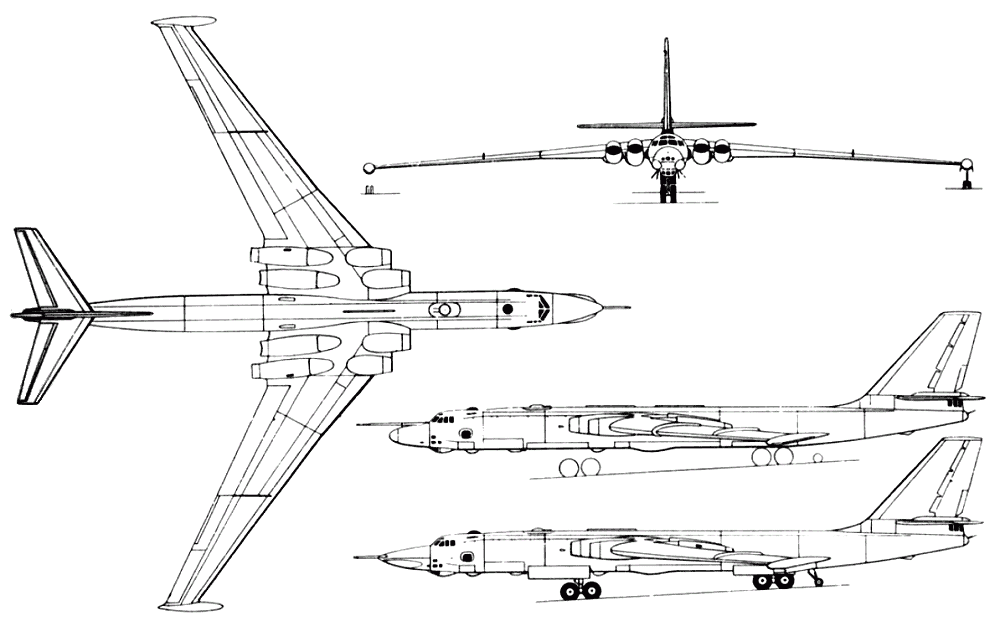
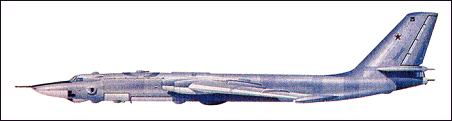
| Vladimir M. Myasishchev was responsible for contributions to a number of Soviet aircraft designs from 1924, but is best known for the Myasishchev M-4 which was the nation's first four-engine turbojet-powered strategic bomber to become operational. Following its maiden flight in late 1953, the type was first displayed in a fly-past over Moscow on 1 May 1954. A mid-wing cantilever monoplane with a deep section swept wing, the M-4 has a tail unit with all-swept surfaces, and retractable landing gear comprising two main units in tandem on the fuselage centreline, each with a four-wheel bogie, plus twin-wheel outrigger balancing units which retract into the wingtips. The circular-section fuselage incorporates a pressurised nose compartment and tail turret for the crew, and a large internal weapons bay in the lower fuselage between the main landing gear units. The powerplant comprises four turbojets buried in the wing roots, these being initially Mikulin AM-3Ds each of 8700kg thrust. Designed to carry thermonuclear weapons over intercontinental ranges, the initial bomber version, which has the NATO codename 'Bison-A', is believed to have entered service initially in early 1956, and production probably totalled about 200 aircraft. Subsequent modified versions have included the maritime reconnaissance 'Bison-B', first identified during 1964, which had a radome in a solid nose replacing the glazed nose of 'Bison-A', and the even later 'Bison-C', which was also for maritime reconnaissance and introduced a larger radar installation in a lengthened nose. A number of 'Bison-A' bombers have been equipped to serve as inflight-refuelling tankers, with a hose-reel unit mounted in the bomb bay. One other version is known, a test-bed aircraft powered by four D-15 turbojet engines each of 13000kg thrust and designated 201-M This was used in September 1959 to establish a number of payload-to-height records. About 40 tanker/transport versions of the M-4 were estimated to remain in service in 1992. These are to be replaced by II-78 'Midas' tankers.
| MODEL | 3M |
| CREW | 8 |
| ENGINE | 4 x VD-7, 107.8kN |
| WEIGHTS |
| Take-off weight | 202000 kg | 445336 lb |
| Empty weight | 74430 kg | 164091 lb |
| DIMENSIONS |
| Wingspan | 50.53 m | 166 ft 9 in |
| Length | 51.70 m | 170 ft 7 in |
| Wing area | 340.0 m2 | 3659.73 sq ft |
| PERFORMANCE |
| Max. speed | 940 km/h | 584 mph |
| Ceiling | 12150 m | 39850 ft |
| Range | 11850 km | 7363 miles |
| ARMAMENT | 6 x 23mm cannons, 24000kg of bombs and missiles |
 | A three-view drawing (1000 x 626) |
| Timothy Potter, e-mail, 23.03.2018 13:46 A soviet copy of the Victor bomber except this was nuclear powered. reply | | bombardier, e-mail, 24.05.2011 13:30 The aircraft's wings were based on the Junkers EF132 reply | | bombardier, e-mail, 24.05.2011 13:08 Nice bomber but it would be decimated by US aircraft in the event of war.Some US interceptors were equiped with nuclear rockets.I don't think it would have survived being attacked by such weapons reply | | Klaatu, e-mail, 12.04.2011 19:27 An impressive-looking airplane but, by all Soviet Air Force accounts, something of a dog, for a variety of reasons. That was why they were eventually converted into aerial refueling tankers. Nowhere near as successful as the turbo-prop Tu-95 "Bear", which long out-lasted these pure-jet aircraft in the strategic bombing role reply | |
| | Sergei, e-mail, 23.11.2010 17:13 Production run:
M-4 (Bison-A) - 2 proto + 32 production
3M (Bison-B) - 74
The last tankers (all bombers were converted such way) were struck off charge in 1994
The same or very similar fate as Valiant and Victor... and very similar scheme of wing /engines reply | | Nikos J. Farsaris, e-mail, 27.12.2008 19:46 The truth is that early model examples lacked the intercontinental range and the missile equipment of the Tu-95. Certainly it was not a copy of western or Nazi plan but rather an indengenous Russian one. Myasischev after all was a very experienced designer at the time. reply | | Alex, e-mail, 17.07.2008 03:22 Dr. Nick Stage-PHD, there are no information avaliable about Kurt Tank's TA-468A design. I think you just "make up" this project to prove thouse silly Russians can't ever come up with good aircraft.
Best of luck with your scientific and history work :-) reply | | Maksim, 17.12.2007 20:37 A direct copy of the proposal, most probably just a sketch I can't find even on Luft'46, it sounds interesting ;)
By the way, do you know, that the B-2 is nothing more than a direct copy of the Hortens' flying wing ? ;) reply | | Dr. Nick Stage-PHD., e-mail, 17.12.2007 03:17 This aircraft's biggest drawback was it's four engines
that were gas-guzzlers, and even if it could have attacked
the continental United States, USAF F-84's, F-86's, and
F-89's, would have decimated this bomber attack groupings.
The best sustainable speed was 445-to-470 mph., not the
"advertized" 584 mph maximum speed. The F-86C Sabre Jet
USAF fighter aircraft could maintain speeds above 620 mph.
The aircraft controls required Soviet "musclemen"
to operate the avionics. Servo-systems were not yet
in full operation, during this aircraft's deployment.
This aircraft was a direct copy of Nazi Germany's
Kurt Tank's TA-468A 4-jet engined bomber proposal
of 1943-1944.
Joseph Stalin did not have the needed "aero-brain-power"
to expand this plane much beyond it's Nazi German
prototypes, so there was a high crash rate.
Promising plane, but a high rate of in-flight jet
engine fires. Faulty oil lubrication systems made this
aircraft an aerial fire-trap in medium-to-long-distance
flights. Over-heating was a constant engine problem.
It was a better air-to-air refueling plane, than a
strategic long-range bomber. reply |
|
Do you have any comments?
|
| 
COMPANY
PROFILE
All the World's Rotorcraft
|