 |
Myasishchev M-501961 |  |
| BOMBER | Virtual Aircraft Museum / USSR / Russia / Myasishchev |
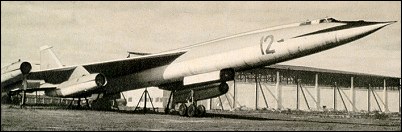 |
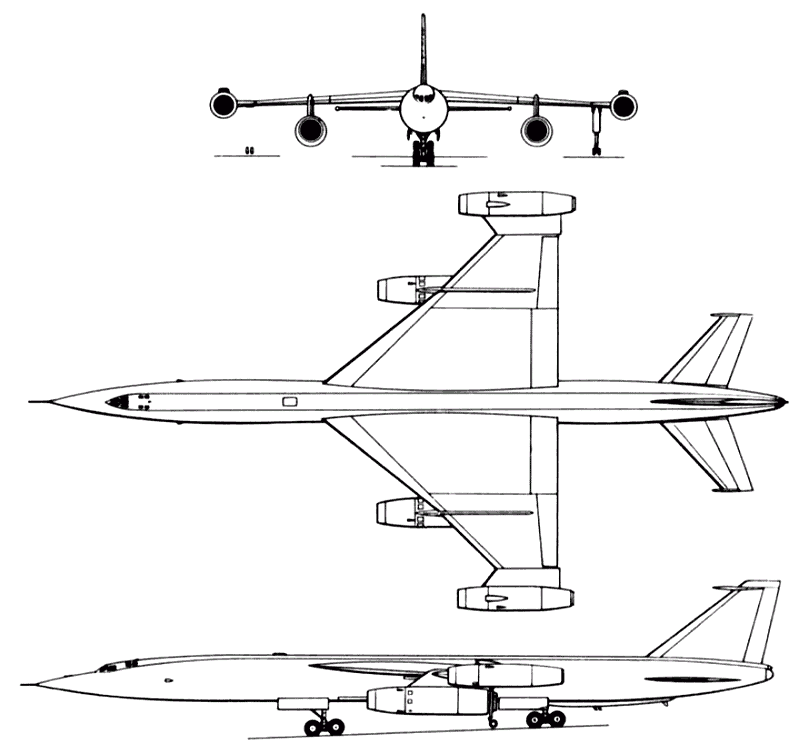
Although built only in prototype form, this design by Myasishchev was an extremely advanced turbojet-powered bomber with supersonic flight capability. In configuration, the Myasishchev M-50, codenamed 'Bounder' by NATO, had a shoulder-mounted cropped delta-wing, a conventional tail unit with all-swept surfaces, and landing gear comprising retractable tandem main units mounted on the fuselage centre line, each with a four-wheel bogie; while retractable outrigger balancing struts, each with two wheels, were mounted near the wingtips. The slender area-ruled fuselage provided pressurised accommodation for a crew of three and incorporated a large weapons bay. Power was provided by four wing-mounted Soloviev D-15 turbo-jets of 13000kg thrust in underwing pods. First flight of the M-50 is thought to have taken place in 1957, and the last of several prototypes, re-designated M-52, took part in the Soviet Aviation Day fly-past in 1961. With the two re-heated outer engines relocated to the wing tips, the M-52 was powered by four Kolesov ND-7F or VD-7F turbojets, with an afterburning thrust of 18145kg. Considered formidable by the West, the M-52 was estimated to be capable of Mach 1.83 or 1950km/h at optimum altitude. FACTS AND FIGURES © Although the principles of 'waisting' the fuselage to achieve the area rule effect were widely known by 1955, they were not applied to the M-50, leading again to high drag. © The M-50 was almost exactly the same length as the XB-70, with a slightly longer wingspan, but less than half the wing area. © The wing was swept at 50 degrees, regarded by Western experts as a poor choice when combined with a high wing loading. The wing was generally thought to be too small. © The wingtip engine location contributed significantly to drag. The pylons which attached them to the wing underwent significant modification between public appearances. © The Bounder was intended ro carry a weapons load of up to 20,000kg. Myasishchev M-50 on YOUTUBE

|  COMPANY PROFILE | ||||||||||||||||||||||||||||||||||||||||||||||||||||||||||||
|


|