|
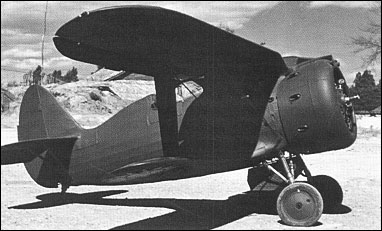
| Despite an international trend away from the biplane
configuration for fighters by the mid 'thirties, the Soviet
Air Force vigorously demanded continuation of such
warplanes, and, in 1937, one of Polikarpov's principal
team leaders, Aleksei Ya Shcherbakov, was assigned
the task of developing a more potent fighter biplane.
Assisted by Mikhail Gurevich, Shcherbakov created
the I-153 (I-15ter), prototype trials commencing in summer
1938. The basic structure of the I-152 was extensively
restressed, the Clark YH wing profile was retained,
but configuration reverted to the "gulled'' upper wing - resulting in the sobriquet of Chaika being resurrected
- and, as a concession to modernity,
manually-retractable main undercarriage members
were introduced. Initially, the 775hp M-25V engine
was retained, armament remaining four 7.62mm guns,
but comparatively early in the production run the
1,000hp Shvetsov M-62 engine was standardised,
boosting max speed from 415km/h at
3000m to 444km/h at 4600m. Some aircraft were fitted with a quartet of
12.7mm guns (I-153BS) and one, experimentally, with
twin synchronised 20mm cannon (I-153P). Production
deliveries began during the early spring of 1939, and
continued until late 1940, 3,437 examples being produced.
Ninety-three were supplied to the Chinese
Central Government early in 1940, and the I-153 remained
in first-line service until well into 1943.
| WEIGHTS |
| Take-off weight | 2110 kg | 4652 lb |
| Empty weight | 1452 kg | 3201 lb |
| DIMENSIONS |
| Wingspan | 10.00 m | 33 ft 10 in |
| Length | 6.17 m | 20 ft 3 in |
| Height | 2.80 m | 9 ft 2 in |
| Wing area | 22.14 m2 | 238.31 sq ft |
| PERFORMANCE |
| Max. speed | 444 km/h | 276 mph |
| Range | 4 70 km | 292 miles |
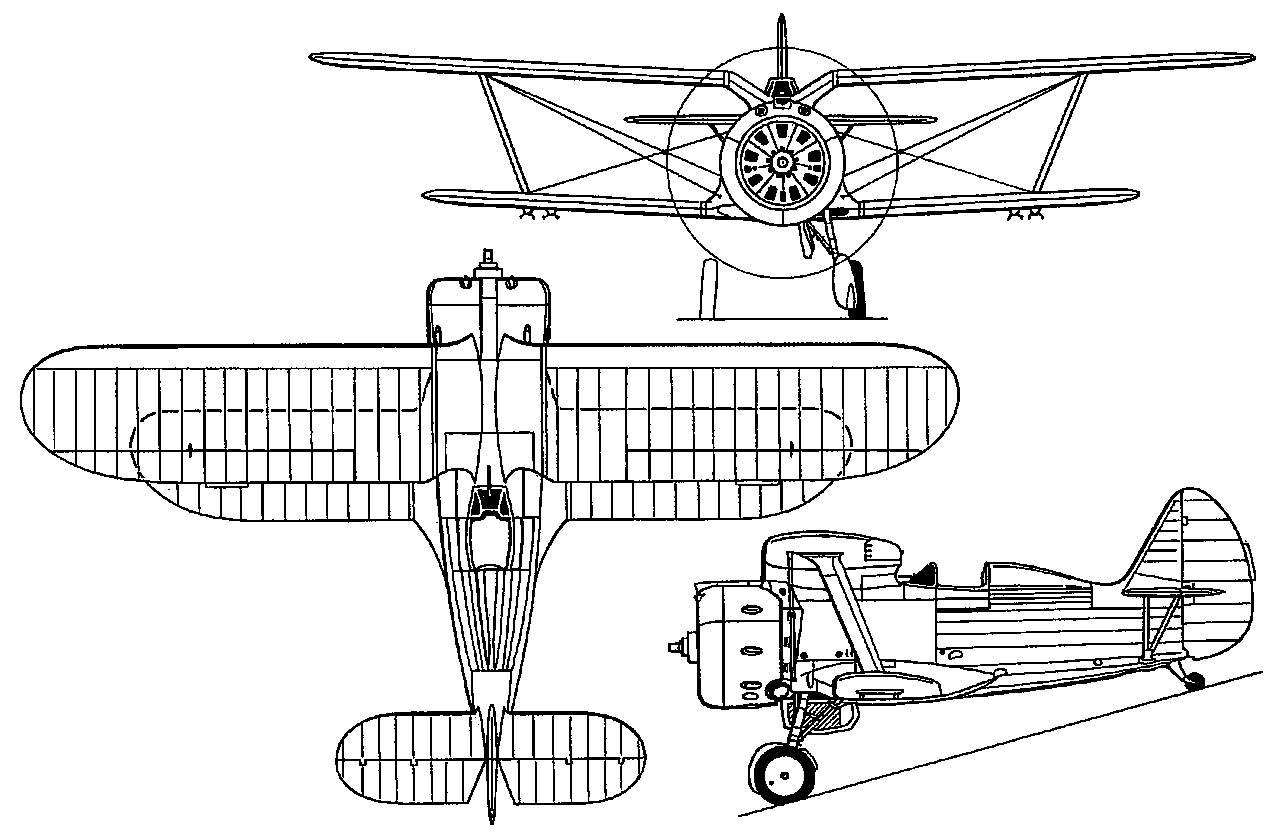
 | A three-view drawing (1280 x 838) |
| Klaatu83, e-mail, 13.02.2021 16:08 Like the Fairey Albacore, this represented the over-development of an obsolete concept. Yes, it can be said to have been one of the best biplane fighters ever produced. However, by the time it entered service it was already outclassed by existing monoplanes. reply | | sven, 20.09.2015 00:06 On the deck protecting tanks it may well have been a headache for even the 109s.Tight turning and at slow speed it could play to its strengths .At altitude it would be a different story reply | | Jaspreet Singh, e-mail, 18.09.2015 20:32 this is really beautiful aircraft , i was looking for history about this kind of aircraft , short tail Biplane , its really difficult found more about them . reply | | bombardier, e-mail, 13.12.2011 21:31 The I-190 was the biplane equivalent of the I-180.It was the I-153 modified to accept the M-88 radial engine with 1.100hp.It was even faster than the I-153 but by the time it was ready biplanes were obsolete as combat aircraft. reply | |
| | bombardier, e-mail, 23.05.2011 15:05 One of the best biplanes to fly and the fastest production biplane reply | | Ivan Posada, e-mail, 16.05.2008 19:06 this plane was the base of prototype Polikarpov I-190 reply |
|
Do you have any comments?
|
| 
COMPANY
PROFILE
All the World's Rotorcraft
|