|
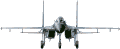
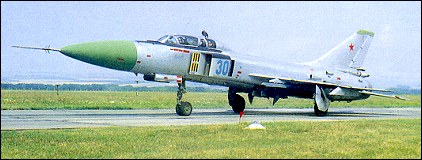
| Development of a single-seat interceptor fighter providing better supersonic performance while (initially) preserving a fundamentally similar wing was begun as the T-5 in the late 'fifties. This was a larger aircraft than the preceding T-43 and was powered by paired Tumansky R-11 turbojets with lateral air intakes. Retaining the tailed-delta configuration and 57° sweepback at wing quarter chord, the interceptor was built as the T-58 prototype and flown on 30 May 1962, and, as the Su-15, 10 examples participated in the July 1967 air display at Domodedovo. The initial version, effectively confined to a large pre-series for service evaluation, possessed a wing similar to that of the Su-9 and Su-11, with some 30cm removed adjacent to the fuselage each side. The Oryol-D Al radar and two R-8 AAMs were fitted, and power was provided by two R-11F2S-300 turbojets each rated at 3900kg and 6200kg with max afterburning. The virtually pure delta wing gave place on the next version, the Su-15T (the suffix signifying introduction of Taifun radar), to a cranked leading edge with outboard sweepback reduced to 47°, overall span remaining unchanged. Su-15T production was limited to 10 aircraft delivered during 1969.
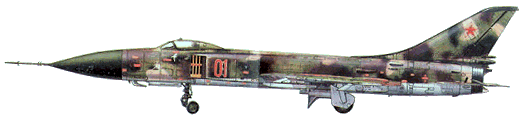
A V/STOL technology demonstrator derivative, the Su-15VD (vertikal'nye dvigateli, or vertical engines), was demonstrated at Domodedovo in July 1967, this having a trio of 2350kg Koliesov RD-36-35 lift engines mounted vertically in the centre of the fuselage. The definitive wing appeared on the Su-15TM (Taifun modifikatsiya) which became the major production version in 1972 and achieved operational status in the second half of 1973. This introduced a further variation of the cranked planform with a span extension of 60cm, the improved Taifun-M radar, and Gavrilov-developed R-13F-300 turbojets rated at 4237kg and 6600kg with afterburning. Armament, too, was upgraded, two additional wing pylons being introduced inboard and a pair of IR-homing R-23TE and two radar-guided R-23RE AAMs normally being carried. Twin pods each containing a twin-barrel 23mm cannon could be carried side-by-side on fuselage pylons. From 1975, the conical radome was replaced by one of ogival shape, production of the Su-15TM ending in the late 'seventies after manufacture of some 1,500 interceptors of this type.
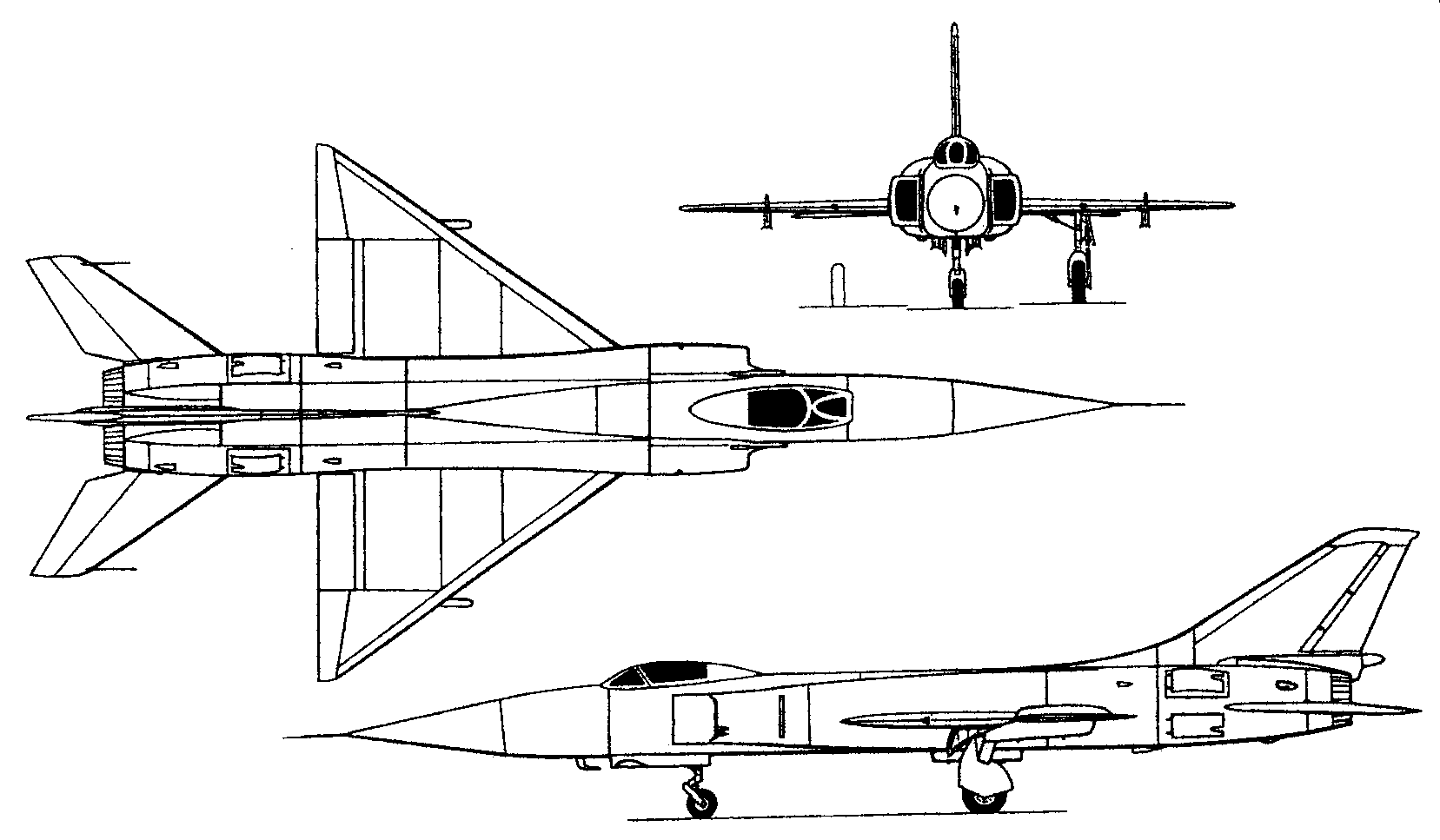
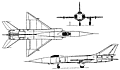 | A three-view drawing (1657 x 967) |
| MODEL | Su-15TM |
| WEIGHTS |
| Take-off weight | 17200 kg | 37920 lb |
| DIMENSIONS |
| Wingspan | 9.34 m | 31 ft 8 in |
| Length | 21.41 m | 70 ft 3 in |
| Wing area | 36.6 m2 | 393.96 sq ft |
| PERFORMANCE |
| Max. speed | 2230 km/h | 1386 mph |
| Ceiling | 18500 m | 60700 ft |
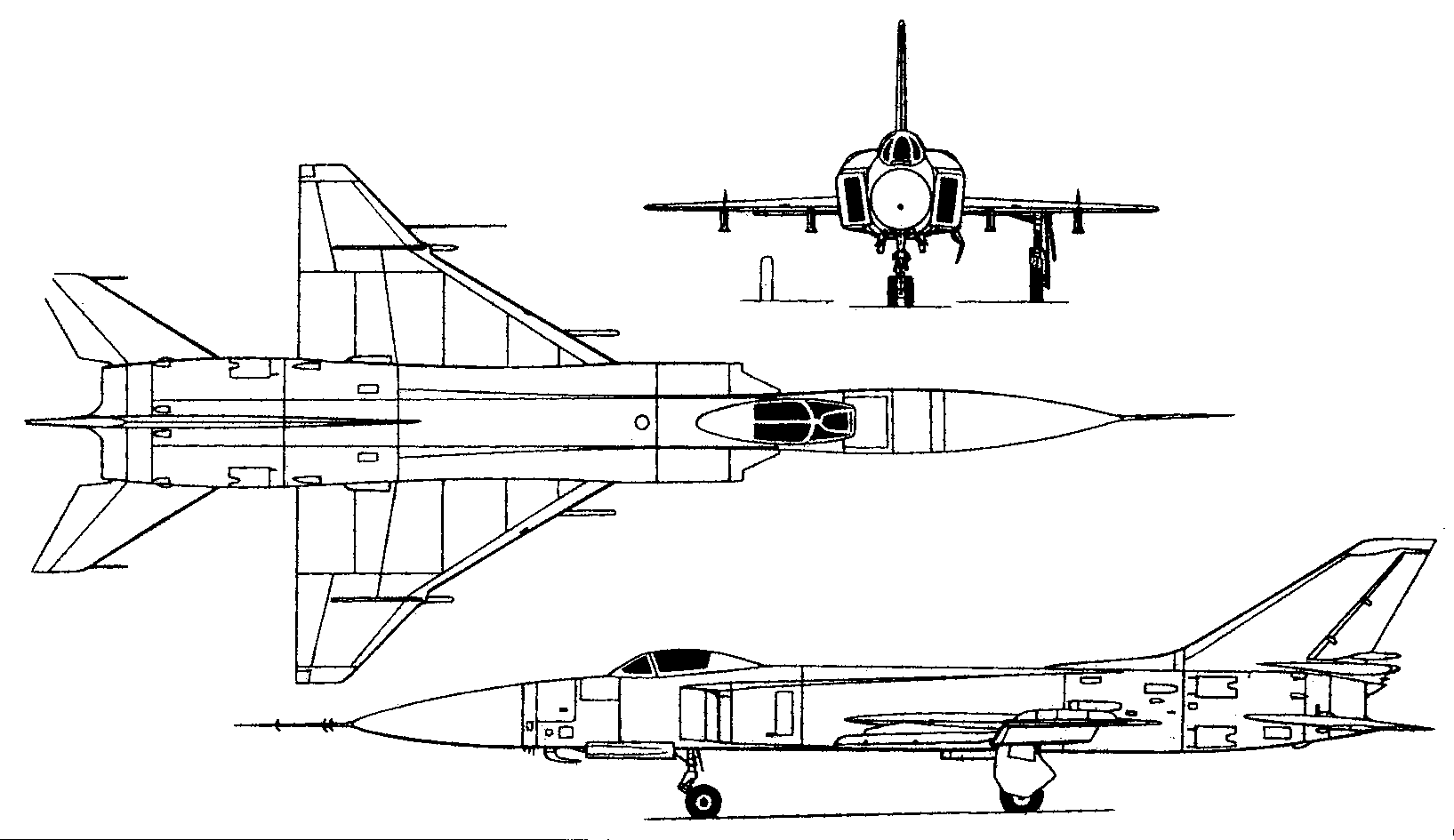
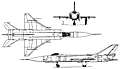 | A three-view drawing (1635 x 945) |
| Ry'aan, e-mail, 13.09.2016 01:20 The soviets must have definitely been proud to produce Such a beautiful aircraft. It gives me inspiration to build the twin seater version in 1 /72nd scale. reply | | Mike, e-mail, 18.02.2014 23:27 Yes this really is a classic, the Russians must have been very very satisfied with them, because to the best of my knowledge, they never exported any outside of the Soviet Union, not even to any of their Warsaw Pact Allies. reply | | Steven, 12.07.2011 05:39 One of the first signs of Sukhoi,s growing power reply | | paul scott, e-mail, 18.08.2009 18:14 A classic Russian design. As Leo says, became notorious because of its downing of the Japan Air airliner over Korea in 1983. reply | |
| | leo rudnicki, e-mail, 11.04.2009 07:35 The plane used to shoot down the Korean 747 over the sea of Japan. reply | | Amit Saxena, e-mail, 02.06.2007 12:33 This aircraft is really a beauty. It shows the desire of mankind to conquer the boundless sky, in which man has succeeded to a great extent. A masterpiece!!!! reply |
|
Do you have any comments?
|
| 
COMPANY
PROFILE
All the World's Rotorcraft
|