 |
Tupolev Tu-1101957 |  |
| JET AIRLINER | Virtual Aircraft Museum / USSR / Russia / Tupolev |
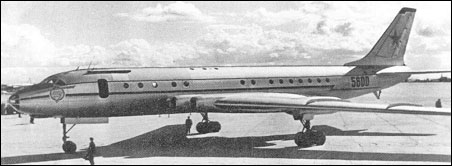 |
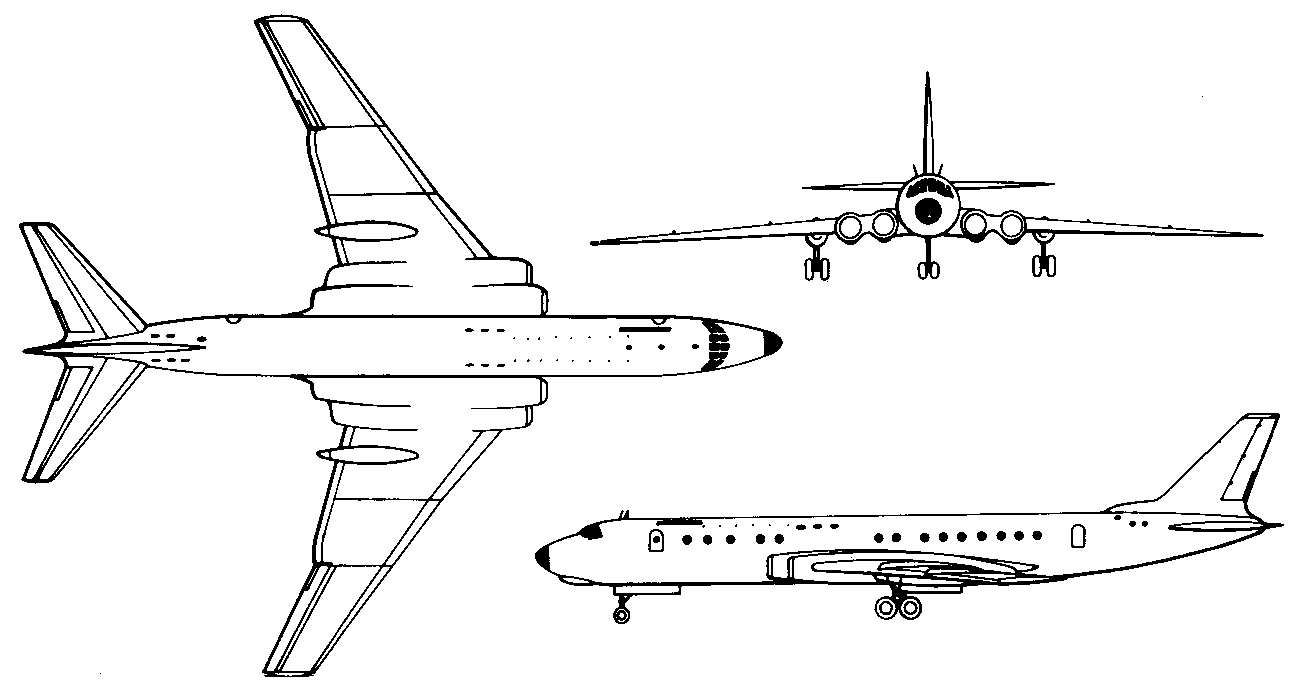
In order to meet Aeroflot's requirement for a 100-seat jetliner, Dmitri Markov installed four 5,000shp Lyulka AL-7P engines in place of the two larger AM-3s in a slightly stretched fuselage of a Tu-104 - the stretch, of 1.2m, gave the Tu-110, as the new version was numbered, a fuselage length of 40.06m. The span was also increased by 2.96m to give space for the extra two engines to be installed. The third change was to the interior, where the cabin was divided into two sections to provide for first and economy class passengers. Take-off weight of the four-engined aircraft, at 79,300kg, was 3,300kg higher than the original Tu-104. With a maximum speed of 1,000km/h, a ceiling of 12,000m, and a range of 3,300km, there was little difference in performance. One aircraft was built at factory N 156 from parts manufactured at factory N 22 in Kazan and brought to Moscow, and it made its first flight on 11 March 1957. Although it flew well, it offered little advance on the Tu-104, and no production orders followed, although two others were completed at Kazan. Instead, Aeroflot and Tupolev agreed that the slightly larger body should become standard on the Tu-104B, which began service in 1959.
|  COMPANY PROFILE | |||||||||||
|


|
The engine you're talking about is the Lyulka AL-7P.
reply