 |
Tupolev Tu-851951 |  |
| BOMBER | Virtual Aircraft Museum / USSR / Russia / Tupolev |
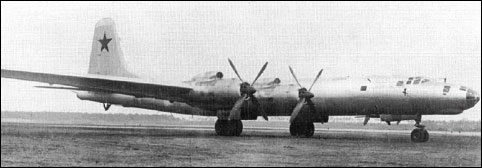 |
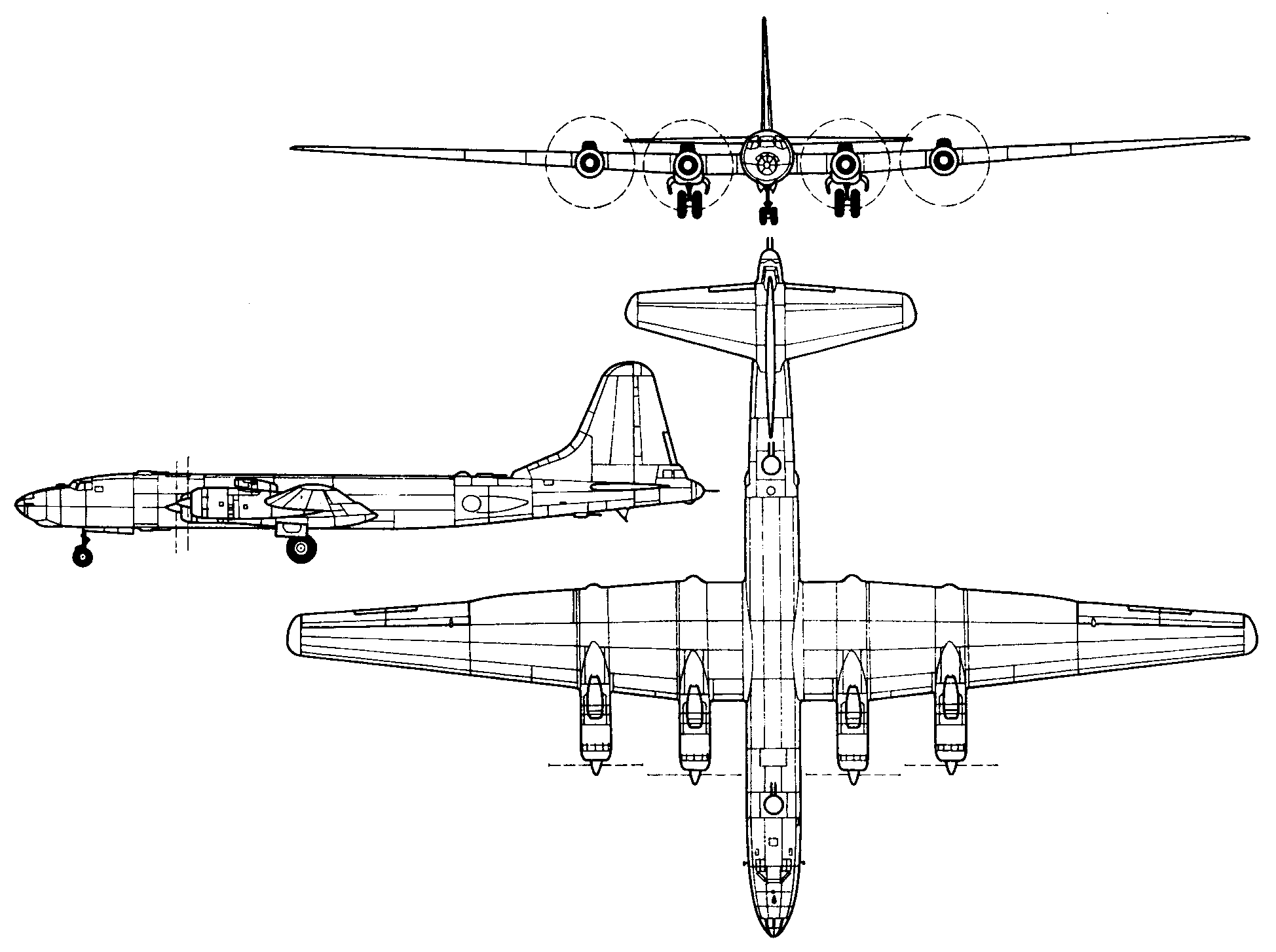
At the end of the 1940s, Vladimir Dobrynin's engine design bureau had developed a new air-cooled, twenty-four- cylinder in-line piston engine, the VD-4K, which offered a 4,300hp supercharged power output. Dmitri Markov set about designing a very long-range strategic bomber with these engines. Starting from the Tu-80 he began by designing a high-aspect wing with increased span - now it was 55.94m compared to the 43.83m of the Tu-75 and Tu-80, and wing area was 273.6m2, compared to 162.7m2. Wing aspect ratio was 11.4:1. This allowed the new aircraft to carry some forty-four tonnes of fuel which would give it a range of 12,000km. He streamlined the fuselage, and provided accommodation for a second crew which would be needed with the aircraft's twenty-six- hour endurance capability. Normal crew was eight so the Tu-85 carried sixteen in a pressurised cabin. The Tu-85 was fitted with large four-blade propellers, and it was armed with five turrets each fitted with a pair of NR-23 cannons which could be remotely controlled by a gunner, who had a screen to show the arc of fire from each position a development of the B-29/Tu-4 system. The Tu-85 was constructed at factory N 156 in 1949 and 1950. When completed, it was brought to Zhukovski aerodrome, reassembled and readied for flight. On 9 January 1951, Aleksei Pereliot was in command as it took off for the first time. In factory and state tests, it gave excellent results. Although its empty weight was 55.4 tonnes and its normal take-off weight seventy-five tonnes, it could take off at 107 tonnes when necessary, allowing it to carry the enormous fuel load needed to achieve its 12,300km range with a five-tonne payload, or to increase its normal five-tonne bomb load to twenty tonnes. Cruising speed for maximum range was established at 450km/h, but maximum speed was much higher. At low level, it was measured at 563km/h, and at a level of 10,000m it reached 665km/h. But by now, turbine engines were establishing themselves and offering higher speeds with lower fuel burns. The Tu-85 was the end of the line for Tupolev's piston-engined, and also for Soviet, aircraft. Although the United States would stay with pistons for another five years, for the Soviet Union, and for Europe, the time had come to move on. Only one Tu-85, the prototype was built. It was the last large Tupolev aircraft without swept wings.
|  COMPANY PROFILE | |||||||||||||||||||||||||||||||||||||||||||||||||||||||||
|


|