 |
Tupolev Tu-981956 |  |
| EXPERIMENTAL BOMBER | Virtual Aircraft Museum / USSR / Russia / Tupolev |
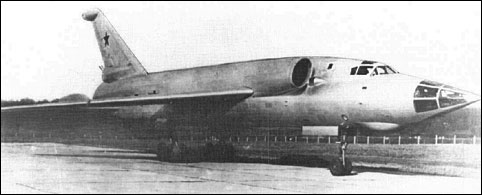 |
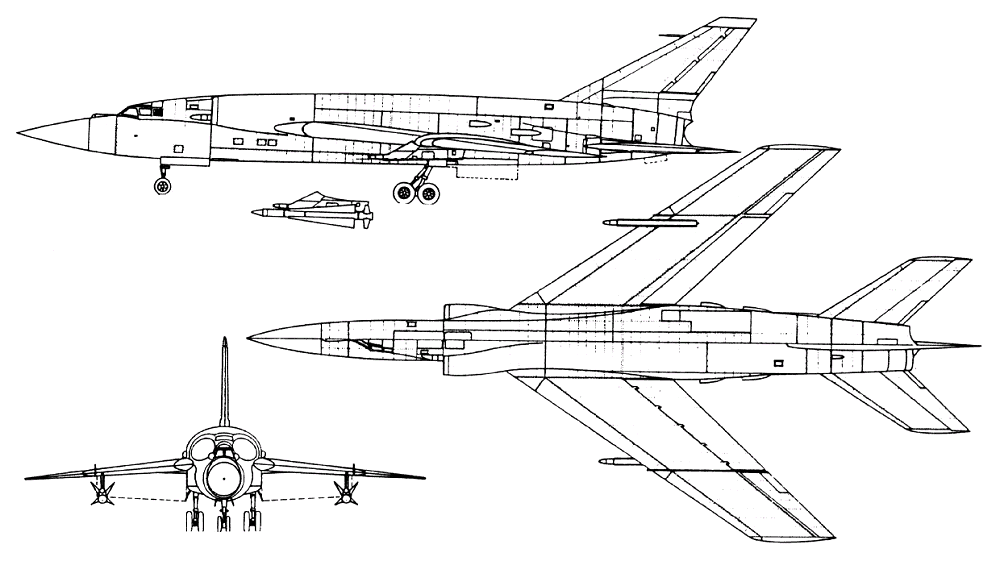
Tupolev's progress in the development of aircraft design rarely came about by huge technical leaps; rather it was a progressive, but time-consuming, step by step advancement. Thus when work began on the Tu-98 at the beginning of 1954, it was not intended for production; instead it was a bridge to evaluate the problems of supersonic flight, and a stepping stone to the Tu-105 and the Tu-128 programmes which would follow later. Chief designer on the project was Dmitri Markov; he based the wing design on that of the earlier Tu-16, but cleaned it up and moved the engines back into the fuselage, with two large air intakes located just behind and on either side of the cockpit. The engines selected were Lyulka's AL-7Fs, which developed 10,000kg static thrust, and were fitted with afterburners. With a maximum takeoff weight of 39,000kg, the Tu-98 was close in size to the Tu-16, but the extra power, and particularly the afterburners, gave it the extra energy to go through the sound barrier. The first aircraft was completed by early 1956, and, as usual, after road transfer, it was reassembled at Zhukovski and made ready for flight. Unfortunately details of its first flight are not available except that it was made in spring 1956. A second aircraft joined the first in the state trials. Performance was measured at a maximum speed of 1238km/h (with afterburners on) at 12,000m.
|  COMPANY PROFILE | |||||||||||||||||||||||||||||||||||||||||||||||||||
|


|