|
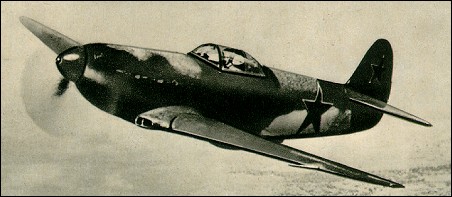
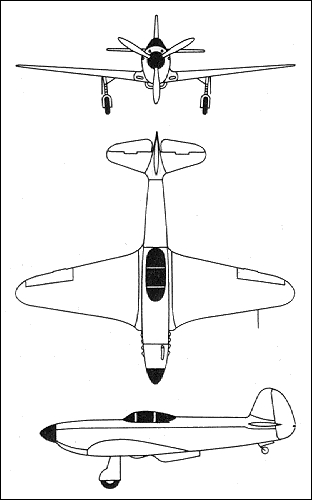
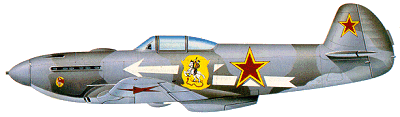
| Design began at the end of 1941 of a single-seat fighter using the new VK-107 engine, requiring the least-possible drag, smallest dimensions and weight consistent with a manoeuvrable and tough machine. Due to delays with the new engine and pressure to build the maximum number of aircraft already on the production lines, this new Yak-3 programme was shelved. A new small wing was developed and tested along with other changes on a Yak-1M in late 1942, and the first Yak-3 prototype was flown in late 1943. Although evaluation aircraft flew in combat, the first series Yak-3s did not enter operation with the 91st IAP until July 1944. The Yak-3 was found to be an exceptional dogfighter at altitudes up to 4000m. Its improved performance was remarkable, particularly as the initial non-availability of the VK-107 engine forced reliance to be placed on the VK-105PF-2 that had powered earlier Yaks. Built to a total of 4,848, the Yak-3 achieved fame and a very high score rate against German aircraft in 1944-45. The Yak-3 equipped the famous Free French 'Normandie-Niemen' unit, and achieved its peak of perfection when the VK-107A engine of 1268kW became available in limited numbers from August 1944, the type's maximum speed then improving to 720km/h at 6000m.
| CREW | 1 |
| ENGINE | 1 x VK-105PF, 870kW |
| WEIGHTS |
| Take-off weight | 2650 kg | 5842 lb |
| DIMENSIONS |
| Wingspan | 9.2 m | 30 ft 2 in |
| Length | 8.5 m | 28 ft 11 in |
| Height | 2.4 m | 8 ft 10 in |
| Wing area | 14.8 m2 | 159.31 sq ft |
| PERFORMANCE |
| Max. speed | 660 km/h | 410 mph |
| Cruise speed | 560 km/h | 348 mph |
| Ceiling | 10700 m | 35100 ft |
| Range | 900 km | 559 miles |
| ARMAMENT | 1 x 20mm machine-guns, 2 x 12.7mm machine-guns, bombs or missiles |
| Klaatu83, e-mail, 18.02.2017 22:56 Just as the Yak-9 was an improved version of the Yak-7, the Yak-3 was an improved version of the Yak-1. The Yak-3 was also one of the few successful "lightweight fighters" of WW-II. That concept had been tried in other countries, including the French (Caudron C7.14) and U.S. (Bell XP-77) without success. The Yak-3 worked because its' creators started out with a proven airframe and did not sacrifice horsepower or firepower in order to save weight. reply | | fardad izadi, e-mail, 07.12.2016 14:55 The pilots of the Yak-3 had the best forward view,because of the integrated wind shield of this fantastic fighter. reply | | Allan Ritchie, e-mail, 21.05.2016 08:56 its amazing that the russians can build such clevour weapons but that same clevourness isnt evident in anythingelse reply | | Fardad Izadi, e-mail, 05.03.2016 09:00 One of The best WWII Russian fighter from Yak-1b family ,but with the maximum pilot front visibility & now a day it is equipped with the Allison V-1710 for best performance during air shows. reply | |
| | Fardad Izadi, e-mail, 05.03.2016 08:59 One of The best WWII Russian fighter from Yak-1b family ,but with the maximum pilot front visibility & now a day it is equipped with the Allison V-1710 for best performance during air shows. reply | | Barry, 01.03.2016 17:56 Are Jason Andrews and the oddly named Victor Karkovsky some type of retards? reply | | Aaron, e-mail, 27.06.2011 18:38 VVS pilots respected the Fw-190 but did not fear it as much as the Me-109 overall. They considered the 190s weakest point to be its acceleration. They considered the 190 to be most dangerous from the frontal attach where its heavy armament was involved. The 109 was respected more because of its ability to fight well on the vertical plane. Even the P-39N /Q was more than a match for the Fw.190A-3-8 in the vertical plane. The VVS pilots believed their Yak-1,3& most of the Yak-9s, La-5FN, La-7 and P-39N /Qs were more dynamic in their performance than the 190A in the vertical and horizontal planes. The VVS was very impressed with the Fw-190D though. reply | | rick, e-mail, 28.12.2010 22:39 Iam looking for a good yak 3 for sale please email any info reply | | Ron, e-mail, 18.12.2010 06:38 I meant M-105PF not VK-105. But you knew that. reply | | Ron, e-mail, 18.12.2010 06:34 Jason,
Which model is your Yak-9? The -9U came after the Yak-3 but the others (Yak-9, -9D, -9DD, -9T, -9B ...etc) began before the -3.
The Yak-9U is all metal like western fighters. It could do a negative g dive unlike all the other Yaks (Yak-3 included) which had to roll into a dive like a Hurricane.
The reason is that new VK-107A engine. Because of delays, some of the first -9U fighters still had to use the previous VK-105.
Tell us which one you flew and how it handled.
How many degrees per second could it roll? and such. reply | | L Barr, 23.11.2010 00:44 Gentleman at Weslico, Texas is building Yak 3 with Allison
engines and has been for several years. reply | | Jason Andrews, 20.11.2010 07:18 I have to admit, the Russian KGB is full of LUNATICS! The Yak is a great aircraft, I personally own and fly a Yak 9, which came later in the war after the Yak 3. ANNA KREISLING does exist because I have a picture of us together in front of her DC-3 AT the RENO AIR RACES OF 1987! She is a great person, very gracious and friendly like most Germans! She once told me that it was both Hitler and Heinrich Himmler who wanted Hannah Reitch to be in the spotlight, but that her job for the Third Reich was to carry out the most secret of missions. She agreed, it is vital to stay hidden. reply | | KGB DIR. Victor Karkovsky, 05.11.2010 06:30 The YAK is a classic example of why we won World War II!! The T-34 TANK, THE 1940 SVT-40 TOKAREV RIFLE!!Plus we have the worlds bravest soldiers!! You stupid American Dogs are going to pay for insulting Vladimir Putin, OUR GREAT AND GLORIOUS LEADER!!ANNA CHAPMAN our MOST Beautiful spy was found drugged and working in a Donkey show in TiJUANA after she tried to kidnap ANNA KREISLING, THE WHITE WOLF OF THE LUFTWAFFE. YOU CIA and SS security people think its funny to capture our agents then let them go in Mexico!!! Don't you realize that Anna Kreisling is the one who flew Adolf Hitler out of Berlin! That she now commands more than 40,000 SS and Luftwaffe personel in Antarctica!! That over 42 NAZI SUBMARINES are based there!! We know of bases in Egypt, Norway, AREA 51, Tibet, Japan, Brazil and Argentina!!
Our scientists even say that your Nazi's have a base on the Moon!! AND THAT IS WHY NO ONE HAS RETURNED TO THE MOON! BECAUSE THE U.N. HAS CEDED IT TO Germany! reply | | Aaron, e-mail, 14.08.2010 20:57 The VK-107A powered Yak-3 did not enter service in WW2. Too many problems and the -3 airframe was not as suited for this enging as was the Yak-9U.
The Yak-3's roll rate equalled that of any Fw-190 and its turning circle was smaller than any contemporary fighter in the VVS.
The Yak-3P was the definitive production model of WW2. Its armament was three B-20s (lightweight and fast firing 20mm canons. The Yak-3 and the Yak-3P's performance was nearly identical. Both shared the same VK-105PF2 engine producing 1320hp at combat power. The following is typical performance of the Yak-3:
352mph /SL. 401mph /14,104ft. Climb: 4450fpm /SL and it could climb to 16,400ft in 4.5min. The PROTOTYPE could climb to 5K in 4.1min. and reach a top speed of 404mph /14,104ft. and had an initial climb of 5100fpm.
It must be noted that production problems from time to time did vary these figures, but most were as stated above.
The Yak-3P was utilized in 1945 and did not see action against Germany. Two squadrons became operational against Japan from August 8 on. And they performed excellently against such aircraft as the Ki.61 Tony and Ki.84 Frank. reply | |
| | Ron, e-mail, 29.08.2010 00:38 The weight of fire for the (3xB-20) Yak-3P was 3.25 kg per second.
A very few saw action by war's end but most of the 596 built were post-war.
One B-20 cannon was unsynchronized so you'd expect it to beat the made in Moscow La-7 with it's 3 synchronized B-20s. It put out 3.4 kg. Both were enough to be a welcome improvement. (Most La-7s had only 2 ShVAK 20-mm cannons like the La-5)
Maybe the difference was in the engine they had to synchronize with.
The Yak-9UT is the one with the twin B-20s and a hub NS-37 for a 6 kg weight of fire per second. It was only in time for the Berlin assault (many of the 282 built participated). Careful of that high velocity recoil! reply | | Bill Montague, e-mail, 04.02.2010 04:12 The new built Yak-3Ms with the Allison V-1710 engine makes for a great flying, very dependable little warbird.The airframe is built like a Mack truck (very strong) and contrary to what you may have heard, the airplane is easily managed by almost anyone, provided that anyone has some good quality tail dragger experience. I have a Yak-3M and love it. reply | | Ronald, e-mail, 24.08.2009 04:18 Terminal dive was said to be 578 mph. Red-line may be much less. reply | | Ronald, e-mail, 20.06.2009 09:26 This is the one the Luftwaffe was warned about! It evolved from the light Yak-1B so it was more vulnerable than other types but it added a 3rd gun vs 2 for most Yaks and Lavochkins.
It was the first hot Yak, more speed for the same power. It's wingspan was shortened giving it a better roll rate than an Fw 190A some say. This also made the landing hot (fast). It took over top cover duties from the La-5FN and was numerically the most important Soviet fighter for the last year of the war. The French unit mentioned above, could have chosen any Allied fighter but this was their pick to finish the war in. Sorry Spitfire, sorry Tempest and Mustang ...etc.
I believe the Yak-9U was the one powered by the VK-107A before the end of the war. The Yak-3 did also get this engine but it was effectively postwar. Thus, it suffered in negative-g initial dives like all VK-105 powered Yaks during the war. reply | | Ronald, e-mail, 02.09.2008 08:09 Weight of fire / sec. salvo = 2.72kg
Climb to 5km = 4.1 min.
360 turn = under 19 sec. reply |
|
Do you have any comments?
|
| 
COMPANY
PROFILE
All the World's Rotorcraft
|