|
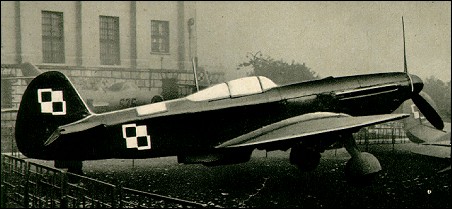
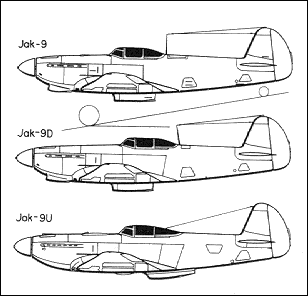
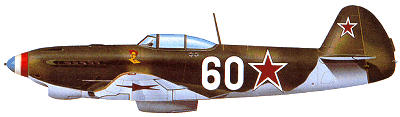
| A development of the experimental Yak-7DI fighter, the original Yakovlev Yak-9 differed in having a revised rudder and wooden wings incorporating metal spars; the series version, which entered production in the summer of 1942, also introduced a retractable tail-wheel. Deliveries to V-VS lAPs (fighter regiments) began in October 1942 and the type was soon engaged in the Battle of Stalingrad. By February 1943 production aircraft were being built with reduced-span wings that incorporated duralumin ribs and with the initial powerplant (an M105PF or M-105PF-1) being replaced by the 925kW M-105PF-3 . The Yak- 9 operated with a wide variety of armament, including all types of aircraft cannon then in production in the Soviet Union, and during 1943 there appeared variants which developed the full potential of the Yak-9 for use in anti-tank, light bomber and long-range escort roles.
The second generation of Yak-9s began with the Yak-911 prototype of late 1943, which introduced a redesigned airframe , a new wing of increased span and area, and the more powerful VK-107 engine; to overcome resulting centre of gravity problems the wing was moved slightly forward . Production of the Yak-9 ended in 1946 after a record 16,769 aircraft had been delivered. Main post-war operators, apart from the Soviet Union, were Bulgaria, Poland and Yugoslavia.
| CREW | 1 |
| ENGINE | 1 x M-105PF, 870kW |
| WEIGHTS |
| Take-off weight | 2873-3060 kg | 6334 - 6746 lb |
| DIMENSIONS |
| Wingspan | 10.0 m | 33 ft 10 in |
| Length | 8.5 m | 28 ft 11 in |
| Wing area | 17.1 m2 | 184.06 sq ft |
| PERFORMANCE |
| Max. speed | 595 km/h | 370 mph |
| Ceiling | 11000 m | 36100 ft |
| Range w/max.fuel | 1000 km | 621 miles |
| Range w/max payload | 850 km | 528 miles |
| ARMAMENT | 1 x 20mm machine-guns, 1 x 12.7mm machine-guns |
| Ron, e-mail, 30.01.2013 05:45 If the heavier nose gun made the elevator heavy, care would be needed in aerobatics. Still, this fighter had late-war firepower early. Compared to the P-39 sans wing guns, it could turn, climb and run at least as well as the P-39Q-10 and still out-shoot it with fewer guns (2 vs 3)!! The Yak-9T ballistics were better harmonized and all high velocity. Its projectiles were heavier and twice as fast in rate per second fired too. Granted, the ammo would run out sooner.
It only lacked high altitude performance, but so did the P-39.
Production efficiency of the Yak was better than most anything flying if it took 3 times more man-hours to make a Bf 109G! Who else could do that? reply | | Mark, e-mail, 20.09.2012 17:38 Yakovlev Yak-9
Μονοκινητήριο μαχητικό της Σοβιετικής Ένωσης, το μεγαλύτερο σε παραγωγή κατά τον 2ο Παγκόσμιο Πόλεμο με περίπου 17.000 αεροπλάνα και 15 διαφορετικές εκδόσεις σε ρόλους μαχητικού, ελαφρύ βομβαρδιστικού(Yak-9B) και συνοδευτικού. Τα χαρακτηριστικά του ήταν μήκος 8.55 μέτρα, άνοιγμα πτερυγίων 9.74 μέτρα, βάρος 2.250 κιλών, μέγιστη ταχύτητα 600χλμ /ώρα και ακτίνα δράσης 1.360χλμ (Yak-9D). Με καλύτερες επιδόσεις σε χαμηλό υψόμετρο, ήταν γρηγορότερο και πιο ευέλικτο από το Bf 109, αλλά υστερούσε σε οπλισμό, κυρίως στις πρώτες εκδόσεις του. Η έκδοση Yak-9U, με μέγιστη ταχύτητα 700χλμ /ώρα του έδωσε τον τίτλο του ταχύτερου αεροπλάνου έως τότε. Το πρώτο Yak-9 χρησιμοποιήθηκε το 1942 στη Μάχη του Στάλινγκραντ και ο πιο αποτελεσματικός πιλότος του ήταν ο Σοβιετικός A.I. Vybornov με νίκη σε 19 αερομαχίες, ο οποίος τιμήθηκε με το μετάλλιο Χρυσού Άστρου του Ήρωα της Σοβιετικής Ένωσης
Μετά τον πόλεμο, η Σοβιετική Ένωση παρείχε αρκετά μαχητικά Yak-9P σε μερικές χώρες του Σοβιετικού μπλοκ, βοηθώντας τες να ξαναχτίσουν τις αεροπορικές τους δυνάμεις reply | | Aaron, e-mail, 28.06.2011 18:33 m.,
I'd like to see the P-63C take a crack at a Fw-190D also. Up to 25,000ft speeds and climb would be close. I haven't read anything on the turning ability of the P-63 other than it was better handling and more maneuverable than the P-39 at medium and high speeds. I do know that it would outroll the 190 at speeds over 326mph and easily outrolled the P-39 at any speeds over 150mph. This is considering the P-63C is decked out in U.S. equipment. Strip the wing guns and verious other VVS non-essetial equipment and WOW! You now have a low and medium height air superiority fighter / interceptor elite. reply | | Aaron, e-mail, 28.06.2011 18:02 VVS pilots respected the Fw-190A but did not fear it as much as the Me-109F or G overall. They considered the 190s weakest point to be its acceleration. They considered the 190 to be most dangerous from the frontal attack where its heavy armament was involved. the 109 was repected more overall because of its ability to fight well on the vertical plane. Even the P-39N /Q models were more than a match for the Fw-190A3-8 in the vertical plane. The VVS pilots believed their Yak-1&3, most models of the Yak-9, La-5FN, La-7 and P-39N /Qs were more dynamic in their performance than the 190A in the vertical and horizontal planes. The VVS was very impressed with the FW-190D though. reply | |
| | Ron, e-mail, 20.02.2011 06:46 m.,
Which Yak-9 is no match for the Fw 190 and which 190?
The Yak-9U and the Fw 190D /Ta 152 would be interesting contenders. For the Fw 190A-8 /Ta 152C the Yak-3 /La-7 would be a better match. Even the Yak-9T-37 /45 would measure up, maybe even the La-5FN too. Heck, I'd like to see the P-63 take a turn!
Of course back in the time of the Fw 190A-4 when it first got boost in some of the production models, it was indeed second to none. Still light on it's feet and with gobs of power, guns, and armor. It pantsed everything else back then I have to agree. The legend was born.
But this is the Yak-9 so we're not in 1941 /2 anymore. reply | | m., 06.02.2011 02:14 It is no match to FW-190 reply | | Aaron, e-mail, 14.08.2010 06:33 The aircraft pictured here appears to be a Yak-9U. In October 1944 when it was introduced it had engine problems and could not perform up to its full standards. By the end of that year most of the production difficulties had been worked out producing the following:
Yak-9U /1945 : VK-107A 1650hp. 357-364mph /SL. 418-425mph
/16,400ft. 4200fpm /SL 16,400ft /4.1 min. 36,490ft service ceiling. all at 7,056 lbs. reply | | Aaron, e-mail, 14.08.2010 06:19 The original Yak-9 was perhaps the best performing and handling of the M-105PF 1260hp variants. At 6320 lbs. it could attain 323mph /SL 373mph /13,760ft. and climb initially at 3615mph. and reaching 16,400ft /5.1min. Service ceiling was listed at 36,500ft. All this in December of 1942 when it was needed most. It could outmaneuver the Bf.109G below 16,400ft and its improved rate of roll (over other Russian fighters) proved critical against the Fw-190, allowing the Yak to make use of its superior turning circle and vertical abilities to full effect. reply | | Aaron, e-mail, 14.08.2010 06:37 Ron,
The figures you have quoted, 434mph and 39,040ft were achieved by the prototype, not a combat ready production machine. reply | | Chuck, e-mail, 16.08.2010 14:43 Probably the best looking prop driven fighter of the WW2 Russian fleet. It was even turned into a profile model made by Sterling models in the USA for Gas powered Control-line flying. Both Elevator and Flap control with the two control wires made the model an excellent stunt and combat champion. I had one powered with a Fox 35 engine, and won many trophies in the early 50's with it. Would love to have flown in the Real Aircraft. Chuck. Waterbury Ct., USA reply | | Ron, e-mail, 12.02.2010 06:37 When the Yak-9D was tested against the Gustav-2, the Anton-4 and it's stablemate La-5FN in mock combat, it turned 360 in around 16.5 seconds average, but otherwise it's handling suffered from the extra internal fuel load (of the D model). The La-5FN averaged 18.5; next the 109G-2 did 20.8; and lastly the 190A-4 did around 22.5 seconds (roughly 2 seconds between each one, in a spread of 6 seconds total difference). Granted, results may have been different at higher altitudes favorable to the Bf and Fw but typical combat favored the Russians at lower levels. Why it posted such a superior time I can only speculate. That's in Yak-1M territory! Both of these 2 Yaks had only 2 nose guns (as well as the La-5 but both were cannon) while the 2 German fighters had 3 or 4 guns, making the obvious trade-off for adequate firepower. Since it's in mock dogfight tests and the time is an average for different pilots taking turns, maybe it was more competitive than the typical performance test flight with one plane and pilot. How's that sound?
The La-5 and the G-2 had similar firepower but the La-5FN could sustain more damage and yet it still handled and turned better than both Luftwaffe fighters. What's more, the twin cannons were sometimes Vya-23s instead of ShVAK 20s! Slower and less reliable perhaps, but twice as effective even at long range! No airborne armor could withstand it. reply | | Ronald, e-mail, 11.10.2008 02:31 The Yak-9 by mid-1944, outnumbered all other Soviet fighters combined. The 7,222 lb Yak-9DD doubled the internal fuel for a maximum extra long range of 1,367 miles vs 870 for the -9D 'long range' mainstay.
The Yak-9T had the cockpit moved back 40cm for the breech of the NS-37 heavy cannon. This improved aerobatics as a side-effect. When the 37mm wasn't available in production the Vya-23 cannon was installed. Since it entered service in early 1943 it accounted for about half the air-to-air victories for all Soviet fighter types in action though it was intended for close ground support and anti-shipping. The Yak-9U was the ultimate Allied interceptor of WW 2 with the Spitfire. No other Russian fighter had the altitude (39,040'), the speed (434 mph), or the initial climb (4920 fpm) of the -9U. It restored the 3 gun compliment of the -7 vs 2 for other -9s. It was modernized to world construction standards with an all-metal redesign. Good for postwar longevity. It's new M-107A 1,650 hp powerplant was late for early production batches so they had a more pedestrian performance (420 mph). 16,769 Yak-9s were produced. reply | | Ronald, e-mail, 02.09.2008 08:19 Yak-9D (T)[U] weight of fire /sec. salvo = 2kg(4.75kg)[2.72kg].
Climb to 5km = 6.1(5.5)[5.0] min.
360 turn = under 20 (under 19)[20] sec. reply |
|
Do you have any comments?
|
| 
COMPANY
PROFILE
All the World's Rotorcraft
|