|
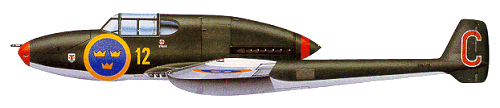
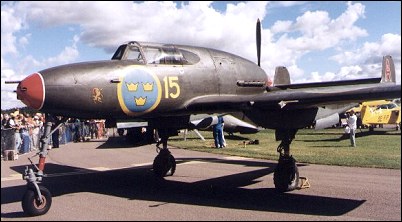
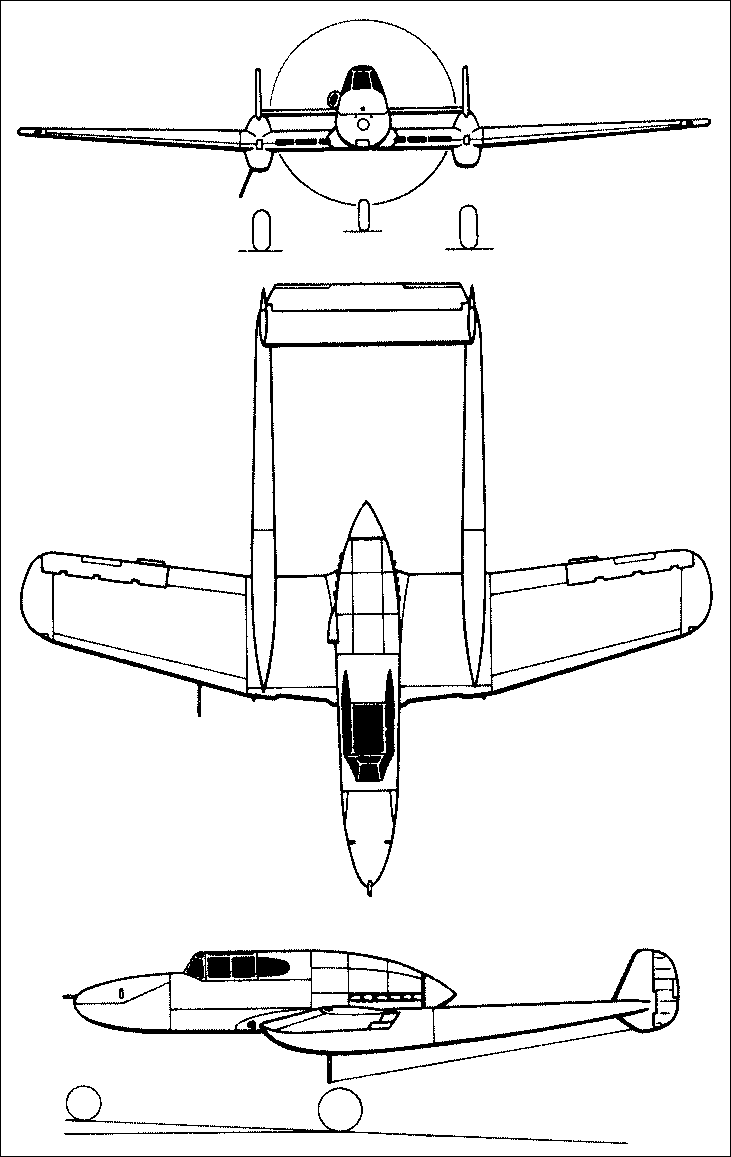
| In 1941, when the Flygvapen was equipped with a mixture of fighter aircraft of Italian and US origin, it was decided to initiate design and development of an indigenous aircraft in this category that would be suitable for use also in an attack role. The resulting design was of unusual configuration, being a cantilever low-wing monoplane having moderate wing sweep, with central fuselage nacelle to accommodate the pilot on an ejection seat and a rear-mounted powerplant in pusher configuration, twin booms extending aft from the wings with twin fins and rudders united by the tailplane with elevator, and retractable tricycle landing gear. The first of three Saab-21A prototypes was flown on 30 July 1943 and these, like a few early production aircraft, were powered by the imported Daimler-Benz DB 605; all subsequent production had a Swedish licence-built version of this engine.
When introduced into service in late 1945 as the J21A-1 the new type was the only pusher-engined fighter to become operational during World War II, being followed by the generally similar J21A-2 and, finally, by the A21A attack aircraft, these three versions being built to a total of 299 before production ended in 1948.
The A21A had the same armament as the J21A fighter, was equipped to carry rockets or light bombs on under-wing racks, and had provision for the installation of a ventral gun pack housing eight 13.2mm machine-guns.
| MODEL | J-21 |
| CREW | 1 |
| ENGINE | 1 x Deimler-Benz DB 605B, 1100kW |
| WEIGHTS |
| Take-off weight | 4150 kg | 9149 lb |
| Empty weight | 3250 kg | 7165 lb |
| DIMENSIONS |
| Wingspan | 11.6 m | 38 ft 1 in |
| Length | 10.45 m | 34 ft 3 in |
| Height | 3.96 m | 13 ft 0 in |
| Wing area | 22.2 m2 | 238.96 sq ft |
| PERFORMANCE |
| Max. speed | 640 km/h | 398 mph |
| Ceiling | 11000 m | 36100 ft |
| ARMAMENT | 1 x 20mm cannon, 4 x 13.2mm machine-guns |
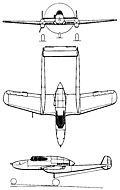 | A three-view drawing (731 x 1157) |
| lxbfYeaa, e-mail, 07.11.2025 02:39 20 reply |
| Kim elDiin Wedefelt, e-mail, 19.01.2018 19:23 J21R , had de Havilland Goblin engines reply |
| Pierre Deveaux, e-mail, 27.01.2013 02:09 From other sources, it seems the belly gun pack housed 7.9mm guns rather than 13.2mm ones. Haven't been to Sweden to check ! A generally missing data is the amount of rounds associated with each guns (13.2mm and 20mm in the nose, 13.2mm in the wings and for each gun in the gunpack) Anyone having knowledge about it ? Reference ? Cheers to all - pierre.deveaux@laposte.net reply | | John, e-mail, 11.02.2012 22:45 I just built a modle of a Fokker XX III and this is a
similar configuration reply | |
| | Barry, 22.12.2010 16:14 The aircraft was designed from an original sketch by Frid Wanstrom in response to a request by the Royal Swedish Air Board. Yes it was developed into the jet powered J21R,powered originally the D.H.Ghost 2,subsequently by a license built Ghost 3, dedtails of which can be found elsewhere on this site. reply |
| Rune, e-mail, 29.03.2010 19:05 Think it was also one of the very first (if not the first) with ejector seat, due to the prop being located behind the pilot. reply |
| Tom, 23.03.2010 19:26 this plane ws an example of a plane that was configured with a piston engine and then re fitted with a jet engine, i think it was a goblin(model) jet engine reply | | Thomas P. Turner, e-mail, 08.01.2010 19:45 I believe the design was modified in the late 1940s with a first-generation turbojet, probably a British design, in place of the piston powerplant. reply |
|
Do you have any comments?
|
| 
COMPANY
PROFILE
All the World's Rotorcraft
|

 Kim elDiin Wedefelt

e
reply