|
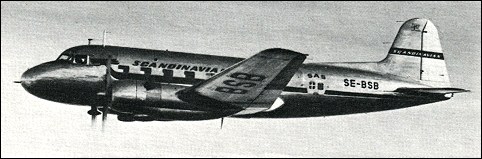
| An apparently unusual category of aircraft to be designed and built by Svenska Aeroplan, which has concentrated primarily on military aircraft, the Saab-90 Scandia represented the company's attempt to join the post-World War II hunt for the legendary 'pot of gold' that would be the reward for the creator of a Douglas DC-3 replacement. Saab was even less successful than some others, producing a total of only 18 Saab-90 aircraft, including the prototype, between 1948 and 1954. A cantilever low-wing monoplane of all-metal construction, with retractable tricycle landing gear and powered by two wing-mounted 1081kW Pratt & Whitney Twin Wasp radial engines, the prototype was flown for the first time on 16 November 1946. Accommodation was provided for a flight crew of four or five and 24 to 36 passengers, according to cabin layout. However, only a single order was received for the Saab-90A production version, from the Swedish airline AB Aerotransport, but when this was absorbed into SAS (Scandinavian Airlines System) the order was reduced to six. The remaining four aircraft were then sold to Aerovias Brasil (later VASP). Both airlines found them efficient aircraft to operate, resulting in production of two more for SAS and five for VASP,
but that was all. A Saab-90B with a pressurised cabin was planned, but with no demand for the type it was not built.
FACTS AND FIGURES © Pilots considered the cockpit
glazing to be inadequate, with
most panels too small and the sills
too high. Looking across the
cockpit, the pilot on the opposite
side could see very little. © Two versions were proposed, one with
24 seats in one double row and one
single row, and a 32-seat model with
two double rows. The pressurized Saab
90B version was never built. © The 14-cylinder R-2180 radial
drove a four-bladed variable-pitch
propeller. The Scandia was the
only civil use for the R-2180 (also
known as the Twin Wasp E1)
engine, although a military
version was used in rhe prototype
Piasecki H-16 helicopter. © The elevators and ailerons were
fabric-covered and interchangeable
port and starboard. © After landing a support strut
could be deployed from the
cockpit to keep the aircraft from
tipping backwards during
passenger and baggage loading
and unloading.
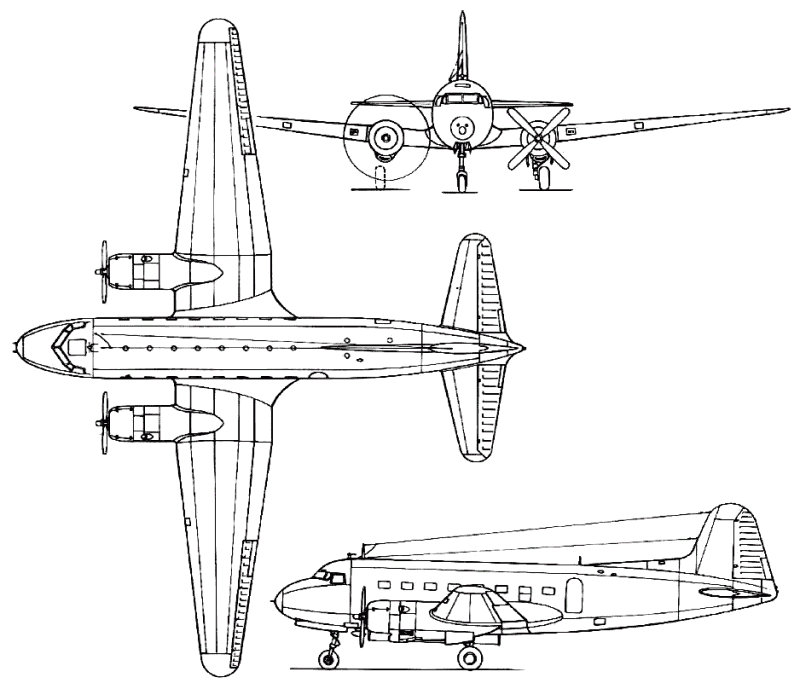
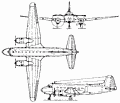 | A three-view drawing (800 x 689) |
| MODEL | Saab 90A Scandia |
| ENGINE | 2 x Pratt & Whitney R-2180-E1 radial piston engines, 1342kW |
| WEIGHTS |
| Take-off weight | 16000 kg | 35274 lb |
| Empty weight | 9960 kg | 21958 lb |
| DIMENSIONS |
| Wingspan | 28 m | 92 ft 10 in |
| Length | 21.3 m | 70 ft 11 in |
| Height | 7.1 m | 23 ft 4 in |
| Wing area | 85.65 m2 | 921.93 sq ft |
| PERFORMANCE |
| Cruise speed | 390 km/h | 242 mph |
| Ceiling | 7500 m | 24600 ft |
| Range | 1480 km | 920 miles |
| Agildo, e-mail, 17.05.2021 17:10 Por gentileza, poderia me informar os e-mails dos Departamentos de Compras /Suprimentos e Marketing?
Trabalho na área gráfica e gostaria de enviar apresentação dos nossos serviços e produtos de impressão e mÃdias sociais.
Obrigado. reply | | Agildo, e-mail, 13.05.2021 16:15 Por gentileza, poderia me informar os e-mails dos Departamentos de Compras /Suprimentos e Marketing?
Trabalho na área gráfica e gostaria de enviar apresentação dos nossos serviços e produtos de impressão e mÃdias sociais.
Obrigado. reply | | Agildo, e-mail, 05.05.2021 21:55 Por gentileza, poderia me informar os e-mails dos Departamentos de Compras /Suprimentos e Marketing?
Trabalho na área gráfica e gostaria de enviar apresentação dos nossos serviços e produtos de impressão e mÃdias sociais.
Obrigado. reply |
| Agildo, e-mail, 30.04.2021 23:21 Por gentileza, poderia me informar os e-mails dos Departamentos de Compras /Suprimentos e Marketing?
Trabalho na área gráfica e gostaria de enviar apresentação dos nossos serviços e produtos de impressão e mÃdias sociais.
Obrigado. reply | |
| | Zanetti Gráfica, e-mail, 12.07.2020 01:54 Olá, tudo bem?
Queremos ajudar a sua empresa e /ou o seu negócio a obter melhores resultados com impressos de qualidade e baixo custo.
Estamos com promoção para todos os Ãtens de nossa linha de produção de materiais gráficos (papel timbrado, blocos, flyers, folhetos, pastas, banners, adesivos, catálogos, cartões de visita e mais de 100 Ãtens além dos serviços personalizados para cada cliente) e para os Ãtens de brindes (canecas, canetas, chaveiros e camisetas entre outros...)
Venda mais através das redes sociais com nossos anúncios para sua divulgação no Facebook, Instagram e Whatsapp.
Entre em contato conosco e visite nosso site:
Site: www.zanettigrafica.com.br
E-mail: vendas@zanettigrafica.com.br
WhatsApp: (11) 3983-9974
Pensando no sucesso do seu negócio, queremos saber: - Como a Zanetti Gráfica pode lhe ajudar? reply | | jorge meloni filho, e-mail, 26.10.2013 17:19 EXTERMÍNIO DE AVIÕES NO BRASIL ! youtube the last exemplar of a saab scandia in the world in bebedouro estado de são paulo brazil reply |
| FAUSTO DE SOUZA NASCIMENTO, e-mail, 03.12.2011 22:39 O Scandia foi uma grande aeronave,que iniciou nas cores da saudosa e maravilhosa VASP,a formidável Ponte aérea,ligando SP ao RJ.Eu voei muito com o Scandia,com a minha tia que não trocava os Scandias pelos Convairs.Eu tive a oportunidade de voar com o Comdte Jaks Torres,de SP para o RJ,e com 7 anos de idade,fui convidado pelas mãos dele a ir na cabine de comando,fiquei bem impressionado com a qtdade de relógios,luzes,interruptores,na realidade era uma quantidade enorme de instrumentos,cheguei a ficar quase 20 minutos de voo na cabine de instrumentos.Aliás,falando no Comdte Jaks Torres,a sua mãe era a Dna Glorinha,que morou na casa da minha saudosa mãe,infelizmente o Comdte Jaks faleceu em um pavoroso acidente aéreo qdo sobrevoaava a região de Paraibuna,junto com tb Comdte Pinto Waltheimer,com 32 pessoas a bordo onde o Scandia foi atingido na velocidade de cruzeiro por um avião bimotor Cessna 310,onde todos vieram a falecer e deixou o Brasil de luto.Qdo aconteceu o fatídico acidente,a Dna.Glorinha não morava mais na casa dos meus pais e segundo a minha mãe,ela de uma hora para outra,teve os cabelos embranquecidos.O Comdte Jaks Torres,era filho único e eu me lembro muito bem que em relação aos filhos únicos,havia a necessidade de uma carta registrada em Cartório,firmada por duas testemunhas,onde se declarava que o interessado ao cargo de piloto,não era arrimo de família.Muitas saudades daquela época,que não volta mais,onde a Aviação,era uma grande e maravilhosa aventura,dia a dia.Obrigado por postarem o Scandia,grande e fabulosa aeronave que deixou a sua história na Aviação brasileira.Obrigado reply | | Anders Annerfalk, e-mail, 23.02.2010 01:01 Wim, you are absolutely right - when Saab was told by the Swedish Air Force to focus on Saab 29 "Tunnan" deliveries, Scandia production was transferred to Fokker, who in turn used Aviolanda and de Schelde to finish the aircraft. reply | | Claudio, e-mail, 30.05.2009 20:50 The last Saab 90 Scandia(the last of Mohicans),is preserved in a Brazilian museum in Bebedouro city(São Paulo).The museum name is "Museu Eduardo André Matarazzo". reply | | Wim Kruining B.A . Art History, e-mail, 12.04.2009 16:54 Was the Scaab Scandia also not built by the Schelde in Dordrecht Holland where I worked as a draftsman around 1950 ? reply |
|
Do you have any comments?
|
| 
COMPANY
PROFILE
All the World's Rotorcraft
|


 jorge meloni filho

20
reply